Change in life, travel and work are always inspiring to me. With this excavation season, there were several developments in the programme which have already opened many doors. Pushing ourselves towards new skills and challenges, the team that came back together this year is working harder than ever to support the students and in our research. The 2018 dig season at Passo di Mirabella kicked off several weeks ago and for returning students and staff, and after an intense first year in my PhD, it was a pretty great feeling to get back to the site. With a few of us in different positions this year and including a new field project manager (Allison Kidd), and myself moving into project managing off-site alongside the Public Archaeology coordinating. The organizational flow appears to be working well already! The ethos of this excavation is generally oriented away from hierarchies but having people in place to provide additional support in a few key areas has made a big difference!
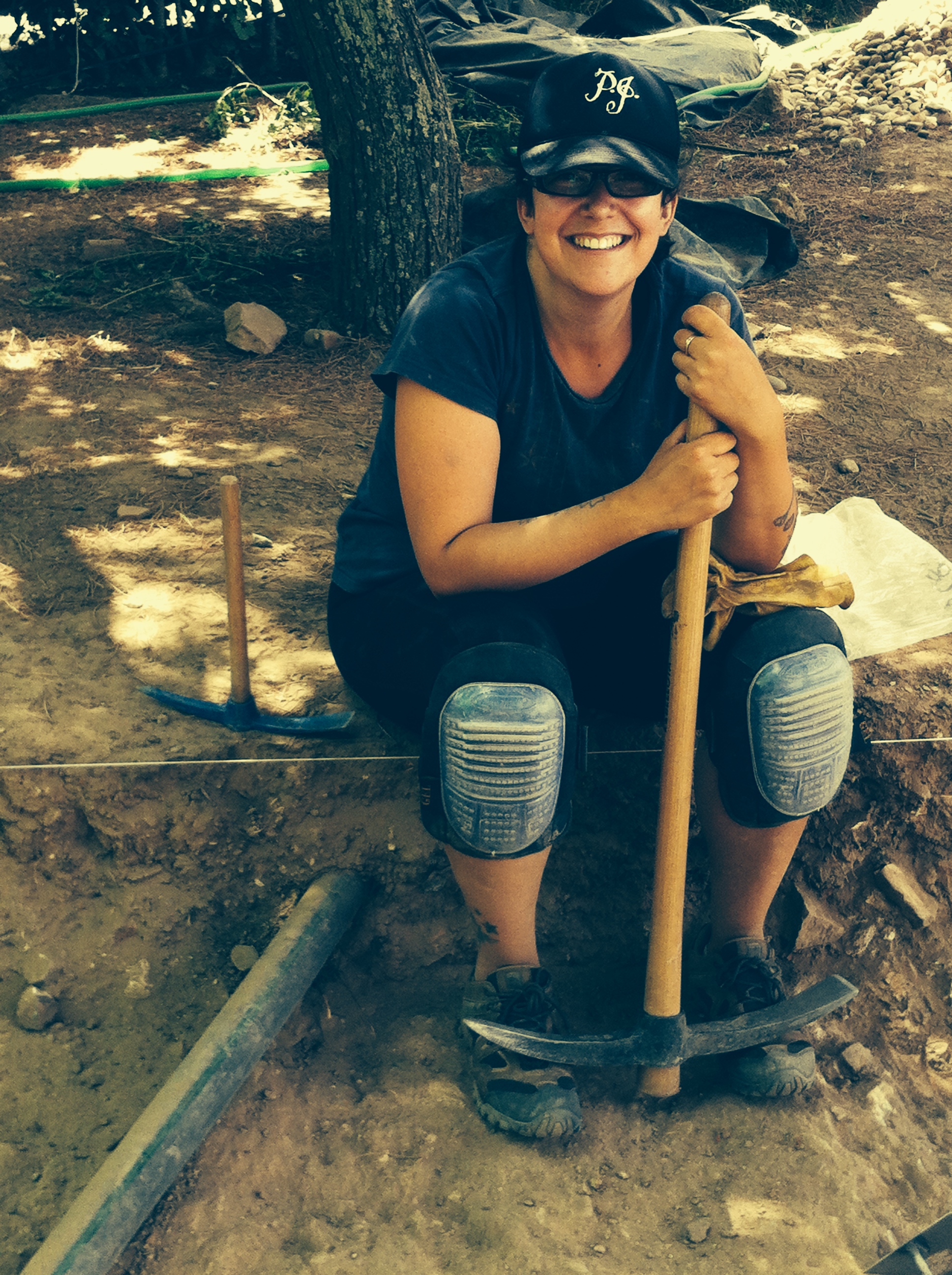
These wonderful rogues, Luke and Rory, working hard in Block one removing topsoil.
Getting back to work
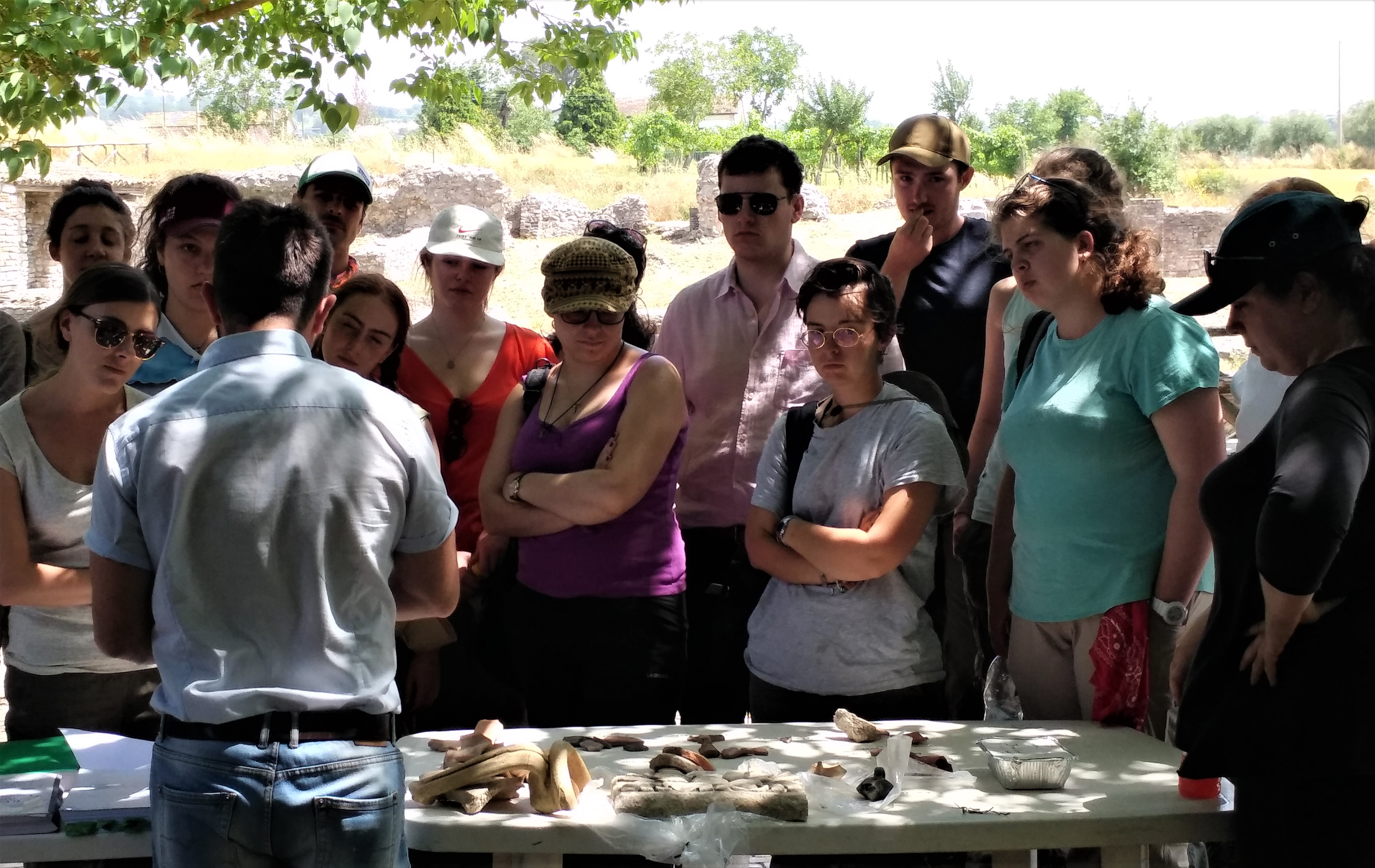
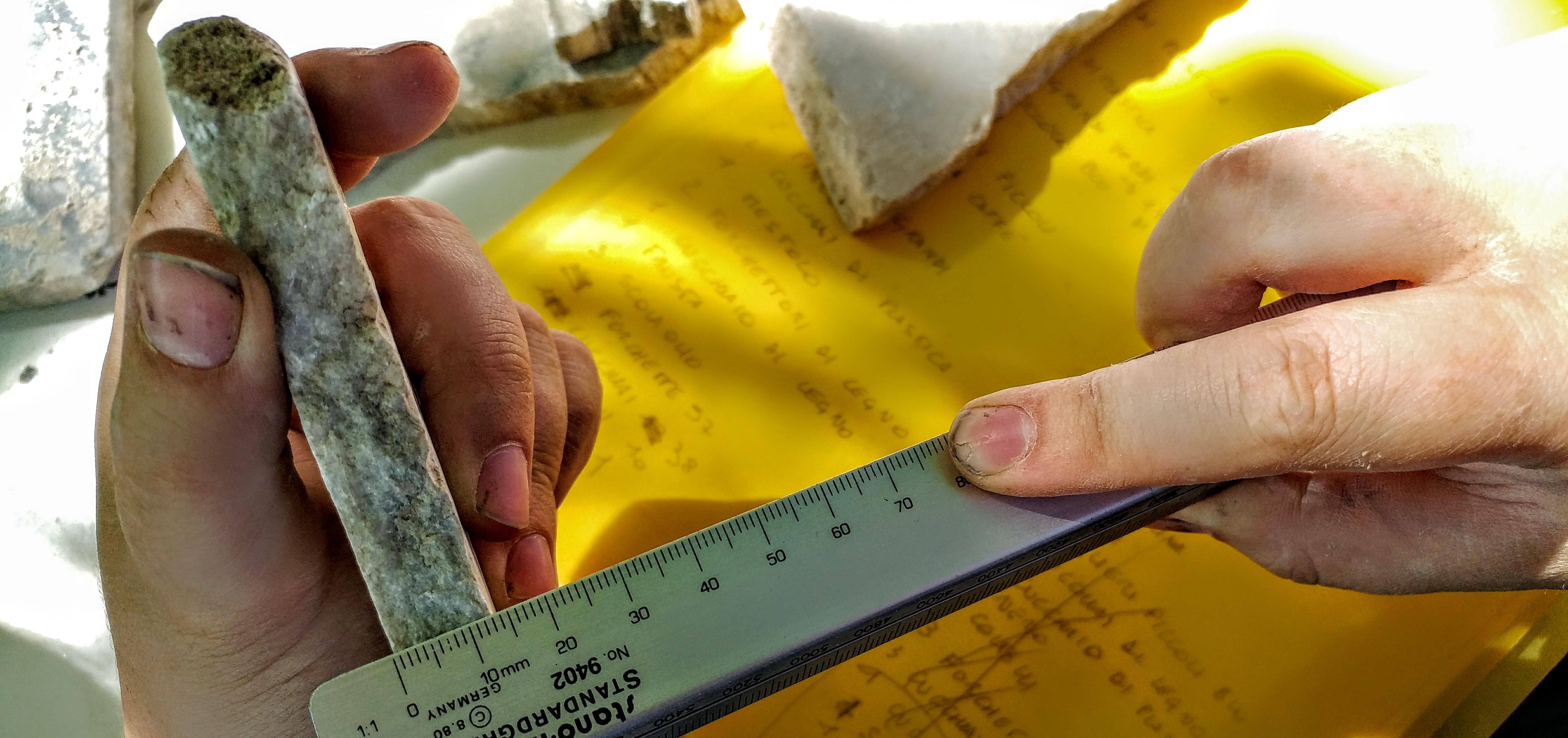
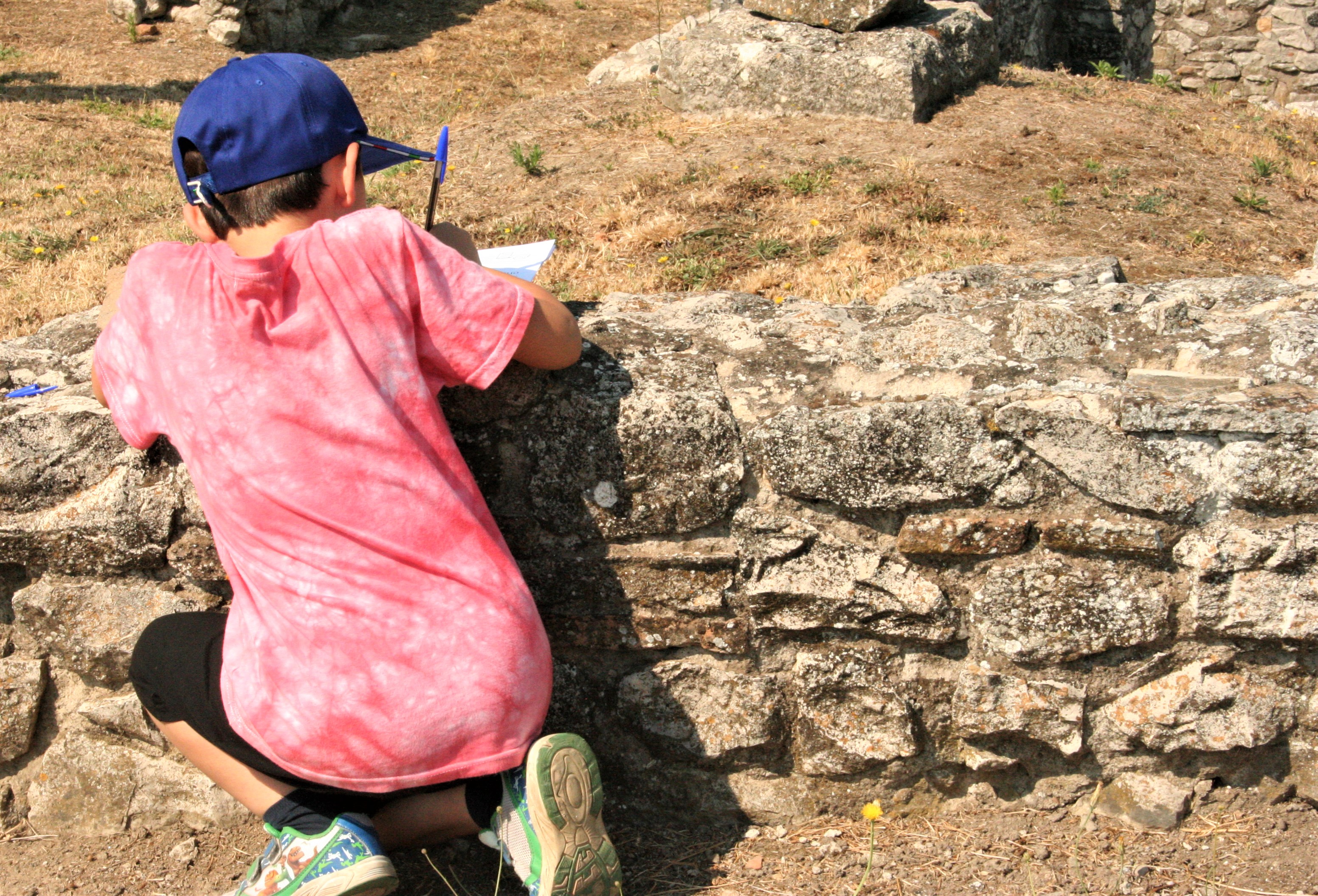
The expansion of the programme offers a broad array of activities, and this year we have even more students coming for specialist training in pottery, osteology, epigraphy and, of course, longer-term excavation training. Public Archaeology appears to still be a bit of a mystery to students, but maybe one day I’ll have my own little troop to work with, but until then, I am always grateful for the occasional drop-in helping with drawing, activity planning and brainstorming. My youngest volunteer was arguably the most focused and enthusiastic public archaeologist yet! New teams of students and supervisors are working hard, but also trying to share their experiences via social media. Posting about their experiences on Facebook, Instagram and through personal blogs, students are engaging with the work from a digital perspective while keeping it interesting for their audiences!
Research and Public Archaeology
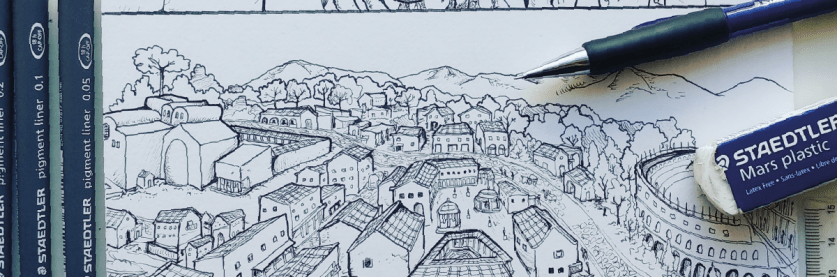
This year marks my third season with the project, and second in a Public Archaeology role. It is another ambitious year. I have been working on new activities which aim to bring the participants closer to the daily life of Ancient Romans. This year we have been able to jump ahead towards more sophisticated engagement materials, since we are able to build on the work from last year.Through regular social media updates, my work has been in part illustrating, but the overarching plan for the Open Day and further research is focused on asking questions relating to pedagogical approaches that will be answered via through educational posters and games during the Open Day. The data collected will be assessed in a follow-up project I am working on in the last fortnight of the excavation season. The games and learning materials bridge modern audiences (specifically children but also to encourage adults as well) wtih themes like international trade and community within the urban spaces of Aeclanum. Through a close collaboration between myself (project development and art direction) and the brilliant GIS and digital graphics team (Josef Soucek and Lucia Michillen), and our field directors, Dr. Ferdinando di Simone and Dr. Ben Russell, we are producing materials at a rapid pace entirely in-house, which is unique in my experience and really allows the Aeclanum project to break new ground in terms of outreach. By linking our outreach materials to new research we are undertaking on the site annually and adapting our creative materials to reflect the developments in these research questions, we can integrate students with related research and skills into the work we are doing.
The Open Day is a few weeks away still, but at the rate the students are excavating, we are certain to have an even clearer image of the stratigraphic processes in the trenches, and what this seasons’ research will be able to elucidate before the end of the season.
If you are going to be visiting Paris with the expectation that you are going to visit the most romantic city on earth, then this is not the list for you. I am just going to assume you will walk along the Champs–Élysées, check out the Eiffel Tower and Notre Dame, so you won’t find those things here. After half a dozen visits to this incredible city, there are some things I think are always worth a look, a re-visit, others to skip. A short trip to Paris can be incredible and dare I say, even relaxing, if you plan to take in sites in between promenades, and cheeky drinks along the Siene and let the ambience take over.
How to MuseumThere is a fine art to going to see art. Nothing makes you unhappier faster than being hangry, sore and tired and shuffling around a palace full of art – much of which looks basically the same. As someone who travels to see museums and archaeological sites exclusively, I double down when I travel alone and see as much as possible, but if there is another human with me, I (grudgingly) stick to a one large museum a day rule. As tempting as it is to visit a few together to save time, it diminishes your ability to appreciate and enjoy them. Breaking up the visits means you won’t literally run through rooms of incredible art just to sit down. I know there are only so many paintings of the crucifixion you can take in on any one visit. Don’t make seeing this stuff a performance of penance.
1. The LouvreI know what you are thinking; OBVIOUSLY you will be going to the Louvre. However, you will never see everything in the louvre, so don’t try. Rather, pick two themes that interest you; Greco-Roman statues and Near Eastern pre-historic art? Tapestries and Medieval painting? Sure, you may not see every highlight, but by focusing on things you are interested in versus what you ‘should’ be seeing, you will likely enjoy it more.
I don’t care if you don’t like Classical statuary, go see the Nike of Samothrace.
Pro tip: visit the Louvre in the evenings if you can since it is significantly less busy then, and you have the Venus di Milo all to yourself rather than struggling to find a spot in between tour groups. Wednesdays and Fridays the museum is open until 10pm/ closed on Tuesdays.
2. Musée d’Orsay/ Musée Orangerie For relatively more modern pieces of art, the impressionist painting collection of d’Orsay and Orangerie are worth the visit. If you’ve ever been curious to see the ‘L’Origine du monde’ (Origin of the World), now is your chance! If you are lucky enough, there might be some performance art happening there during your visit! Both buildings are gorgeous, and worthwhile for a visit. Places for good eats: Eric Kayser Artisan Boulanger & Cafe de la Nouvelle Marie
3. Place de la Concorde For me, nothing says going to Paris like staring at some Aegyptiaca. The big attractive Obelisk of Luxor and ornate fountains symmetrically placed at the center of Place de la Concorde, with Egyptian-styled decoration throughout the square is an interesting throwback to France’s imperial days. The site of execution of Louis XVI and Marie Antoinette, among many others. Surrounding crowds of jeering revolutionairies cramming into this space – briefly named ‘Place de la Révolution‘ during this period- is a viceral mental image of social and political upheaval to conjure.
4. Musée de Cluny (Musée national du Moyen Age) The museum de Cluny is full of art and artefacts from the Middle Ages, as you would expect from the name, but part of the treasure of this place is the building itself, built atop a Roman bath which you can see in the basement, the higgledy-piggledy building features of the exterior are sort of charming.
5. PantheonThe Pantheon feels as far away from its Roman predecessor as one could find; a monument to the civic spirit and fraternity of the famous French individuals. Once a church, a ruined abbey of Saint Genevieve, re-created by Louis XV in the mid-1700s. Interred within the Pantheon are the remains of Victor Hugo, Voltaire, Rousseau among others. There is something quite unique about such a ornate resting place for writers, philosophers and poets – secular heroes seldomly receive this type of hagiographic treatment.This area is great for wandering and grabbing a coffee and these sites are only 4 minutes walk from the Musée de Cluny. If nothing else, there is a famous macaron shop nearby which is worth the visit. Sweet treats near the Pantheon: Sebastien Degardin (Patisserie de la Pantheon) and La Macaron Laduree Paris.
6. Montmartre and Sacré-CœurThe stairs leading up to Sacré-Cœur and the Montmartre are the devil. It is a beast to get up to the top, but don’t cheat and take the funicular. It’s good for you and will build character.The neighbourhood around the basilica is lovely and winding, with a large number of cafés and restaurants priced to keep the likes of me away. Atmospherically, it’s a an area with a relaxed vibe. There is often music floating around by street performers, interesting architecture and artisans with a plethora of stalls selling their paintings/prints. Stopping in at a café with a decent view, this is one of my favourite areas to sketch urban life scenes.
7. VersaillesJumping on the a few metros and RER train out of town, visiting the Palace of Versailles is a pretty solid day trip. Built up from a swamp around his family’s hunting lodge, Louis XIV captured all of France’s nobility in his guilded cage of Versailles. Through elaborate specatcles to entertain them whilst there, and incredibly pedantic and restrictive court etiquette, Louis was gaslighting the French aristorcacy until they competed with eachother to help him put on his pants or use the toilet, as a sign of his favour.
There are so many architectural and decorative wonders in the palace; the public spaces like the Hall of Mirrors and each private room you amble through unveils small reminders of the period where Europe’s most influential art and fashions were being created in Versailles.
In addition to the historical interst of visiting Versailles, the grounds are exquist if you are partial to a manicured garden. Next-level landscaping. The fountains, which were unable to all be used at the same time in his life-time, now put on incredible water shows to classical music. The small cottage of Marie Antoinette in the gardens, the Hameau de la Reine, has lovely neo-Classical temples and picturesque views for some quiet contemplation and maybe some cake.
8. Musée d’Archéologie Nationale, Saint-Germain-en-LayA 40 minute ride on the RER, and you end up in the suburb of Saint-Germain-en-Lay, about 19 km west of Paris. There are nice gardens around the Château de Saint-Germain-en-Laye which house the archaeological collection, that offer a nice picnic space to nap post-Museum.
This is not a journey I would suggest if you have just a few days in Paris, or if you have never been before since there is so much to see and do in the city center. However, if you’ve seen the main sites and are looking for something different and a little quieter/less busy, this would be a worthwhile visit.
9. Spend as much time as possible picnicking and drinking wine along the Seine
I don’t know how much needs to be said on this, but most of the best moments I’ve shared in Paris, with friends or my fiance, have been taking some wine and picnic down to the Seine and hanging out in the sunset. As one of the busiest European tourist destinations, it can be hard to find places to just chill out and take in the majestic views (for free), but along the river you can have all those deep talks, relaxation and watercolour painting opportunities.
10.Make some art!
A small travel kit of water colours and watercolour brushes in tow, and you’ve got the makings for an art filled break. Even if you aren’t sure you are going to be a Renoir or Monet, a cheap and portable set of paints and watercolour pen can be the best companion on your trip. Unlike a photo, trying to make a small artistic rendering requires looking a little differently at the world around you, and a slower pace. Your mom will totally put your painting on her fridge.
Bars and nightlife
The Strasbourg St. Denis area is great for bars, chilling out till the wee hours with the unusual opportunity to hear French being spoken all around you. Nice space to unwind with decent food prices in this neighbourhood.
The Paris Pass
The Paris Pass is a great purchase; after a visit or two to the big museums, it will be evident that this little pink pass has paid for itself. Click here for a link.
Transport
There are many ways you can get into the city-center from the airport, but I tend to use the tested and true coach buses. It can be about €15.00 approximately. Click here for a link to a summary site on the transportation options.
Some nice spots to stay in town:
This AirB&B accomodation was an aboslute gem on a research trip last year, small but fully functional and very well situated. Just 10 minutes or so from the Louvre and Musée d’Orsay, with many small bakeries, grocery stores and bars nearby.
Hostel Oops is a throwback to my backpacking days, but it’s cheap(ish) and really bloody cool inside as hostels go. Right in the Latin Quarter next to some movie theatres and other fun establishments. It need not be mixed accomodations with strangers, as they have some private rooms, but that’s not as much fun…until you are 25.
The last 12 months have been eventful, with a lot of life changing things on the horizon to be excited about. In a few short days, I will be heading off for a third (more lengthy) season in the Roman town of Aeclanum, (near modern Mirabella Eclano, Italy). The last year was incredibly formative for me, as I was privileged enough to work on developing materials with the site directors of Aeclanum from the University of Edinburgh and the Apolline Project for public outreach for the Open Day, as well as ongoing learning materials for children to engage with archaeology in schools.The opportunities to share this work are blooming into new areas for me professionally with a lot of creative directions to pursue.
Pronnoi excavation site, 2008. Photo by Cait Pilon.
My first dig
Ten years ago, before I knew what I wanted to with my life, I applied for the opportunity to work on a three-month salvage excavation in Poros, Kefalonia. This excavation was organised in collaboration with Simon Fraser University and the Ephorate in Kefalonia. One family in Poros, the Metaxas family, made an incredible impact on my time there. They were strong advocates for this dig, working with the local government to see that the archaeological site was excavated before it was robbed or destroyed once it became apparent that there were tombs located there.
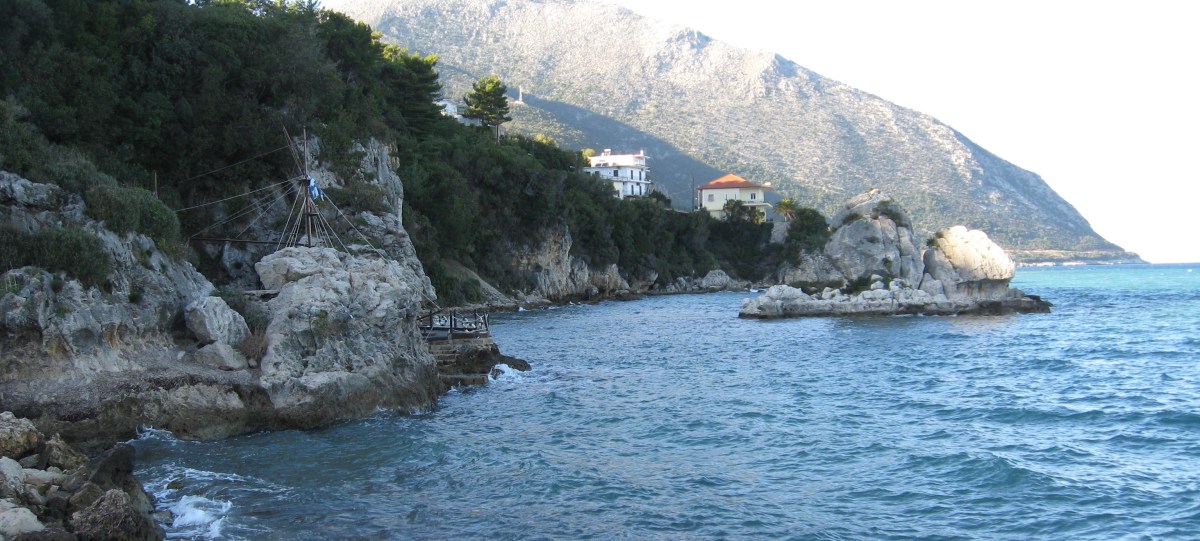
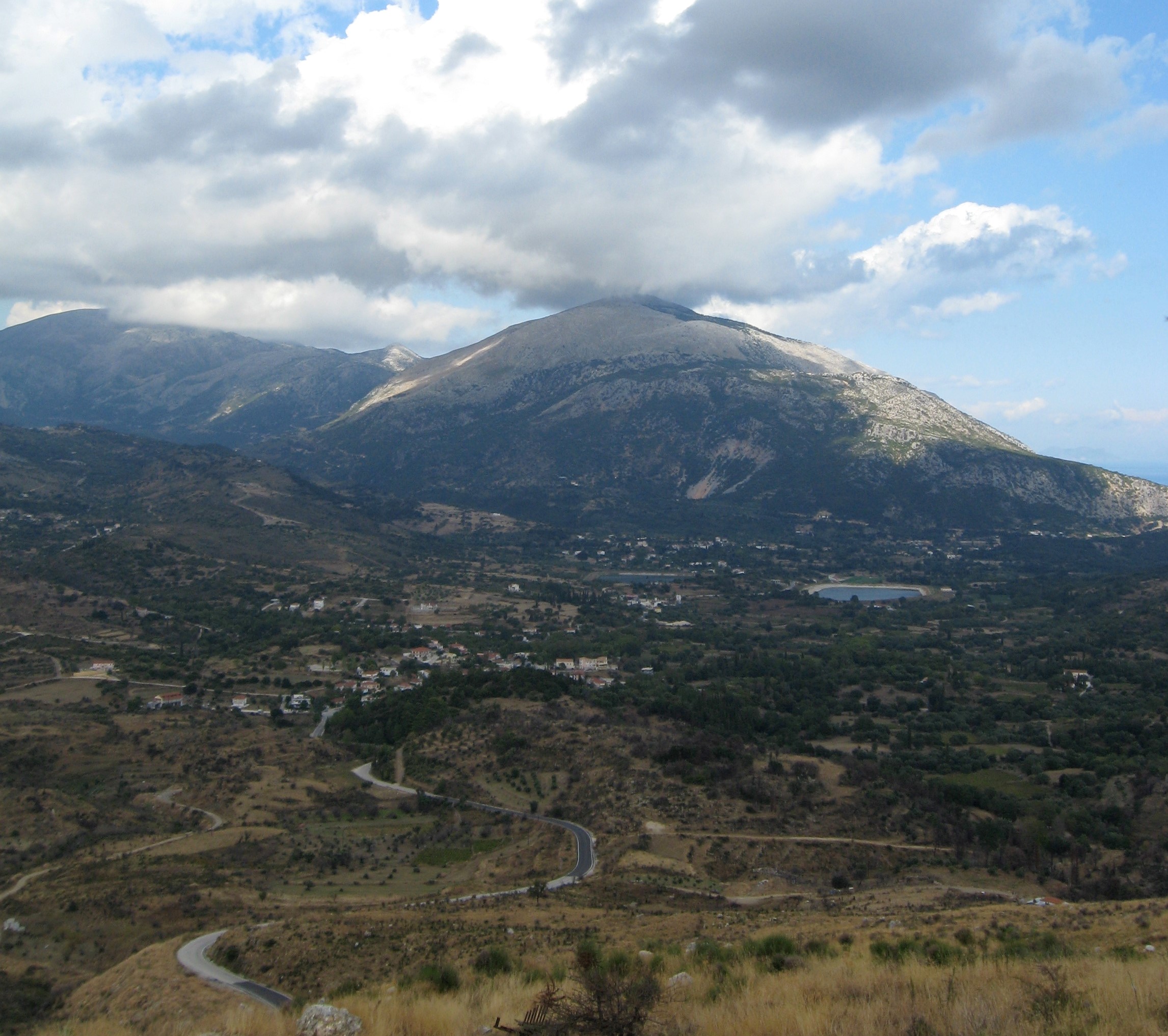
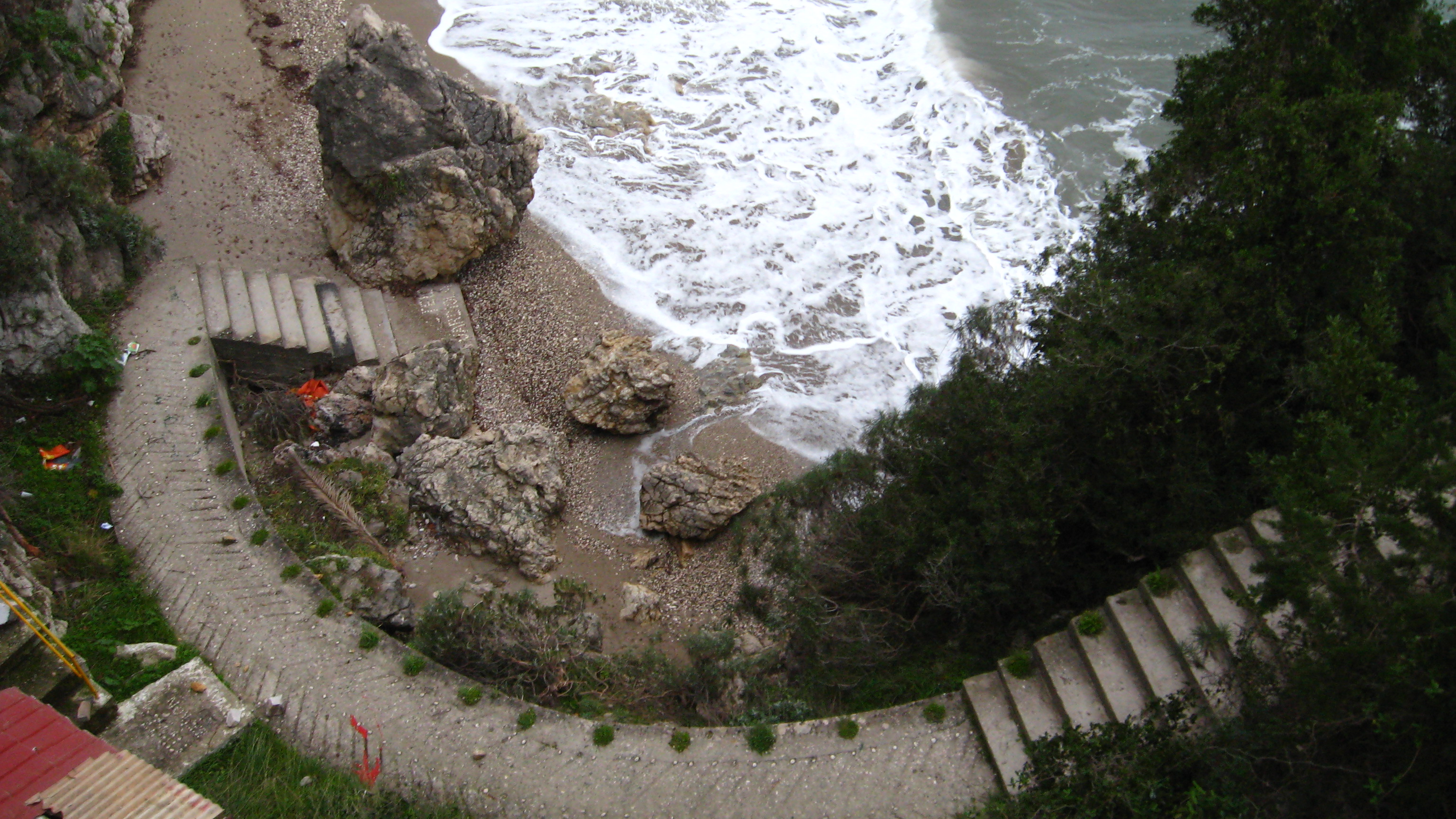
The view across the valley from the necropolis.
It was a project born out of a local passion with an aim to start documenting and publishing the rich history of the area, which had been under occasional excavation for decades with very little making it into the public record. By the time of our arrival, there was evidence of looting, so speed was of the essence and the local archaeologists worked with a ragtag bunch of undergrads to excavate and document the human remains and small finds.
The scientific processes are the same for a salvage dig as a normal one, but the elements that are the focus of the excavation tend to be revealed and in peril, so acting quickly and documenting as much as possible is the priority. Our team worked on the excavation during the day and in the evenings would have classroom time and readings, even the odd Greek lessons. Even on the rainy days where the schedule entailed 8 hours of pottery washing, it was still brilliant to be part of.
The antiquity of the necropolis was evidenced through artefacts which represented multi-period usage on the site for burials, an ancient garbage dump (large amounts of broken pottery and animal bones), and fluted columns and architectural blocks from some unidentified building structure.
Excavation in Pronnoi
The excavation work was productive for getting the half-exposed burials out in time before the winter rains began to set in, though occasionally, flash rainstorms would flood the side of the mountain with us on it. The pithoi were interesting tomb-types that were repurposed from containers for bulk storage of grains or other items to a burial container. Once the ceramic vessel was broken up, a body was interred in a flexed or crouched position, and grave goods were added. The vessel was placed around them with fill, but could be accessed again, if another body was to be added to the burial at a later date.
Grave Goods
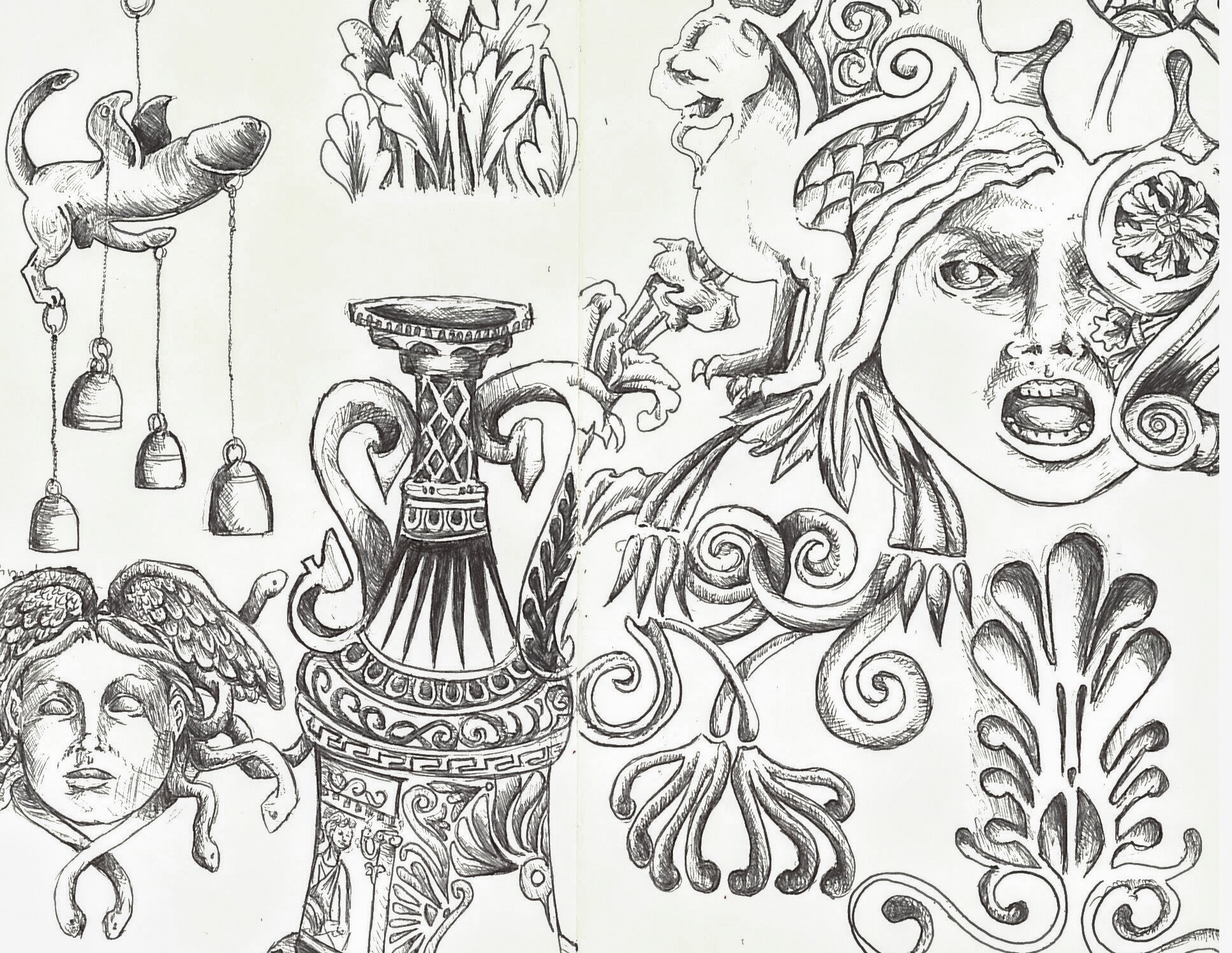
The status of the publication of the finds from the dig is unknown to me, so to avoid getting in trouble, I have made a few artistic renderings of some of the standout artefacts:
Gorgon head, amber.
Corinthian, silver coin.
Lyre player, pottery sherd.
From atop the hill we excavated the necropolis, you could see across the valley with stunning views inland and out to the sea. Putting myself in someone’s sandals from 2,500 years ago and looking out across the same seas they did was a moving experience. Having studied Humanities texts and Art History prepared me in a large way for I was able to see how much more I need to understand before the study of Archaeology or Ancient History. Linking this site in my mind to the Homeric kings and events from the Iliad and Odyssey was only natural, since it was on our reading list, but the chronology of the material culture certainly aided the visualizing of the Bronze Age culture.
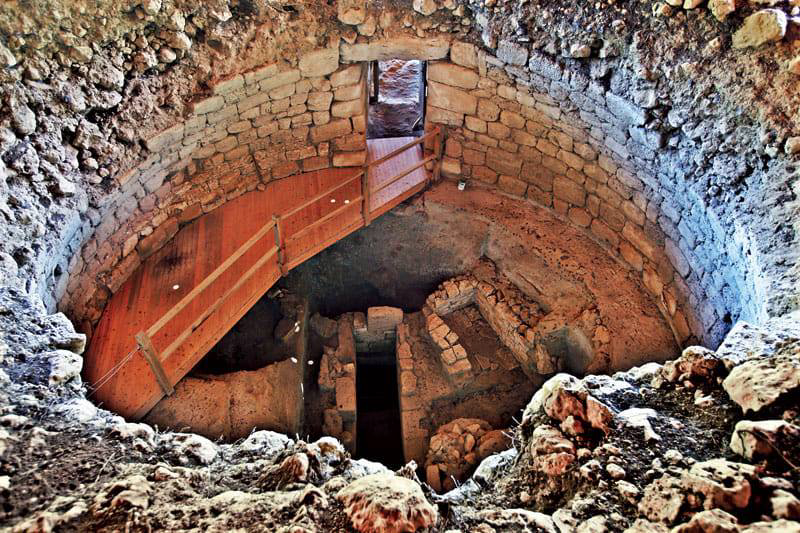
Searching for Bronze Age HeroesThe antiquity and long habitation of the region was visible in another area, Tzanata, 3 km east of Poros in the Eleios-Pronnoi municipal region, which had a preserved tholos tomb, or ‘beehive tomb’. This type of tomb has a dome-shaped chamber (like a beehive cut in half), an entrance passage (dromos) and a doorway (stomion) covered with 1-3 lintel blocks. These monumental structures would be buried underground, though accessible, as there could be multiple burials over long periods of time.
The nearby environs of Poros were home to a Bronze Age tholos tomb, which has been dated to around 1400 BCE. This tomb, excavated by Lazaros Kolonas in 1991, contained several sequential burials that could suggest a common lineage.
While significantly smaller than the most famous tholos tombs of Mycenae, it certainly showed comparable architectural features and represented elite participation in the monumental funerary building of the Bronze Age Mediterranean. Finds in the archaeological museum of Argostoli (temporarily closed) reveal golden grave goods from the Mycenaean cultural influence. Included in these finds were carved gemstones a seal that has been interpreted as ‘royal’ were discovered in the tomb. The proximity to Pylos, among other Bronze Age kingdoms of the area, provide parallels chronologically for local elites of Pronnoi having a similar kind of rule over the area by virtue of using similar funerary cultural practices. However, little is known of this site as the excavation reports remain (I believe) unpublished. If further work has been done on this site, it would open up a lot of interesting questions about the position of Kefalonia within Bronze Age trade and indeed, later into the Classical period.
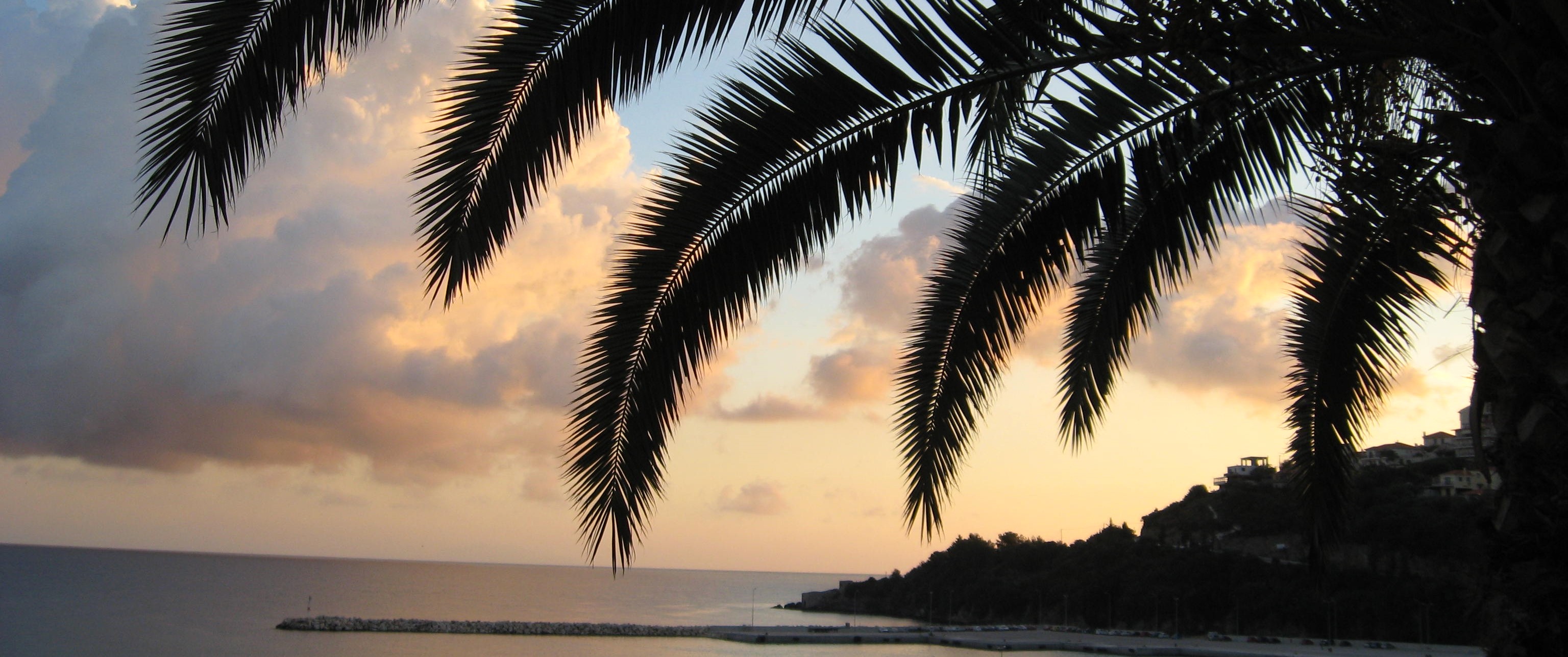
Suffice it to say, my time spent in Poros, Kefalonia, was fundamental in shaping the direction of my studies and career plans. While I have not been back since 2008, the richness in history, the warmth of the community and beauty of the island is still deeply felt. I am making plans to return and investigate the current findings of the area and reunite with the incredible people who made it such a memorable experience for me.
“To be away from home and yet to feel oneself everywhere at home; to see the world, to be at the centre of the world, and yet to remain hidden from the world”
– Charles Baudelaire, The Painter of Modern Life and Other Essays”
Walls of Policastro Bussentino, Italy 2015
The concept of ‘the flâneur‘ is an old one that has recently entered my mind as my PhD research is starting to intersect conceptually with my artistic experiences within ancient city spaces. As someone who feels that you need to walk a city to really experience it, I also believe to really see a city, it helps to sketch it; not the whole thing, and not just its monuments, but small details and elements. The 19th century French symbol of the flâneur is relatable to me for that reason.
For the flâneur, one interacts within urban spaces through engagement (in painting or writing) and observation, but still remains apart- both a performer and spectator. The lesser-known ‘flâneuse’ is the female chronicler of urban life in the 19th century, figures like Virgina Woolf, as discussed in this article, are part of the underespresented presence of female urban explorers. As a modern female explorer of ancient urban spaces, creating a space to discuss, share and engage with these ideas and locations in the public sphere is important to me.
Additionally, this concept resonates for me, as an archaeology student and artist, because it embodies more than a spirit of adventure and making art, but also a spirit of understanding and trying to piece together the urban landscapes that have developed and disappeared over time.
Maratea and the statue of Cristo Redentore, 2015.
Since my first trip abroad, in 2002, the drive to sketch and take in everything that I could has formed an important part of appreciating a significantly bigger world than I knew. Sketches from my earlier books explored famous portraits and statues the likes of which I’d only ever seen in Art History courses.
This initial exposure provided me with access to masterpieces in galleries that were unlike the art I could see with any regularity in Canada. Sketching from paintings was a lot of fun and I felt so fortunate to see the images, but my first visit to archaeological sites in Greece and Italy really affected what I wanted to draw.
Sketches from Delphi: reliefs and helmets 2008
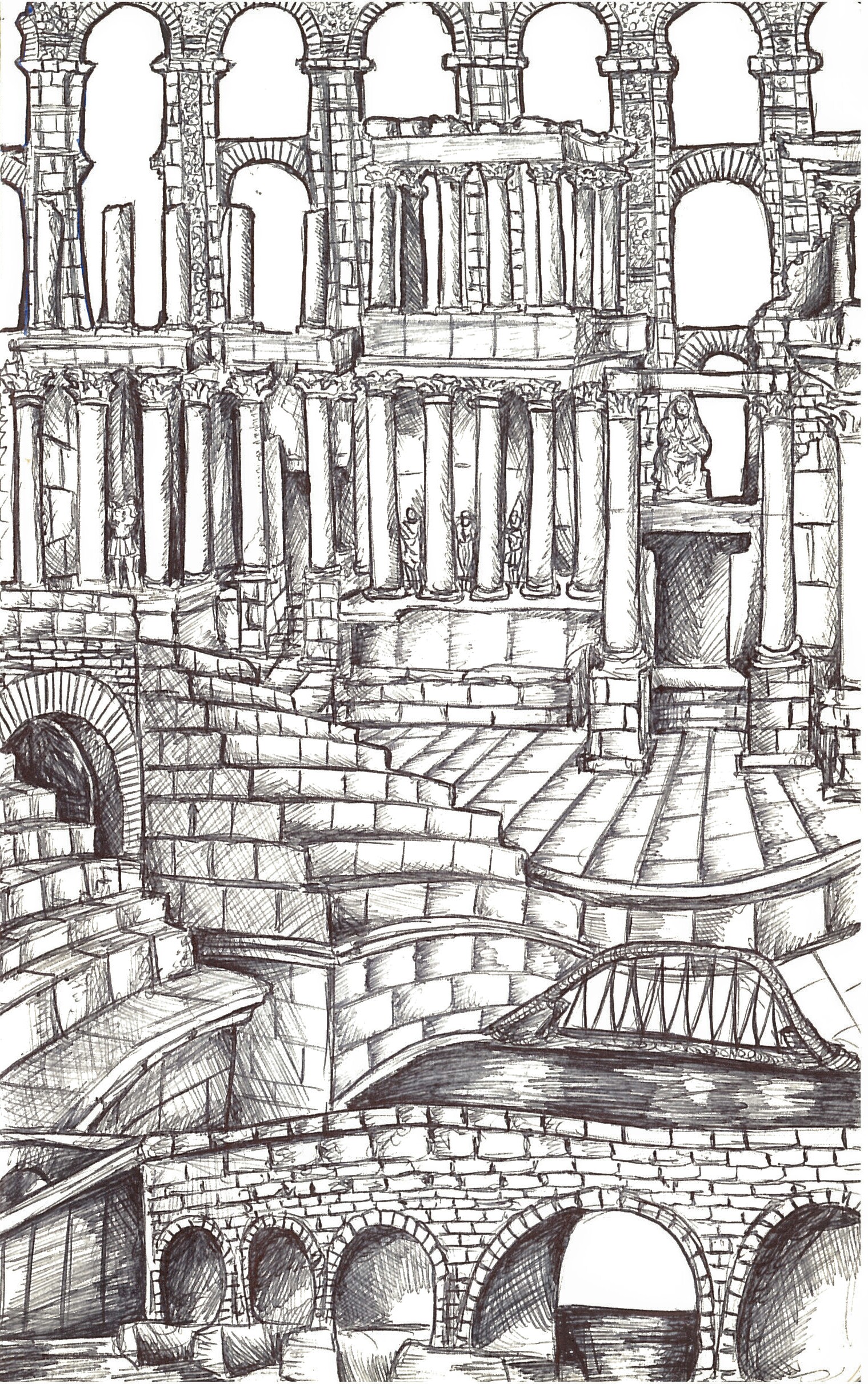
Visiting many sites in the Mediterranean over the last 10 years, I was able to sit and breathe in these ancient cities by focusing in on the shapes and forms of the stone, lines of sight, and views between one temple to the streets or the valleys below. My curiosity directed me to explore artifacts and material culture that were used to adorn Greek, Etruscan or Roman buildings and the individuals who navigated through them.
From Observer to Preformer
Lady of Elche, 4th century BC, Iberia
The most inspiring pieces of art in the world were at my fingertips (sketchbook and pen tip), but my shyness about drawing in front of strangers took a few years to overcome. Ironically, the simple act of drawing in public would lead to some of the most interesting encounters with fellow travellers, curious children and tour groups. I have found the quiet study of the place you are in, or artifacts in front of you, signals something unspoken to other people which is inviting.
Sir John Soane’s Museum 2015
Over time I developed my own sense of style. I could explore patterns and elements taken from brick designs, patterns of lace on Dutch merchant collars, hairstyles of Roman and Greek elite women, and not worry what the person hovering over my shoulder thought.
Much of what made this passion for drawing more appealing was the utility of having something free and enjoyable to do with the many hours you spend while traveling to get to the place you are going. Waiting to cross the sea on a ferry or idle at a train station on my way to a new city, provided me a good amount of time to reflect on my sketches.
This reflection began to take greater shape and purpose once I started to do postgraduate research. Having questions and a focus of study in my mind affects the way I approach the ancient city spaces around me. It focuses my vision, but also encourages me to think on the connections between the visual elements across the Mediterranean. You don’t need to travel all over the Mediterranean to realise there is a shared visual culture being used with an incredible exchange of ideas and styles at play, but it was helpful to visualize the scope.
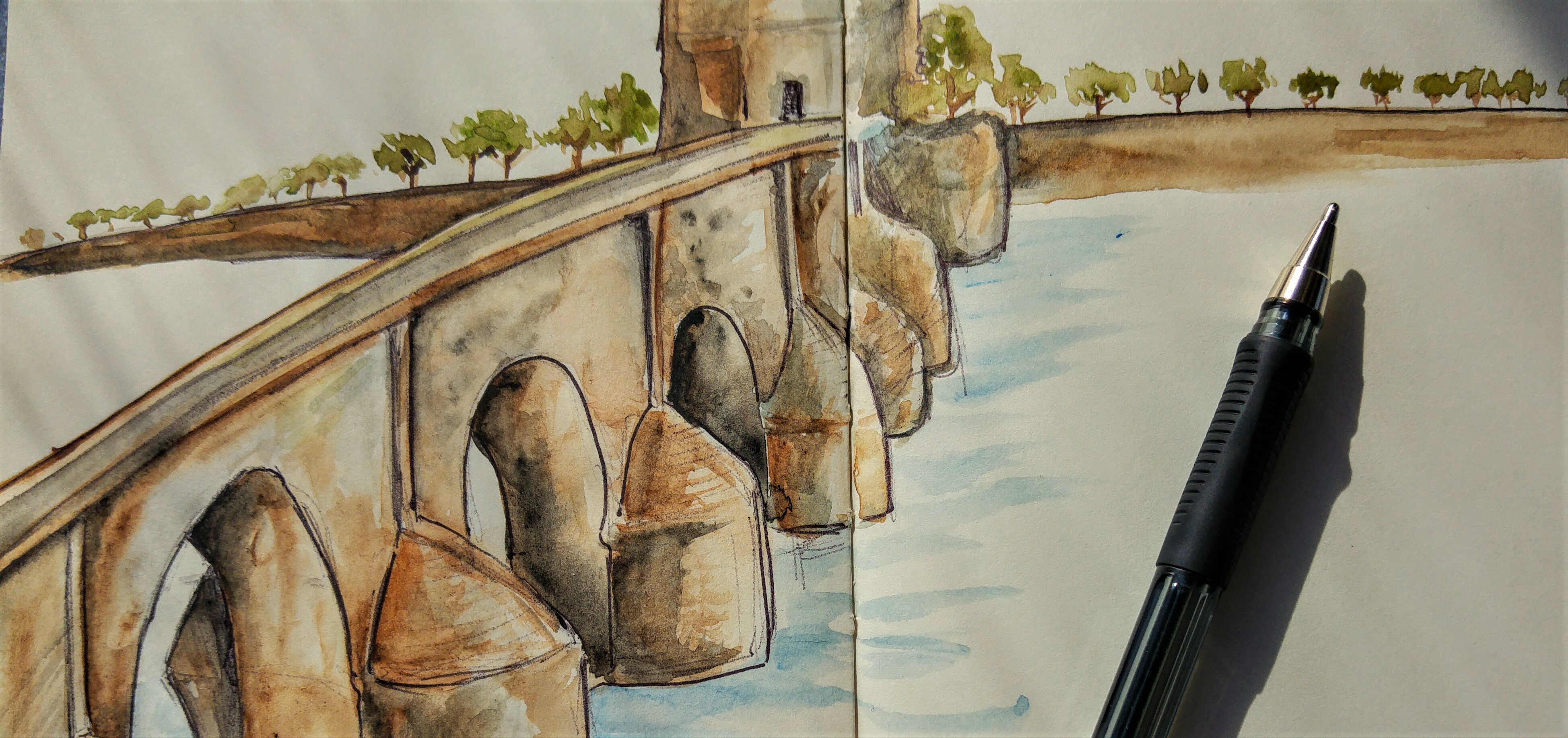
Roman Bridge, Cordoba 2018
It began to create a tapestry of experiences (passive and active) in my mind of ancient art and the interconnectedness of ancient communities that had risen and fallen many centuries ago. I remain inspired to learn more and document it in a way that is meaningful to me and hopefully others. By saving a small piece of my experiences in a sketch or painting, I am starting to develop ways in which these small illuminations of incredible places and artifacts can be used to share the benefits of the study of Archaeology and Ancient History.
Deciding to listen to the good advice I was given at the onset of embarking on my PhD, I opted to follow the rule: once you’ve submitted something substantial, take a week and decompress.
The first few months of my PhD have been a whirlwind of new ideas, late nights and piles of reading. It had been three years since I’d written anything so formal, and the gap in between was noticeable. Like an unused muscle, my writing felt crampy and good for only one lap or two around the court. Though working old muscles can be exhausting, diving into the subject that you love is enjoyable and invigorating. After several years of wanting to spend my daylight hours working on something interesting and challenging, the last two months have sped by. With the completion of my first review submission, there was no shortage of things to work on and develop.Deciding to listen to the good advice I was given at the onset of embarking on my PhD, I opted to follow the rule: once you’ve submitted something substantial, take a week and decompress. That can mean many things of course. Understandably, long train rides and walking many miles might not be someone’s idea of decompression, but hey ho.1. Go Find Your Chill
Normally, I am the last person to take advice relating to self-care and relaxing (shudder), but I thought, ‘why not’? Four hours after submitting my work, I jumped on a train to Manchester to visit a couple of wonderful friends who I met during my MSc at Edinburgh. My wonderful hosts, both a current and future PhDs, welcomed and showed me their adopted city. Manchester was a beauty. With plenty of time to explore the downtown and no particular agenda, other than seeing what they love about it, I could relax and take it all in.
2. Take in a Bit of Culture
There is something restorative in going to art galleries, museums or creative performances. Even if you don’t necessarily like the art on display, just seeing what creative minds have been/are up to can take you outside of yourself for enough time to relax a bit. At least until the next “BREAKING NEWS” alert on your phone goes off. When needing to feel some inspiration, or just wanting a quiet space to draw, museums and galleries tend to be my preferred space to do so. Popping into the Manchester Art Gallery allowed me the rare privilege to see one of my favourite paintings in the flesh – Charles Auguste Mengin’s ‘Sappho’ – which was breath-taking and significantly larger than I’d imagined.The depth of the darkness in Sappho’s gown cannot be done justice with a digitized image, and the highlights looked iridescent in some spaces. Sappho, so often presented longingly and wistfully, is shown powerful, dark and mourning. Her angst and colour palette was a natural favourite for me in my high school goth years.3. Nightime Walks and Christmas Markets
Walking around at night when travelling alone isn’t always the safest choice, so when I have the opportunity for company, it is an excellent way to see another side of a city. As this was my first time in Manchester and it coincided with Christmas festivities, strolling around the streets at night was especially lovely. While making me homesick, one of the perks of living in the United Kingdom is the on-point Christmas markets. The smells of meat, waffles and mulled wine were amazing. It required all the will-power I possessed not to buy adorable kitsch ceramics, and eat all the treats.Onward through town we went, eventually settling into a pub near the university. Ample political debates, methodological discussions and general nerdiness ensued.
4. Treat Yo SelfThis might seem fairly obvious, but taking 30 minutes out of the day to have a leisurely coffee or popping into a print shop and finding Liam Gallagher greeting cards (nailed it, Manchester) is sometimes the treat you need to clear your head. It doesn’t have to be a big production, but leaving the to-go cup behind and just sitting in nice spaces with friends (or alone) is one of my favourite parts of a solo journey. Seldom do I plan a trip without packing as much as possible into the schedule, but trying it out this month was really rewarding and relaxing.
5. ReflectingTaking stock and heading home, I was thoroughly impressed by the juxtaposition between new and old buildings in the city. There is a lot of effort to create dynamic visual landscapes, which living in the historic neighbourhoods of Edinburgh, I occasionally forget that skyscrapers, tower block flats and vivid colour are normal to see. Shaking off the last few weeks of 14+ hour work days, and stress that ate normal stress for breakfast, I definitely came back feeling more refreshed, and through that, optimistic. Though only a few days, it was a wonderful stop.Next stop: BRUSSELS! 48 hours later, my partner and I jumped on a plane and were en route to Eindhoven for a week
October in Scotland has been, on occasion, described as so windy, “it’ll cut ye in half”. Locking myself indoors over this month to re-learn how to study has arguably been made easier by the poor weather. With the first month of my PhD done, and the piles of books I need to read steadily increasing, a kindly offer from my incredibly talented and successful bestie from Vancouver, to meet in Nice for a weekend, was pure class.
Place Massena et la Fontaine du Soleil.
My last rendezvous with Nice was in 2008 (the youthful and relatively tattoo free main picture dates to then); the sights and smells of Nice are summed up for me by ‘ça m’a marqué’. To walk the Promenade des Anglais again in the October sunshine was a welcome change of study space.I wish I could say that I studiously read up on much of the history of Nice, but that would be a lie. We came for sun, beaches and the famous cuisine that characterize this gorgeous little spot of paradise.The open-air markets had spectacular varieties of sea salts and spices, with dried herbs and lavender filling the air in the narrow winding streets.
A picnic of local specialties
For a few short days, the ambling life was pretty spectacular. But the itch to see some of the ancient history in Nice was more powerful than delicious paté and fancy cocktails.
Site Archéologiques de Nice-Cimiez
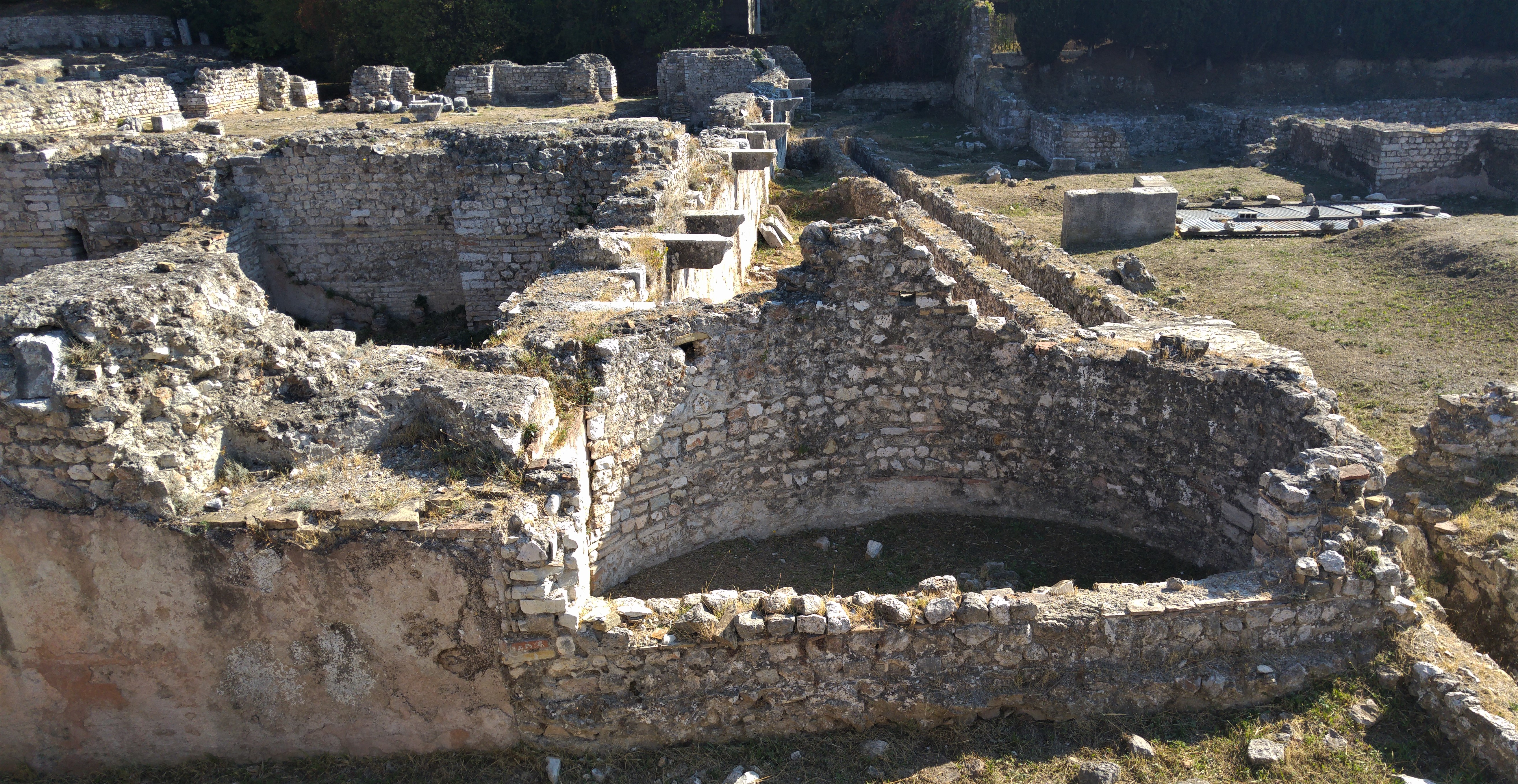
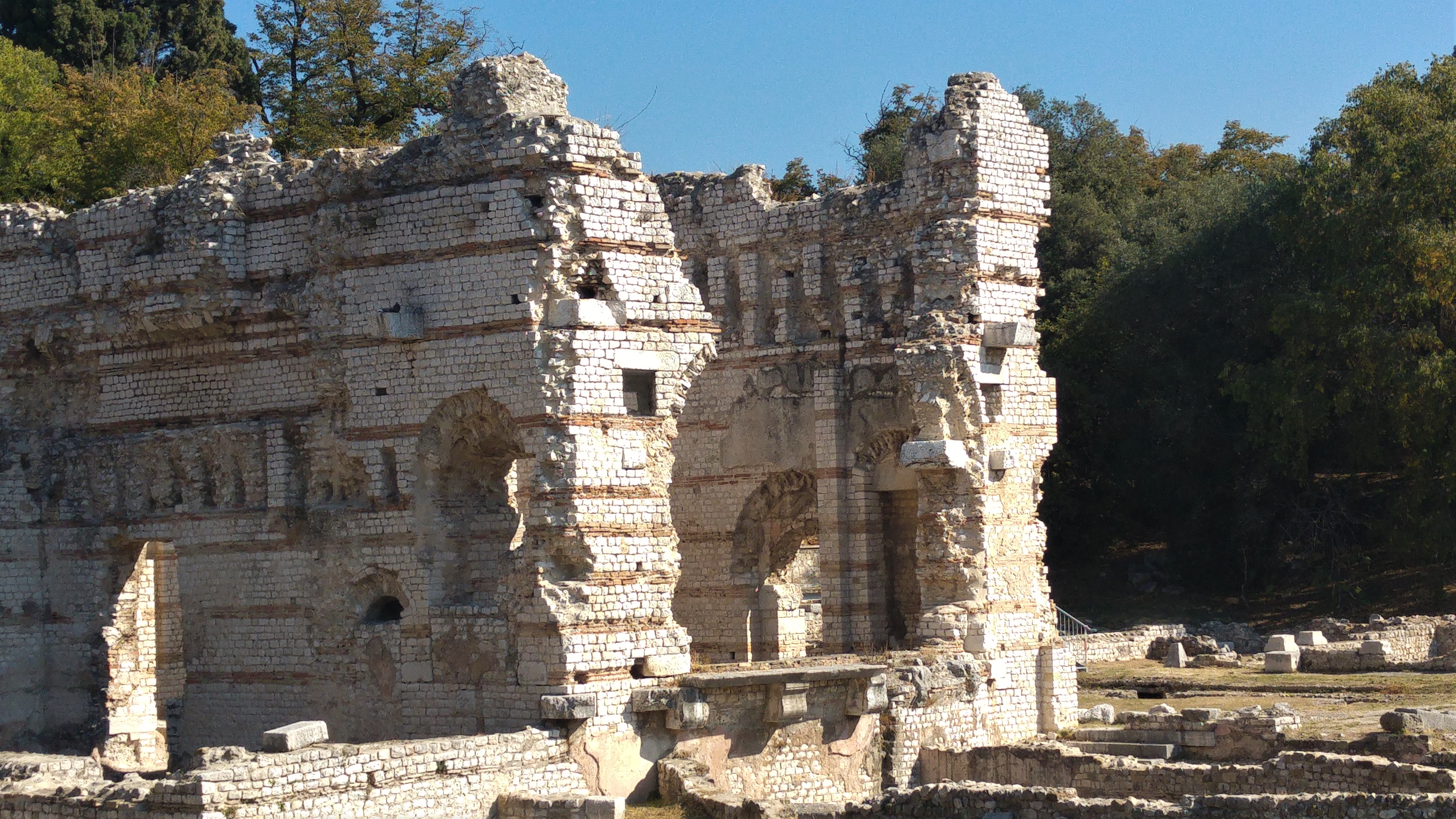
Though in the city centre of Vieulle Nice the shops and amenities were all bustling, Sunday morning in the outskirts of town was effectively closed for business. The imperative task of finding coffee and croissants before exploring Roman ruins was nearly impossible. Eventually, we secured essential pastries and found the archaeological site of Cemenelum. The hilltop archaeological park is situated in the fairly posh and residential neighborhood of Cimiez, and contains a small but interesting portion of the Roman baths.
Eastern bath complex
This Roman city was built not far from an established Greek city, Nikaia, and under Augustus, it became the capital of the province of Alpes Maritmae, with occupation and development into the 4th century AD.
Western bath complex
Northern baths frigidarium
The bath complex and partial roads that remain were part of a bustling military encampment, servicing the legions as they passed through or remained stationed there. Some estimates have placed the inhabitants at 10,000, with a decent amount of seating in the amphitheater, back when it still had seats.
Amphitheater entrance
The face of habitation changed over time, and even with incursions from hostile tribes, Cemenelum maintained a community of Christians into the 7th and 8th centuries AD. The evidence of this phase is present in the houses that were built into the abandoned baths.
After a solid hike up to the site, it was time for a few remaining hours on the beach, and one last swim in the Mediterranean. With the first month of my PhD over, and the piles of books to read getting ever higher, a sunny weekend of ambling around in Nice was the perfect excursion as fall quickly turns to winter. Merci pour ce merveilleux voyage ma chère amie! A la bientot!
The last 12 months have been eventful, with a lot of incredibly life-changing things on the horizon to look forward to. Last week I officially starting my PhD at the University of St. Andrews, and with the other interesting creative academic projects that have come my way, it is a very exciting time. Most of these creative projects have stemmed from the work which I was engaged in this summer in Aeclanum. Over the summer, I shared many images on my Instagram and Facebook pages of the public archaeology project that I was working on this season in the Roman town of Aeclanum (near modern Mirabella Eclano, Italy). I wrote a post in July for the Day of Archaeology annual community outreach publication, discussing some of the surprises and challenges along the way. The aims and plans being developed for this site were fascinating to work on, with much to consider and research.
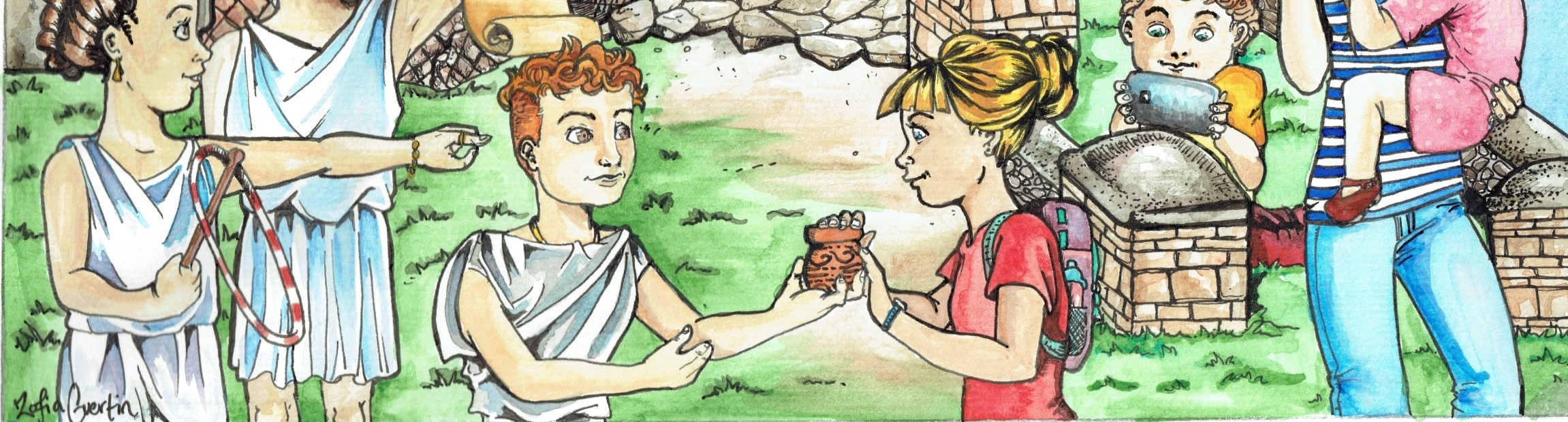
Caius Eggius Rufus and Neratia Prima, our ancient Roman characters who explore daily life in a Roman city.
For me as an illustrator/artist, coming up with the first crack of public engagement materials was really fun and incredibly rewarding. The directors at Aeclanum, Dr. Ben Russell and Dr. Girolamo Ferdinando De Simone, offered guidance into their objectives and vision with the programme. Foundational research was needed, and for me, many visual references, as understanding how to approach a long-term project like this requires a lot of discussion.
Dr. Girolamo Ferdinando De Simone and I with the stratigraphy roll-up 🙂
Dr. De Simone had spent a lot of time developing the approach he wanted to take, with significant experience for how to engage with the public on these topics, so I was able to learn a great deal about the concerns and approaches that are successful. All of which has led to many avenues for it to continue growing and branching out next year, and thereafter.
Preparation for the Open Day
The brand new Aeclanum activity book and site map!
With a big project like this, having students involved was essential. Due to time constraints (excavating and processing finds all day), most of the work we would do together was at night in the accommodations. The students worked very hard, and came up with some really great ideas (pottery games, stratigraphy exercise, etc) and a lot of good research on Roman baths and roads.
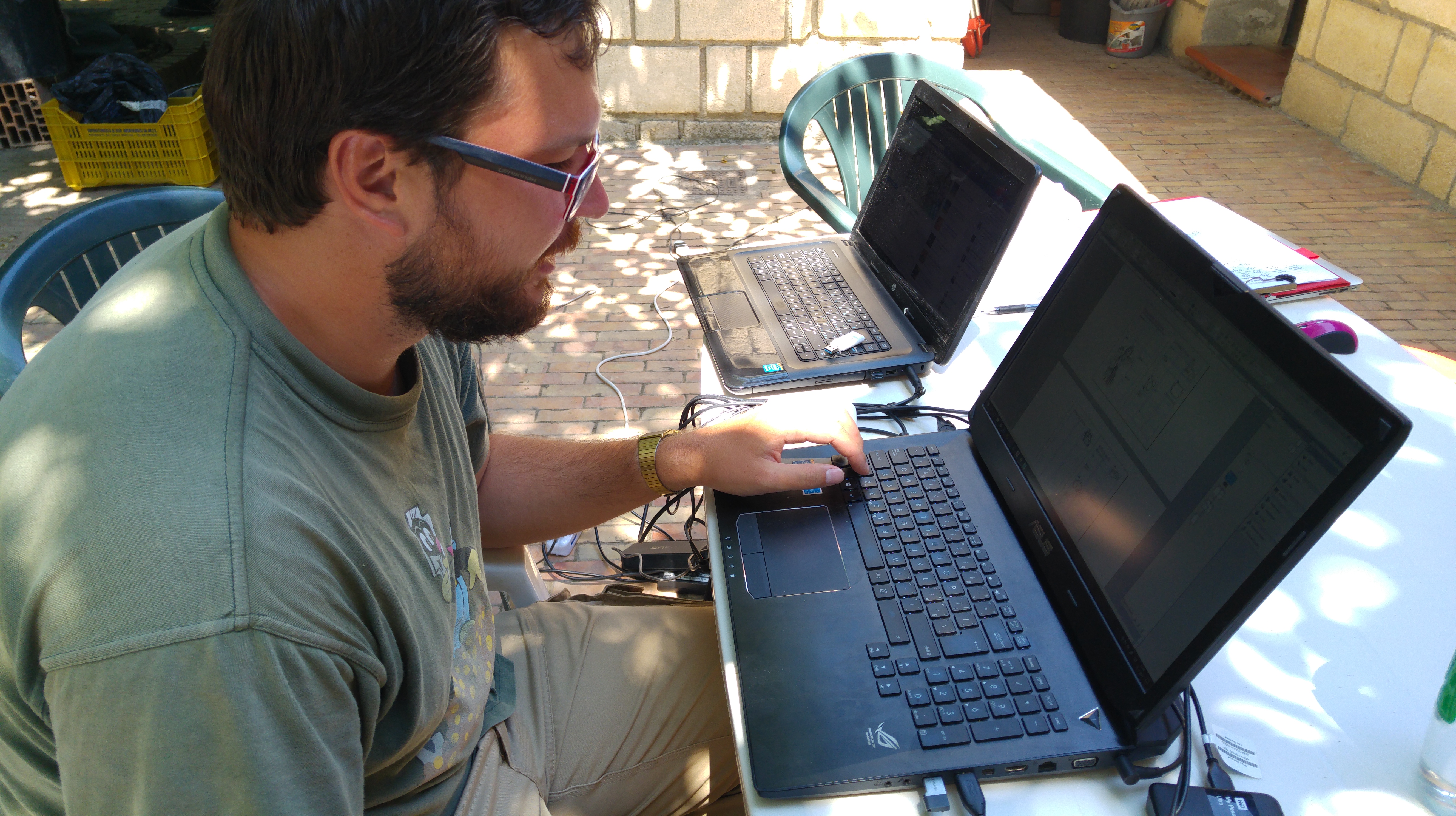
Josef Soucek, digital wizard, here working on the Aeclanum activity book
We were ambitious with the variety and number of activities and materials planned, which inevitably led to some ideas or planned activities being cut or re-configured. Some of the most indispensable collaboration was with the digital specialists, Lucia and Josef. Both are so incredibly talented in a variety of platforms, that for me, it was so exciting to work with them. Taking an idea from discussion to illustration to digitized form, and then adding that into a poster, all at the speed we managed, was really cool!
The Open DayWith many enthusiastic young visitors (and adults!) arriving to the site, the team at Aeclanum put on an awesome display. The efforts made by students and specialists were incredible!
Our crack team of pottery specialists-in-training (from left: Alexandra French, Amy Rabenberg, and Caity Concannon).
As we were somewhat limited by our linguistic abilities, those who spoke Italian guided the children and gave them an opportunity to ask questions and explore.
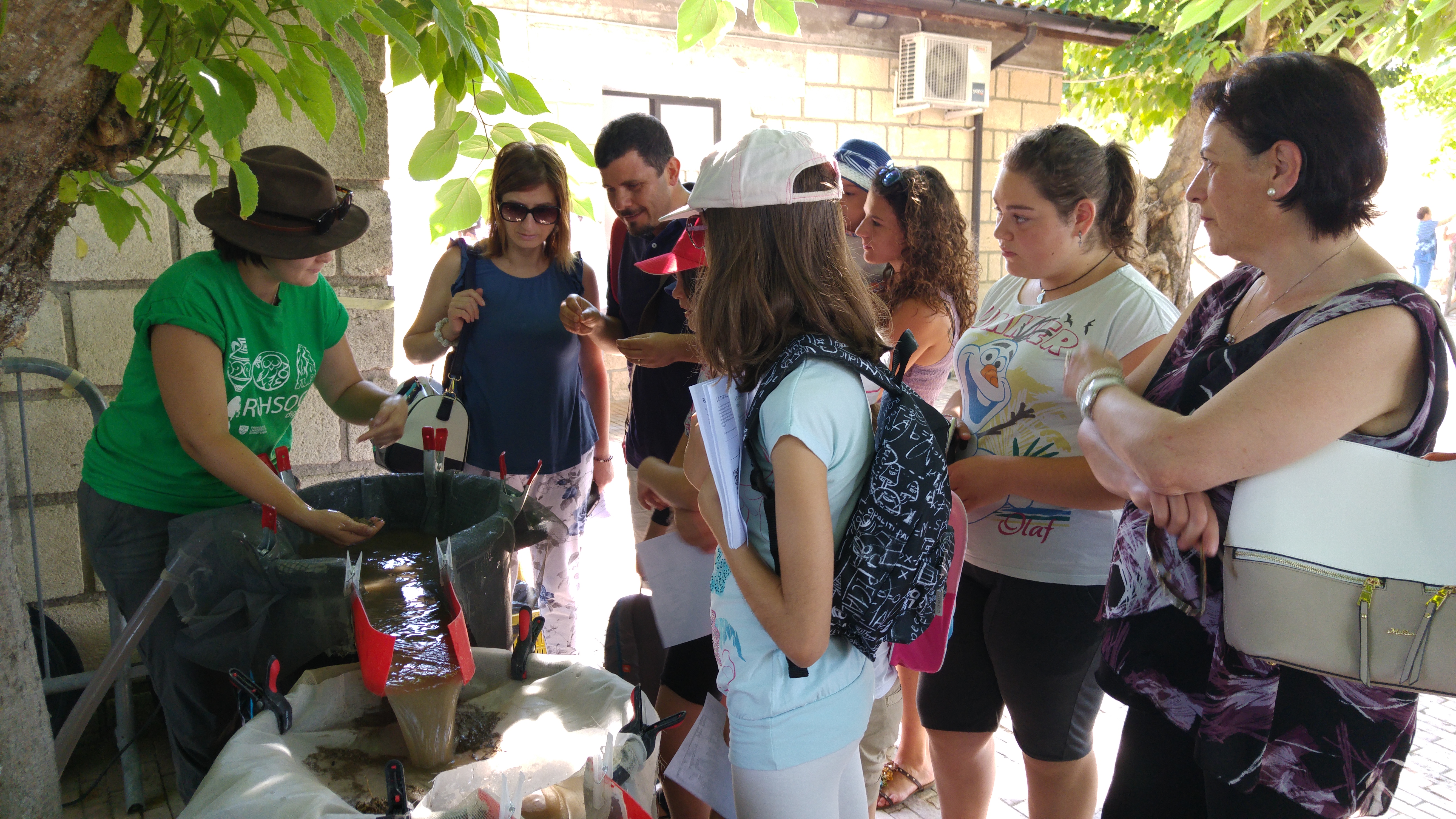
Alex Slucky, in green, describes flotation to visitors
What was fascinating to see was, regardless of gender or age, the participants connected immediately with the activities and were very hands-on.
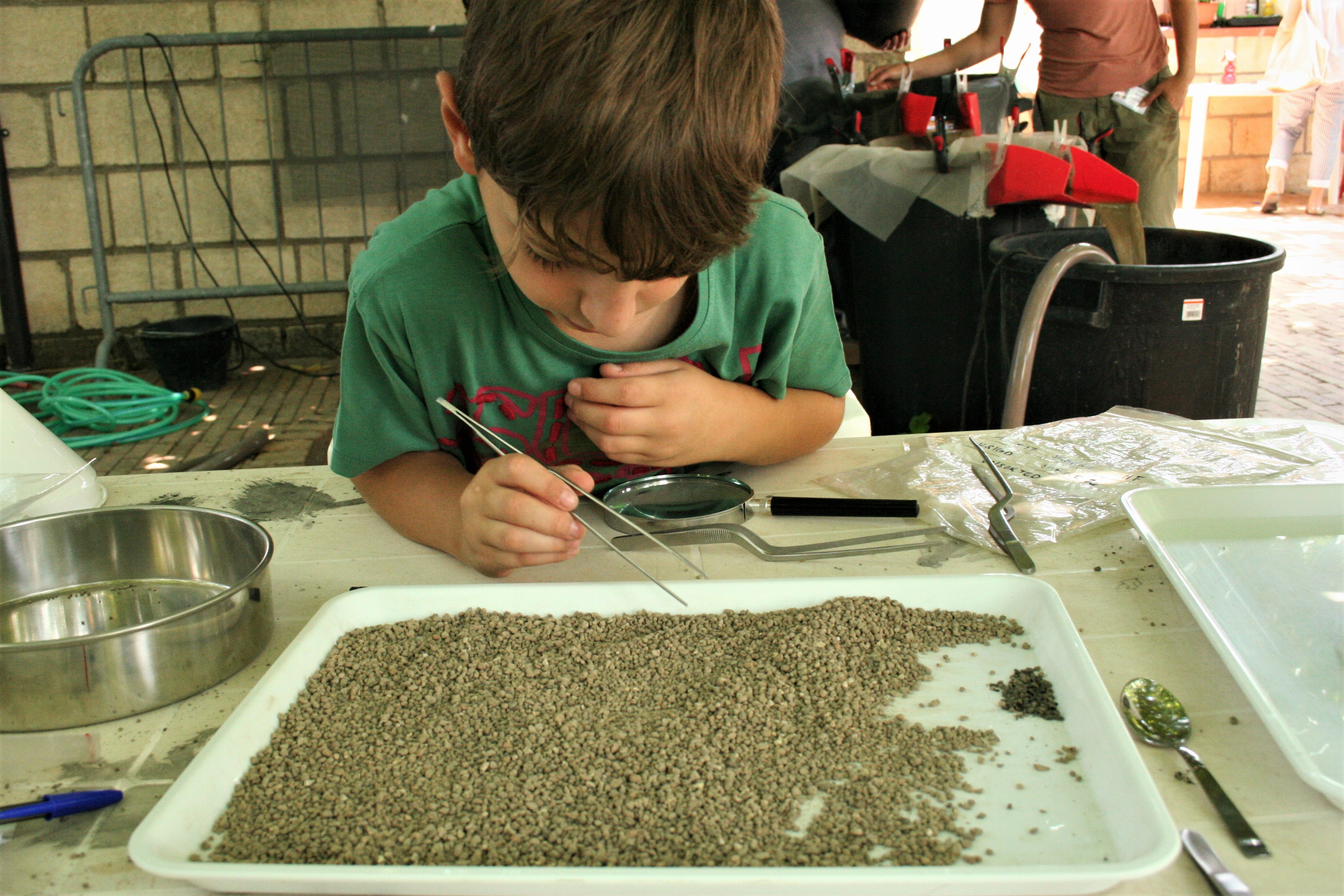
This young archaeologist skillfully picked through dried flotation specimens looking for seeds!
Encouraged to explore several facets of the work, they became quite empowered and very good at spotting the elements they were tasked to find.
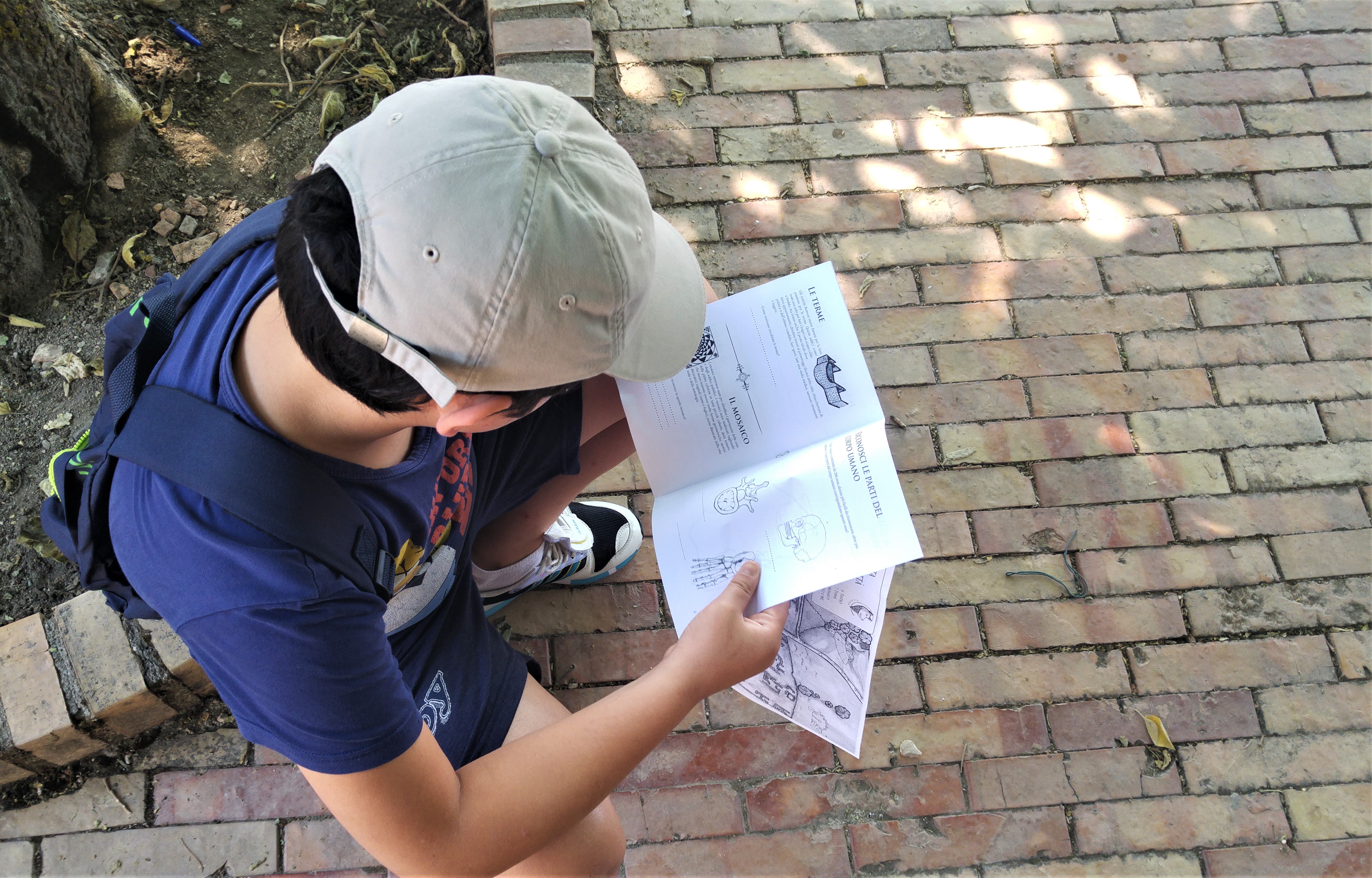
Even students less comfortable speaking in Italian found a myriad of ways to communicate practices, like flotation, pottery washing and excavation. Games that had gone from brainstorm to reality in 30 days were a huge hit with the kids.
The activity book which they could take home was a big hit with kids and parents.
What we were able to produce for our first event was only the tip of the iceberg. Several energetic students volunteered their time this year, and hopefully we will be seeing them again next year to continue developing this programme. Custom made stamps for the Open Day, each relating to a particular area of Archaeology.
What is happening next?With the conclusion of the excavation, there was a lot of momentum to continue developing the educational and public engagement materials. There are several engagement events upcoming in Italy, helmed by Dr. Girolamo Ferdinando De Simone, which may result in some exciting possibilities for collaborative projects with local companies and schools.
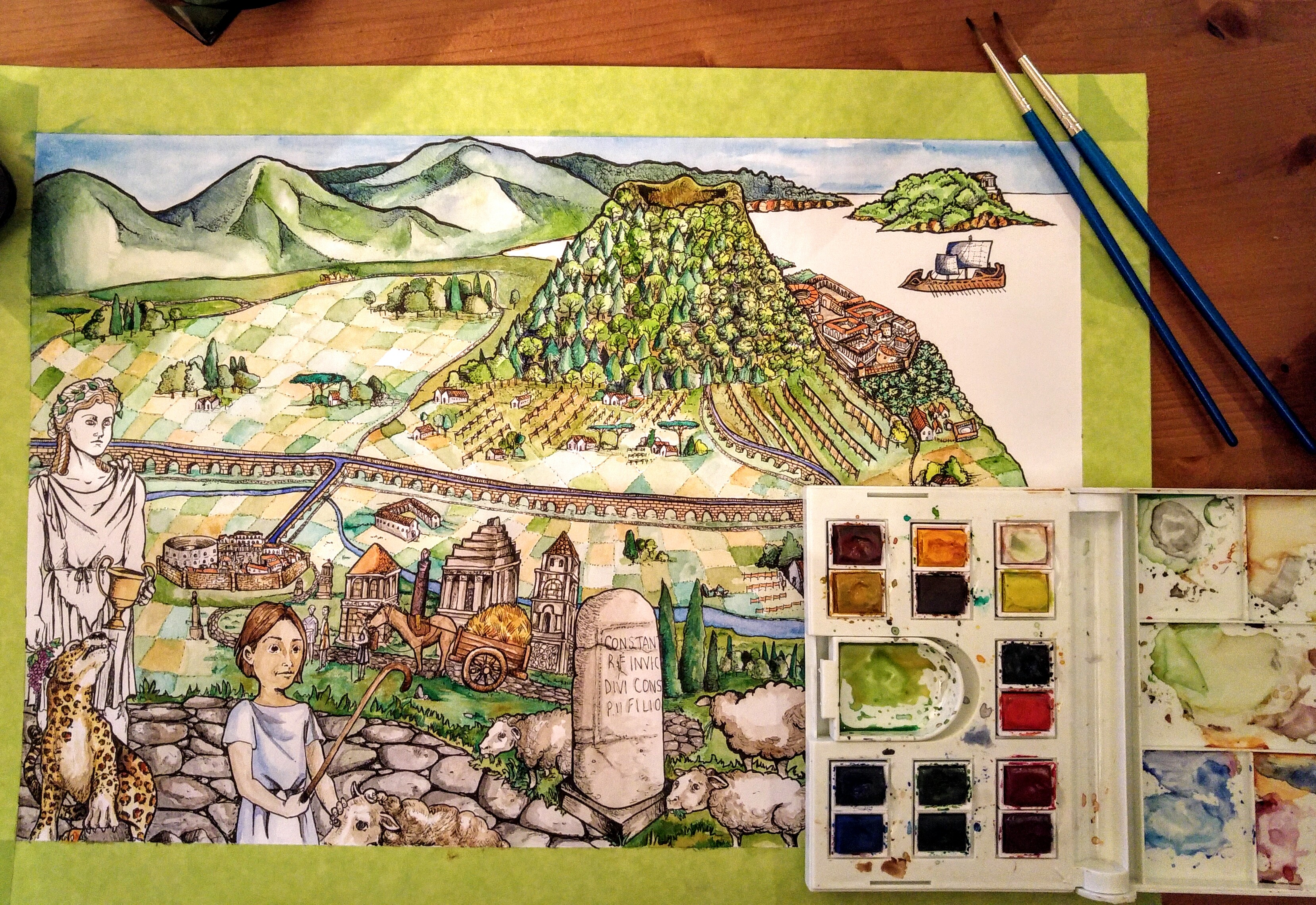
The dark side of VesuviusWorking in collaboration with Dr. De Simone, on a vibrant image of the communities and natural environment of the north slope, is one piece of the puzzle in developing visual aids to better understand the context of the area during the Roman period. Visualizing the presence of roads, rivers and settlements in the shadow of Vesuvius, shines a light on the areas that have been largely ignored. By creating these new materials, hopefully it will paint a more complete picture of the region and how interconnected the communities were.
What is next?The idea of connecting young and old to the history of their region, leaving more knowledge behind than you take away, and continuing to build on the foundations each year going forward, is the approach that I am taking from this year and will bring forward into future seasons. There is much to do and as many approaches as can be imagined.
“I divided the earth from the heaven. I showed the paths of the stars. I ordered the course of the sun and the moon”. (Kyme Aretalogy in honour of Isis)
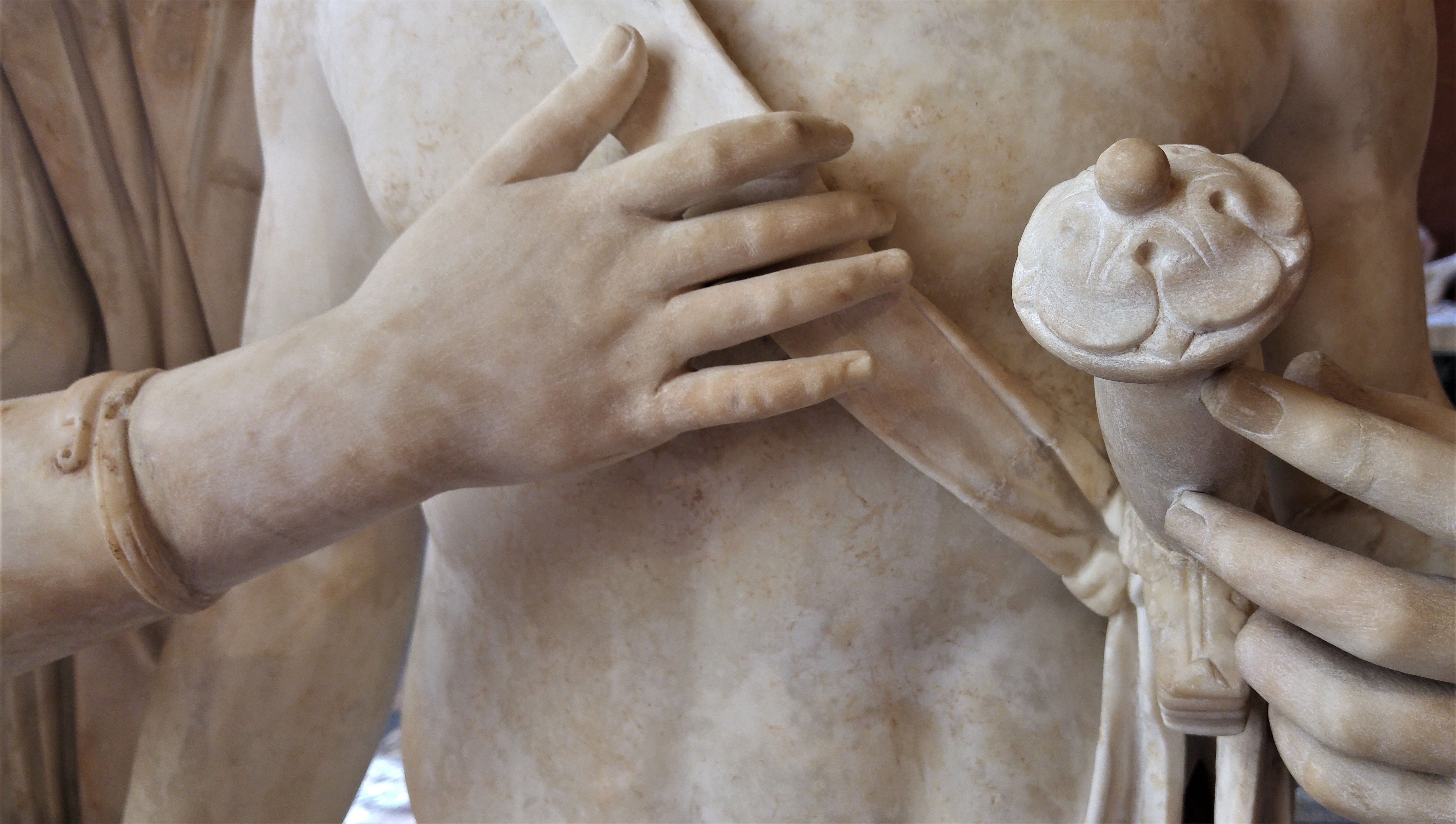
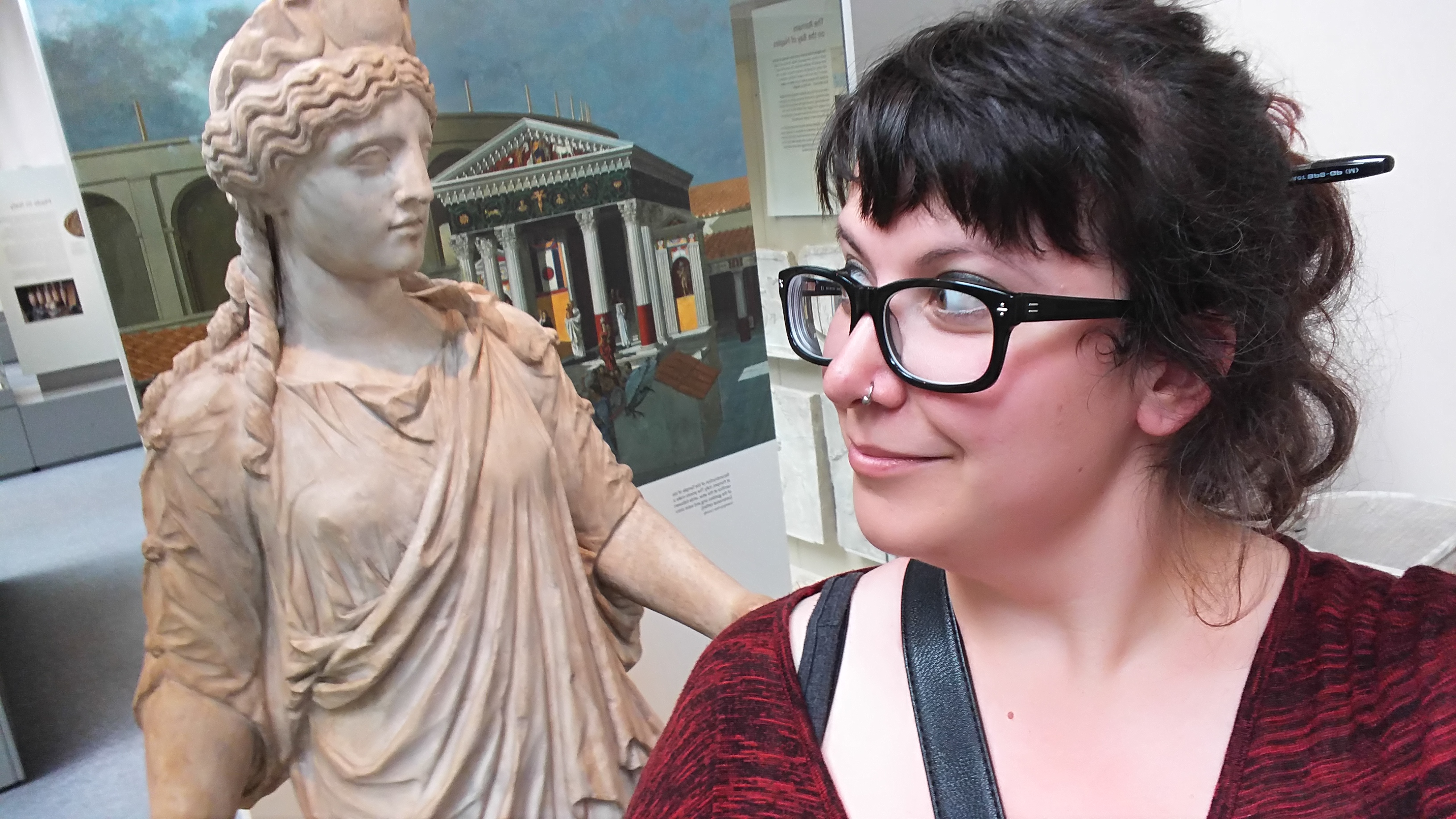
Since backpacking in Europe in 2001, I have been drawn to images and archaeological sites relating to Isis. There are some things that just strike the right chord for you. My first experience with Isis (in a Greco-Roman style) was at the Capitoline Museum in Rome.
Capitoline Isis, Rome (2014).
The statue fit my understanding of what classical sculpture was, and simultaneously had something a bit unusual. The features were so exquisitely carved, and the goddess’s accoutrements were unlike anything I had seen before. While visiting Pompeii during the same trip, I didn’t quite make the connection between the figure in the statue that I’d seen in Rome and the temple in which I had been standing.
During my undergraduate studies, I came across her again while reading Lucian’s ‘Metamorphosis (The Golden Ass)’. My attention was drawn to the way that Lucian described the power of this mysterious foreign goddess. What was so brash about Lucian’s novel was how much he subtly revealed, through winks and nods, about the mystery cult. He described esoteric celebrations, events and magical healing, all the while saying, ‘but it’s a secret, so I can’t really talk about it’. The story is familiar, in a Shakespearean kind of way, through all the hubris, metamorphoses, changes of fortune, and bawdy humour.
Isis-Thermoutis, Musee des Beaux Arts, Lyon (2017).
I was fascinated by this religious movement and how it functioned within the religiously pluralistic Roman society. Isis and her cult would ultimately provide some of the foundation of early Christian practices such as baptism, in addition to the depictions with Horus (the infant nursing on her lap is a dead ringer for the baby Jesus), presaging the metamorphosis into the Virgin Mary.
Isis (holding the snake) and Io (sitting atop the shoulders of the personified Nile) wall painting, Museo Nazionale Napoli (2014).
Jumping in with both feet, I was excited and wanted to understand more about this deity. However, my introduction to the topic began at a much later point in the history of the Cult of Isis; to understand the cult and its significance, I would need to go farther back and approach it more broadly.My Masters at the University of Edinburgh was spent exploring the Greek and Hellenistic routes of the cult, from multiple angles, to start filling in the picture (and creating many of my own pictures).
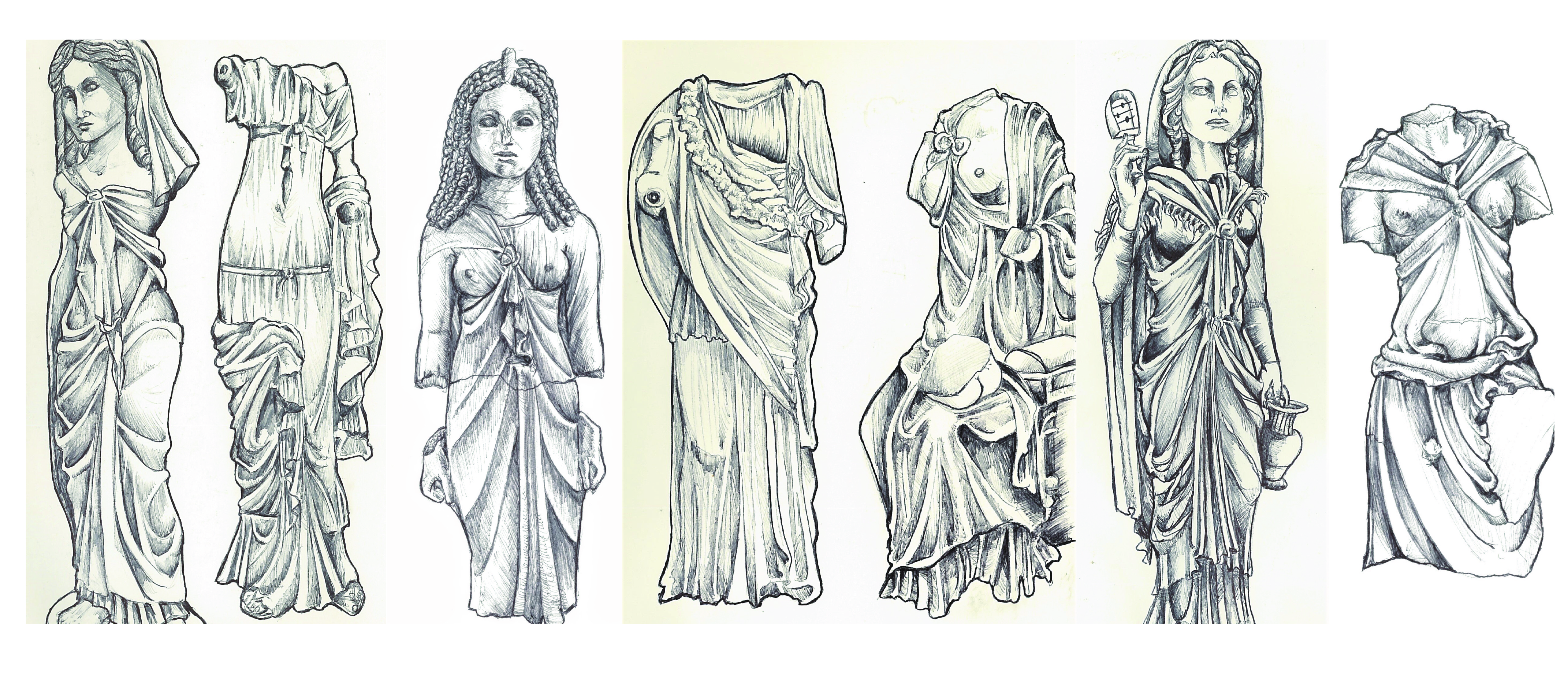
Some of my sketches of Isis statues over the last 4 years.
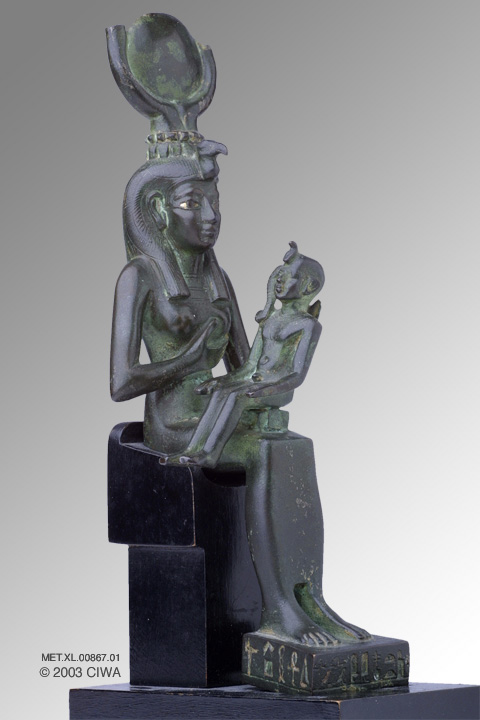
Isis’s power as a deity in Egypt rested in being the wife of Osiris and mother of Horus. She bridged the continuity of kingship from one king to his descendant. Her original function as the literal and symbolic role – as the throne and king-maker in Ancient Egypt – changes quite dramatically once the cult is exported into Greece and Italy.
Isis cradling Horus – from the MET archives.
While the period of Isis worship in the pre-Hellenistic era (before 323 BCE) is interesting, what has captivated me more specifically is what happens with the cult in the Hellenistic-to-Roman period. Like a character from Sailor Moon, she gained many headdresses, wands, tools, and visual associations with other deities (Demeter, Aphrodite, Athena, Nike).
This is the period that I focused on during my MSc, researching the symbols and iconography over time, with an emphasis on the tiny figurines used in her worship. What I discovered was that her strength was in her flexibility. Her image could be adapted to all needs, wants and interests. She could be a local or international deity. She could be closely affiliated with a particular ruling dynasty, or one specific location.
Another investigation looked at the cult’s relationship with Athenian government in Delos, and some of the territorial quarrels that occurred between temples run by different factions on the island. The evidence of a push and pull scenario between Delos’ new overlords (the Athenians) and the previous residents, in the mid-second century BCE. Running cults was big business and politically useful to establishing ones career, and the Athenians had no interest in allowing an Alexandrian ‘Egyptian’ to maintain a monopoly on the worship of Isis in this economically powerful port.
While few temples of Isis remain in even remotely good shape, Pompeii possesses on of the most famous examples.
Temple of Isis and her #1 fan, Pompeii (2016).
Pompeii had one of the best-preserved temples (though most of the decorations were long since removed and put in museums). It was fascinating to see the spread of Egyptian-looking artefacts which tend to denote cult membership. The items that were recovered from Pompeii are varied and showed decorations and materials of incredibly high quality that were made for, and used by, the Temple of Isis.
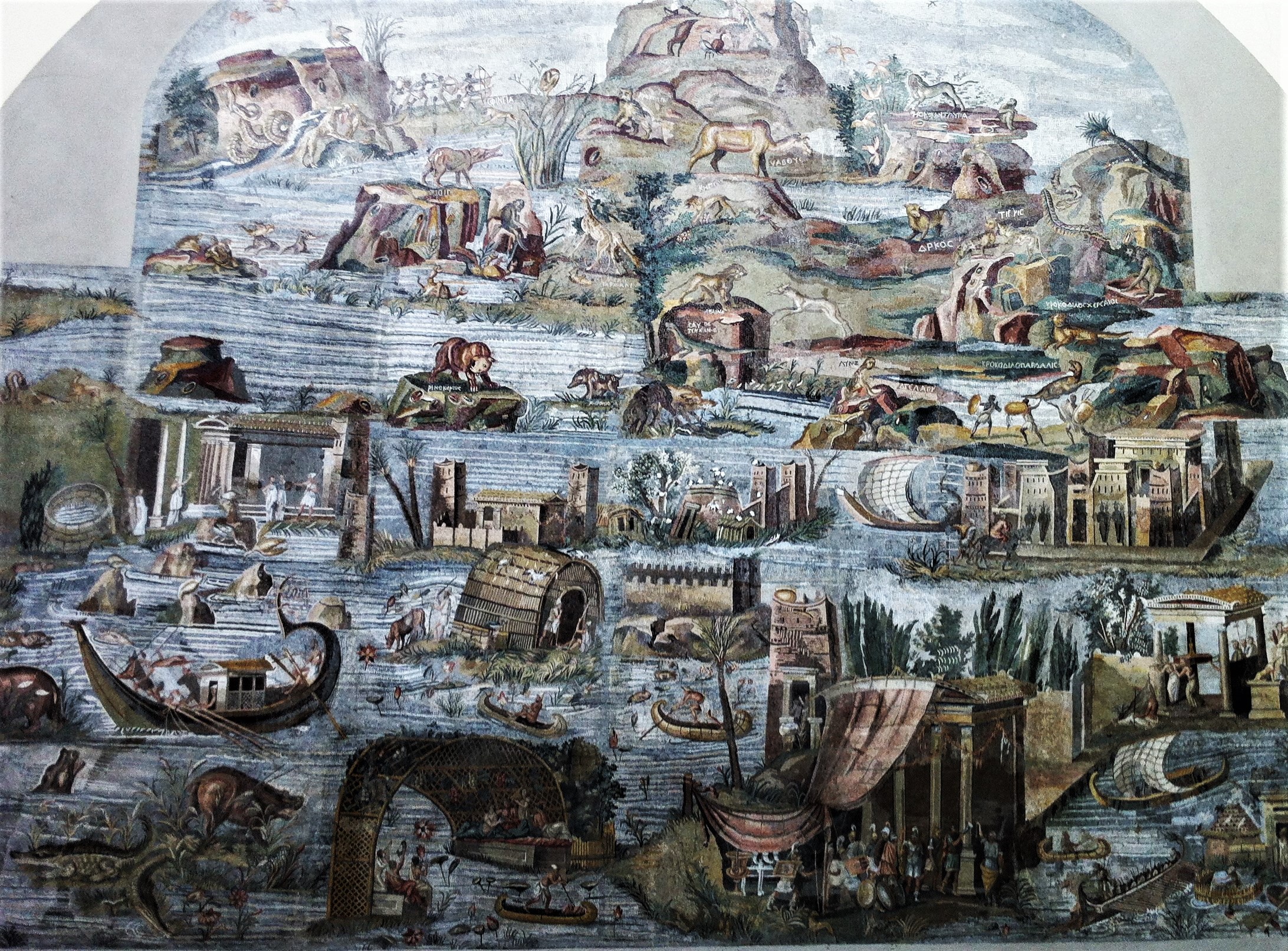
Another leg of the journey in my first large research project involved a trip to Palestrina (ancient Praeneste), some 40 km east of Rome. Part of what I wanted to see was the Egyptian artefacts, which remain some of the most exquisite examples of mosaic work from ancient history.
The Nile Mosaic of Palestrina, Italy (2014).
The Nile Mosaic of Palestrina was breath-taking in person and represented an interesting fusion of culture and appropriation of the Hellenistic Alexandrians and the native Egyptians. Although it is an uneven cultural balance, with the prioritising of the Macedonian elite over the native Egyptians.
It is a rare gem of the exquisite mosaic work that was part of art market in Italy, before the Rome dominated the Mediterranean. It highlighted aspects of Egyptian cult which would find its way into Italy, though altered for Italian tastes.
This September I will be stepping into the subject and delving deeper into urban design, Egyptian architecture and the art styles that appear in Roman cities. There are so many aspects and angles to investigate with this topic, and being able to work on a PhD toward this end is like a dream come true. There are still so many sites, statues, and sistrums to see in my journey into my studies of this Cult of Isis!
There is something breathtaking about the shores, mountains and harbours around Lesbos. Mithymna is a gem of a town, with all the fine features you hope for as a tourist destination, but a significant amount of history is embedded in every corner. As one of the largest Greek islands, and the nearest to Turkey, there is a remarkable amount of cultural fusion and warmth that shaped my experience of living in Mithymna (Μήθυμνα / Molyvos) for several months, some years ago.
Taking a libation at the Mithymna castle.
While being housed during the spring months in Mithymna, I explored the winding cobblestone streets, photographed dangling flowering plants and occasionally sampled the vibrant restaurant scene at the harbour.
Mithymna harbour
These elements, along with adorable roaming stray cats and dogs (some of whom we adopted), formed idyllic scenes that made it a beautiful and tranquil location to study some Byzantine History and Reception Studies (in effect, the study of modern interpretations of the ancient world) during my undergraduate degree.
A charming painting in the old schoolhouse where we took lessons.
What a draw for a historian!Like many ancient city centres, Mithymna has a foundation story whose characters possessed the very names of the location – in this case, Mithymna (daughter of a mythical son of the god Helios) who was married to the personification of Lesbos. Hard to prove, so I’ll take the Oxford Dictionary of the Classical World’s word for it.
Mithymna Castle
The history of Mithymna is actually the stuff of legends, literally. The Bronze Age warrior Achilles was said to have breached the fortifications of Mithymna due to the amorous machinations of King Peisidikis’s daughter.
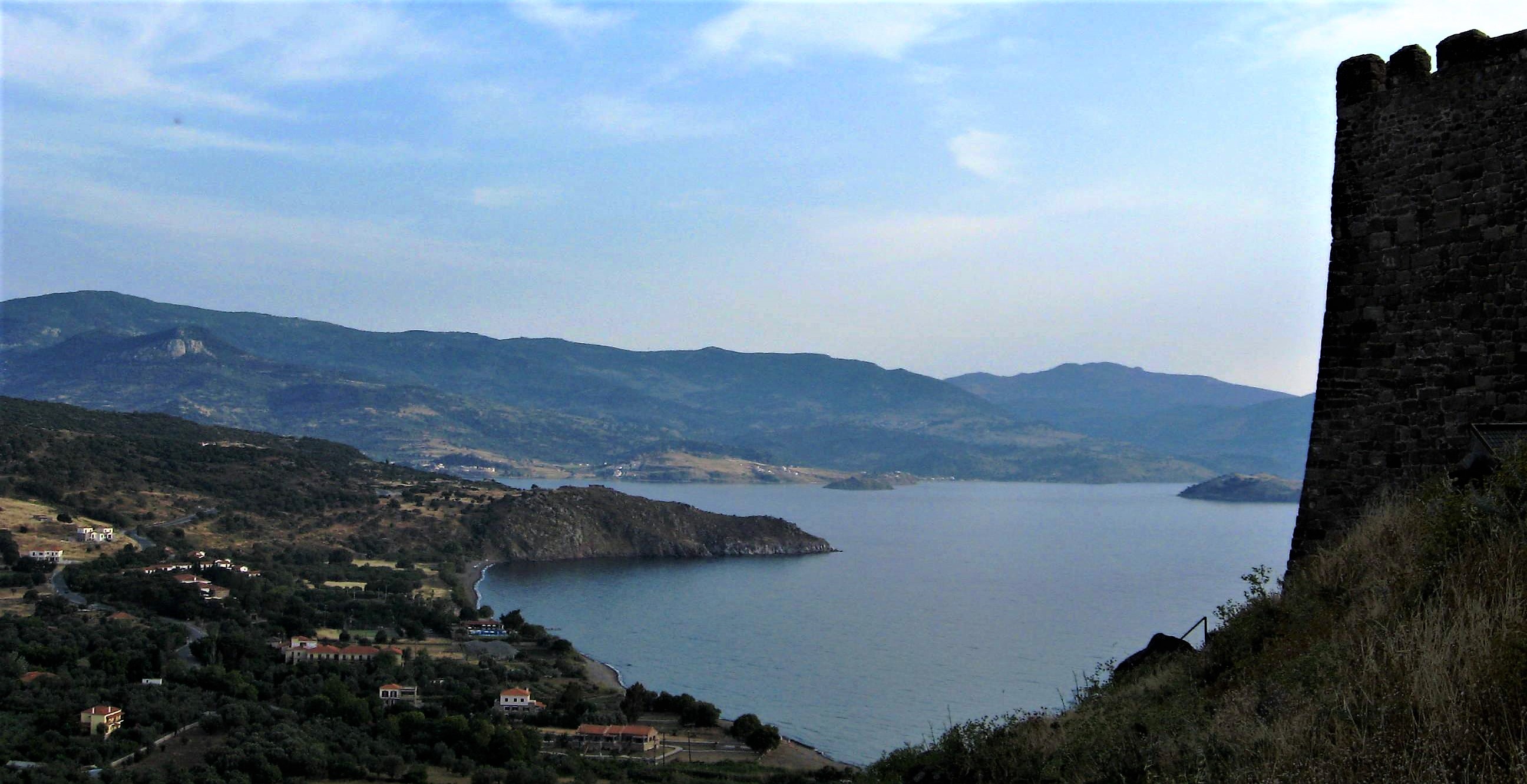
View from Mithymna castle of Efthalou.
The city fell to the Achaeans, as the events of the Illiad take place not far away across the water (you can see Turkey from the shores of Mithymna).
Mithymna had been an important location in the Classical period as it was caught between the Athenians, their ally, and the Spartans throughout the Peloponnesian War (431 – 404 BCE). To and fro, the balance of power shifted from Athens to Sparta, and back again throughout the war; and smaller allied cities were caught in the fight, or served as proxies for the conflict. Mithymna and Mytilene had a solid rivalry throughout this conflict and beyond, which I will go into when I post about Mytilene. But for the time being, some dark business went down during this three decades long war, and Mithymna and Mytilene had some serious issues to work out afterwards.
Splendid isolation on the beach
Remaining significant throughout the Hellenistic period, Mithymna played politics as it was captured by Macedonian forces and Persians, with tyrants ousting and aligning themselves with the conflicting superpowers when they gained control of the island cities. With the division of Alexander’s brief empire by his successors, King Lysimachus and later Ptolemy would control the island. With the influence of the Ptolemaic ruler, my academic obsession, the cults of Isis and Sarapis were introduced and worshiped.
Which brings us neatly to the Roman period.
A bit of Roman road and tomb.
Sprinting through so much history, I can barely touch on how many fascinating moments in ancient history in which Mithymna has played a part, but one of the elements which leaves a physical trace, which I was thrilled to see, was the Roman archaeological remains dispersed throughout the city.The formal alliance between Rome and Mithymna was dated by an epigraphic source to 129 BCE. The Roman poets and writers spent many words to describe the quality and superiority of Mithymnian wines.
While staying in Mithymna, I was fortunate enough to meet a local archaeologist who gave us a small tour of the closed excavation.
Finds from this trench were rich in pottery and sea shells.
At that point, they had a great deal of pottery and many interesting rubbish dumps from the Roman period. It appeared that they were producing pottery, and likely distributing the wines in vessels made at this centre.With the political upheaval in the 5th century AD of the western half of the Roman empire, Lesbos fell into the orbit of political authority from the Byzantine power-base of the eastern empire. This orientation affected the flavour and practices on the island as Christianity became the prevalent belief system and religious power throughout the empire. Thank you for reading my blog!
For the last few months I have taken a hiatus from writing my blog to focus on applying for a PhD at the University of St. Andrews. What a harrowing adventure! From start to finish, it was a good 3-month process with dozens of re-writes, stress and the agonizing wait to hear back. Even starting early, and following advice from friends and online, there were so many unknowns going into it. There were many moments of self-doubt, which had the uncanny ability to creep in when I needed it the least. With the support of some amazing teachers, mentors and friends, I managed to get someone interested in the incredibly nerdy stuff I love – Roman Aegyptiaca. In a post coming soon I will write about what that is, but for now…I will be studying Egyptian-looking things in Roman cities.
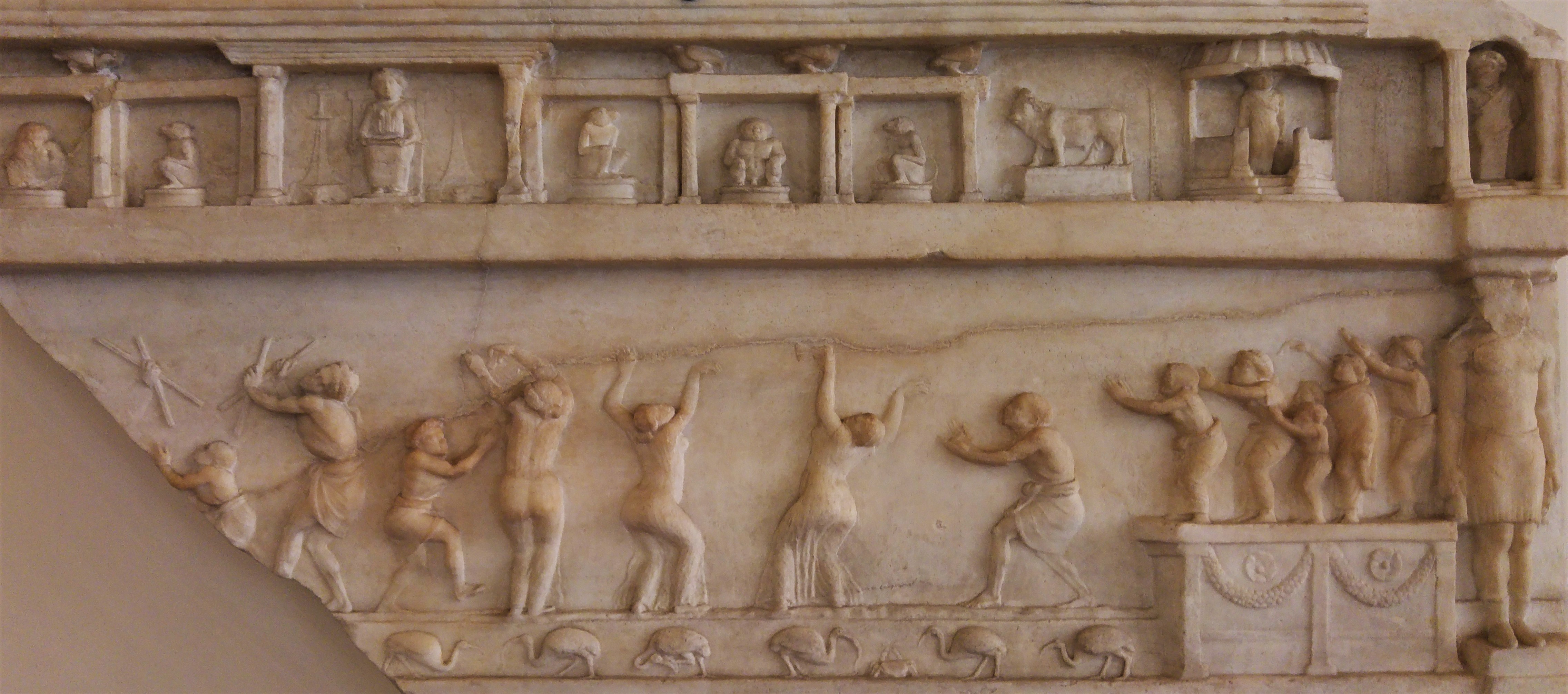
Khoiak Procession from the Nile Mosaic of Palestrina, Italy (2014)
While the outcome might seem straightforward, (person X likes (topic), studies Y = goes on to PhD) the path is rarely as clear as this. An interesting part of the curation on social media, is all of the crap that you don’t want people to see can easily be ignored, not reported or underplayed. I focus and emphasize the things that I am most proud of, that arguably demonstrate a clear connection to my goals and objectives. It’s not always a conscious choice, but it excites me to share upcoming adventures (research trips, excavation work, conferences etc), and even if those activities are the exception to fairly humdrum periods of time, I try focus on the positive and engaging elements in my life. That curation presents a deceptively well-planned and linear pathway however.
Roman road excavation. Merida, Spain (2014)
Like many people in the ‘millennial’ category, I have taken a strange circuitous route to finding a path. For many years I was uncertain what it was I wanted to do, or how I would even get there. My professional or academic shortcomings would emerge when I contemplated pursuing any concrete direction. Supporting myself through school involved things that looked remarkably unrelated: Italian train information CSR, custom picture framer, freelance artist, call centre CSR, book and video store sales person, maternity store sales clerk, telecommunications CSR, office administrator for an engineering firm, work-study intern with a museum, housing assistant, university credit secretary, repairs assistant, catering delivery driver, and endless amounts of ‘exposure’ work (free) and side-hustle to get through.
‘Work for exposure? Oh can I?’ Roman wind chime. Merida, Spain (2014)
Despite working in areas that for many would happily suffice as a career, I have always been half in and half out. Every work placement is an opportunity to learn useful skills, but nothing had any real resonance to me or inducement to stay long term. I always had an eye to what might be ahead and to apply to any and every opportunity, often ending comfortable employment for a scrambling uncertainty.
Egyptian relief. Louvre, Paris (2016)
Sure, I love ancient history, archaeology and art…but what can I really do with all this?
Throughout all of that, I knew I wanted to spend my life studying and sharing aspects of ancient history through art and writing, but unsure as to what my mixed-bag of skills would allow me to do. When I drew all of my work experience, hobbies and passions together a picture emerged that put the question to rest: I want to be an educator of Ancient History. Fundamental to this was attaining a PhD, and getting more focused and industry specific work experience.
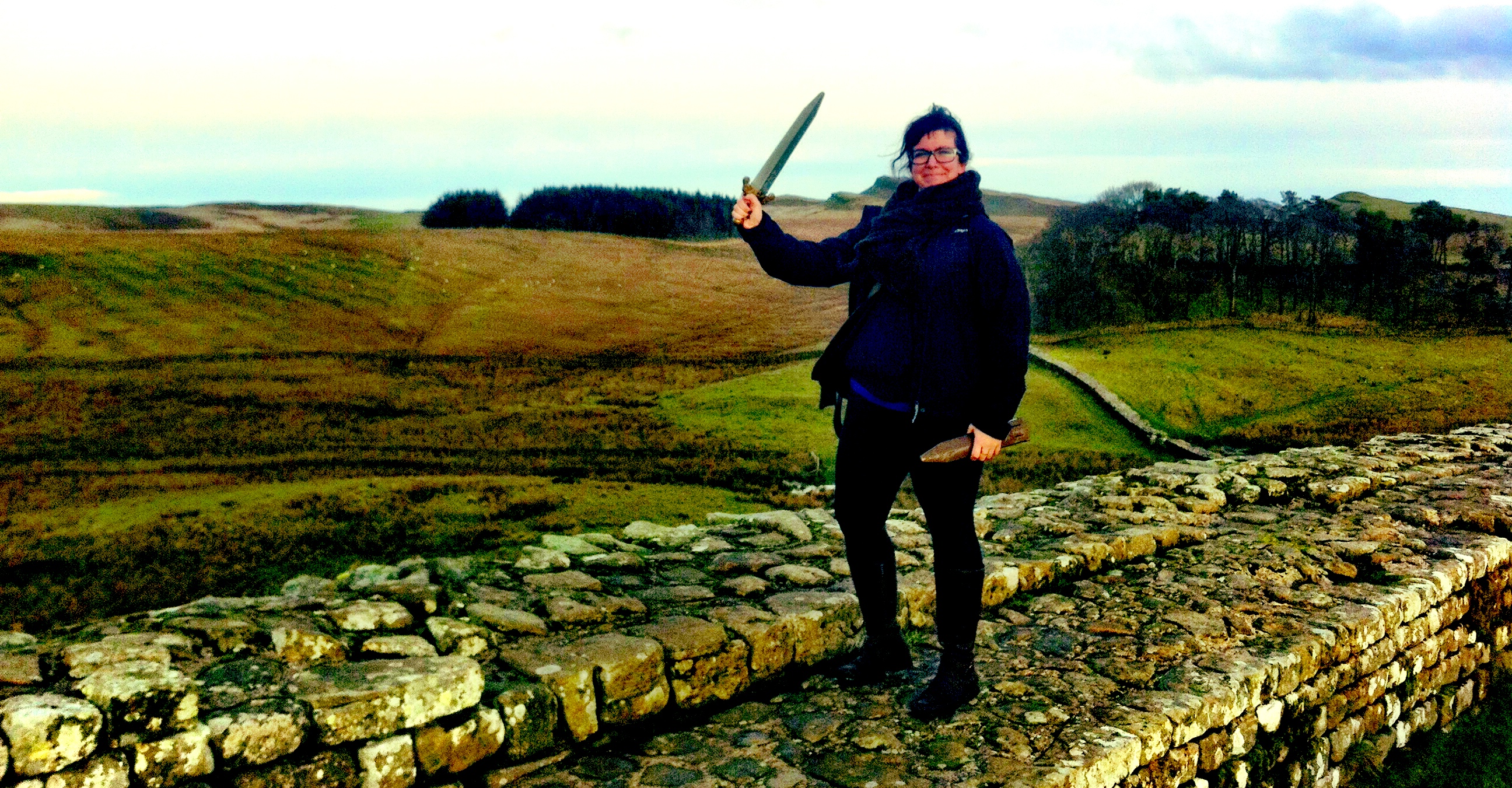
See? So much time spent on ancient walls. Hadrian’s Wall, England (2013)
Having been accepted to St. Andrews, I now have several months to plan and prepare – skills my varied work experience has hammered into me. Much of the existential angst of ‘what will I do and where will I be next?’ can finally be put to rest for the next few years. With the patchwork of experience that has sustained me, now behind, I look forward with more clarity and focus.








 There is a fine art to going to see art. Nothing makes you unhappier faster than being
 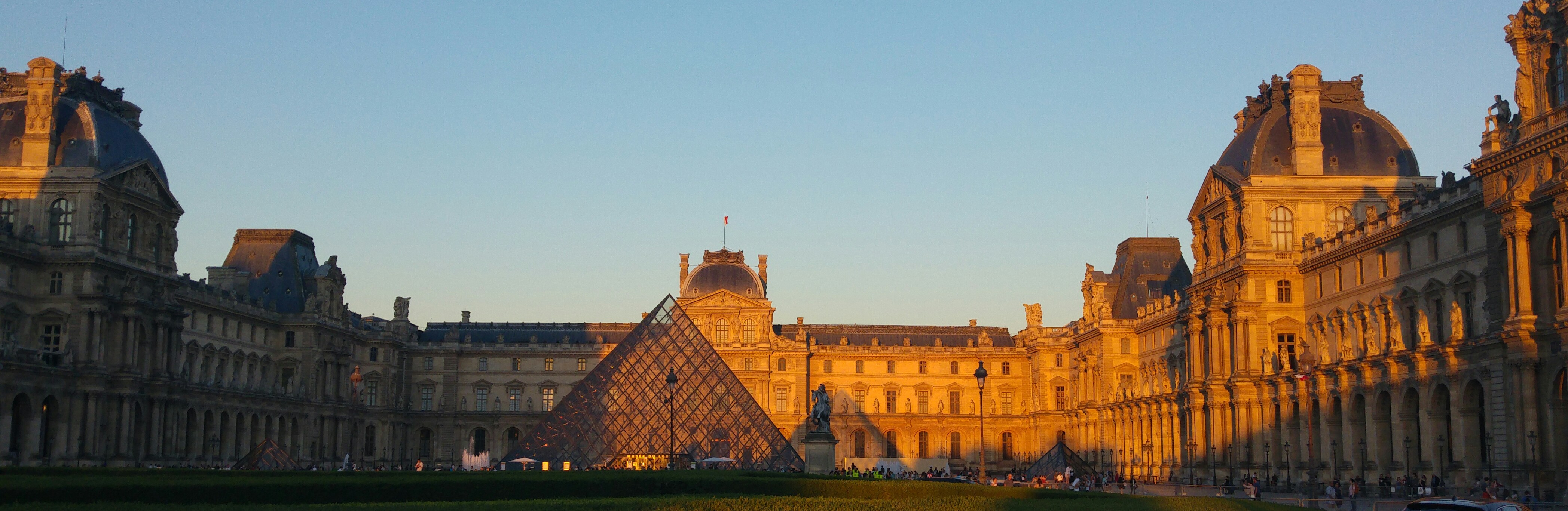 I know what you are thinking; OBVIOUSLY you will be going to the Louvre. However, you will never see everything in the louvre, so don’t try. Rather, pick two themes that interest you; Greco-Roman statues and Near Eastern pre-historic art? Tapestries and Medieval painting? Sure, you may not see every highlight, but by focusing on things you are interested in versus what you ‘should’ be seeing, you will likely enjoy it more.
 For relatively more modern pieces of art, the impressionist painting collection of d’Orsay and Orangerie are worth the visit. If you’ve ever been curious to see the ‘L’Origine du monde’ (Origin of the World), now is your chance! If you are lucky enough, there might be some performance art happening there during your visit! Both buildings are gorgeous, and worthwhile for a visit.
  Places for good eats:
  For me, nothing says going to Paris like staring at some Aegyptiaca. The big attractive Obelisk of Luxor and ornate fountains symmetrically placed at the center of Place de la Concorde, with Egyptian-styled decoration throughout the square is an interesting throwback to France’s imperial days. The site of execution of Louis XVI and Marie Antoinette, among many others. Surrounding crowds of jeering revolutionairies cramming into this space – briefly named ‘Place de la Révolution‘ during this period- is a viceral mental image of social and political upheaval to conjure.
 The museum de Cluny is full of art and artefacts from the Middle Ages, as you would expect from the name, but part of the treasure of this place is the building itself, built atop a Roman bath which you can see in the basement, the higgledy-piggledy building features of the exterior are sort of charming.
 The Pantheon feels as far away from its Roman predecessor as one could find; a monument to the civic spirit and fraternity of the famous French individuals. Once a church, a ruined abbey of Saint Genevieve, re-created by Louis XV in the mid-1700s. Interred within the Pantheon are the remains of Victor Hugo, Voltaire, Rousseau among others. There is something quite unique about such a ornate resting place for writers, philosophers and poets – secular heroes seldomly receive this type of hagiographic treatment.
 This area is great for wandering and grabbing a coffee and these sites are only 4 minutes walk from the Musée de Cluny. If nothing else, there is a famous macaron shop nearby which is worth the visit. Sweet treats near the Pantheon:
  The stairs leading up to Sacré-Cœur and the Montmartre are the devil. It is a beast to get up to the top, but don’t cheat and take the funicular. It’s good for you and will build character.
 The neighbourhood around the basilica is lovely and winding, with a large number of cafés and restaurants priced to keep the likes of me away. Atmospherically, it’s a an area with a relaxed vibe. There is often music floating around by street performers, interesting architecture and artisans with a plethora of stalls selling their paintings/prints. Stopping in at a café with a decent view, this is one of my favourite areas to sketch urban life scenes.
 Jumping on the a few metros and RER train out of town, visiting the Palace of Versailles is a pretty solid day trip. Built up from a swamp around his family’s hunting lodge, Louis XIV captured all of France’s nobility in his guilded cage of Versailles. Through elaborate specatcles to entertain them whilst there, and incredibly pedantic and restrictive court etiquette, Louis was gaslighting the French aristorcacy until they competed with eachother to help him put on his pants or use the toilet, as a sign of his favour.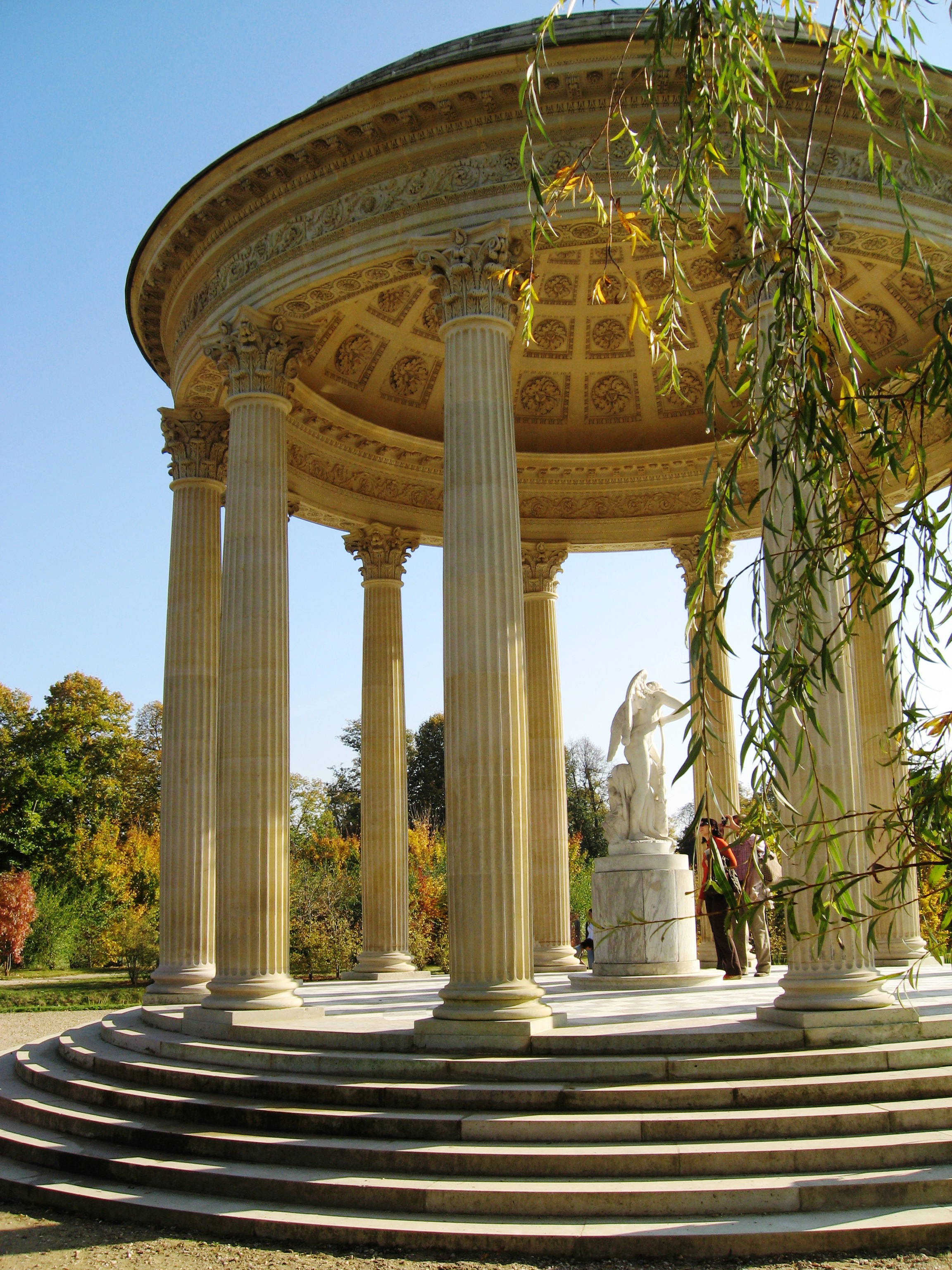
 A 40 minute ride on the RER, and you end up in the suburb of Saint-Germain-en-Lay, about 19 km west of Paris. There are nice gardens around the Château de Saint-Germain-en-Laye which house the archaeological collection, that offer a nice picnic space to nap post-Museum.

 The last 12 months have been eventful, with a lot of life changing things on the horizon to be excited about. In a few short days, I will be heading off for a third (more lengthy) season in the Roman town of Aeclanum, (near modern Mirabella Eclano, Italy). The last year was incredibly formative for me, as I was privileged enough to work on developing materials with the site directors of Aeclanum from the University of Edinburgh and the Apolline Project for public outreach for the Open Day, as well as ongoing learning materials for children to engage with archaeology in schools.The opportunities to share this work are blooming into new areas for me professionally with a lot of creative directions to pursue.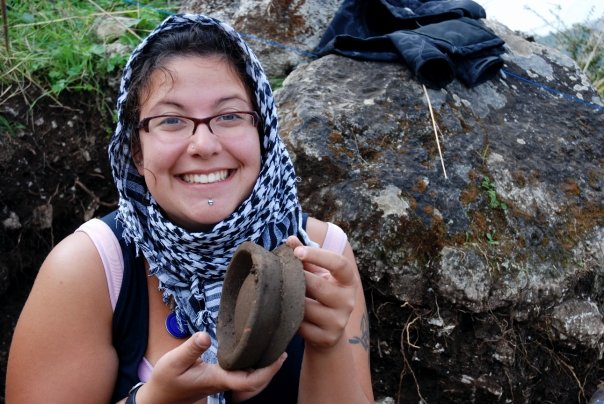

 The antiquity of the necropolis was evidenced through artefacts which represented multi-period usage on the site for burials, an ancient garbage dump (large amounts of broken pottery and animal bones), and fluted columns and architectural blocks from some unidentified building structure.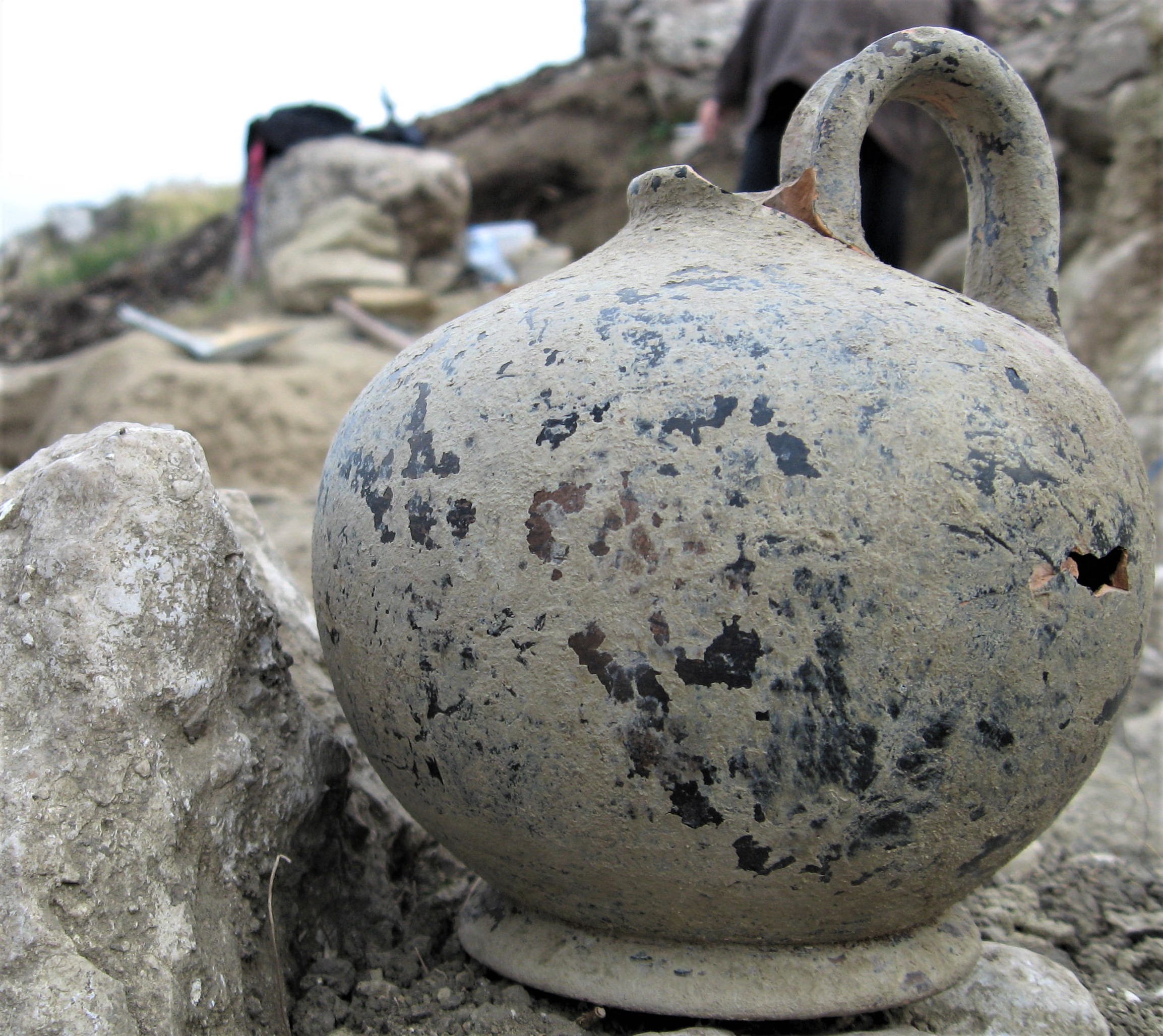
 The status of the publication of the finds from the dig is unknown to me, so to avoid getting in trouble, I have made a few artistic renderings of some of the standout artefacts:




 Suffice it to say, my time spent in Poros, Kefalonia, was fundamental in shaping the direction of my studies and career plans. While I have not been back since 2008, the richness in history, the warmth of the community and beauty of the island is still deeply felt. I am making plans to return and investigate the current findings of the area and reunite with the incredible people who made it such a memorable experience for me.


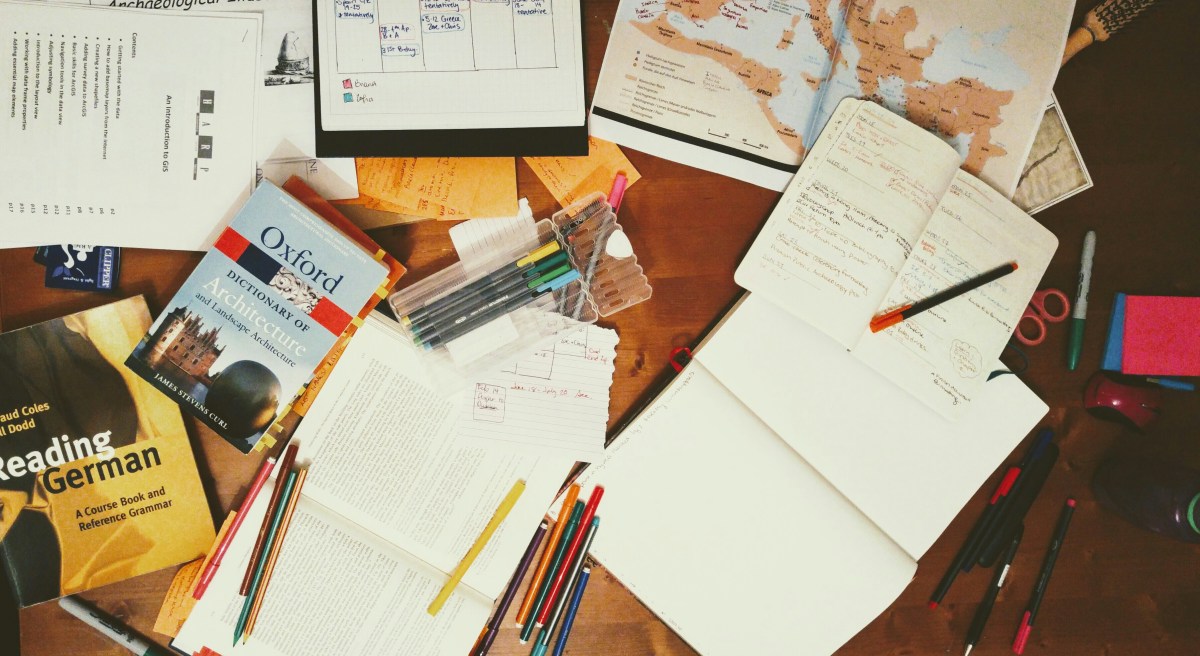
 Deciding to listen to the good advice I was given at the onset of embarking on my PhD, I opted to follow the rule: once you’ve submitted something substantial, take a week and decompress. That can mean many things of course. Understandably, long train rides and walking many miles might not be someone’s idea of decompression, but hey ho.
 1. Go Find Your Chill

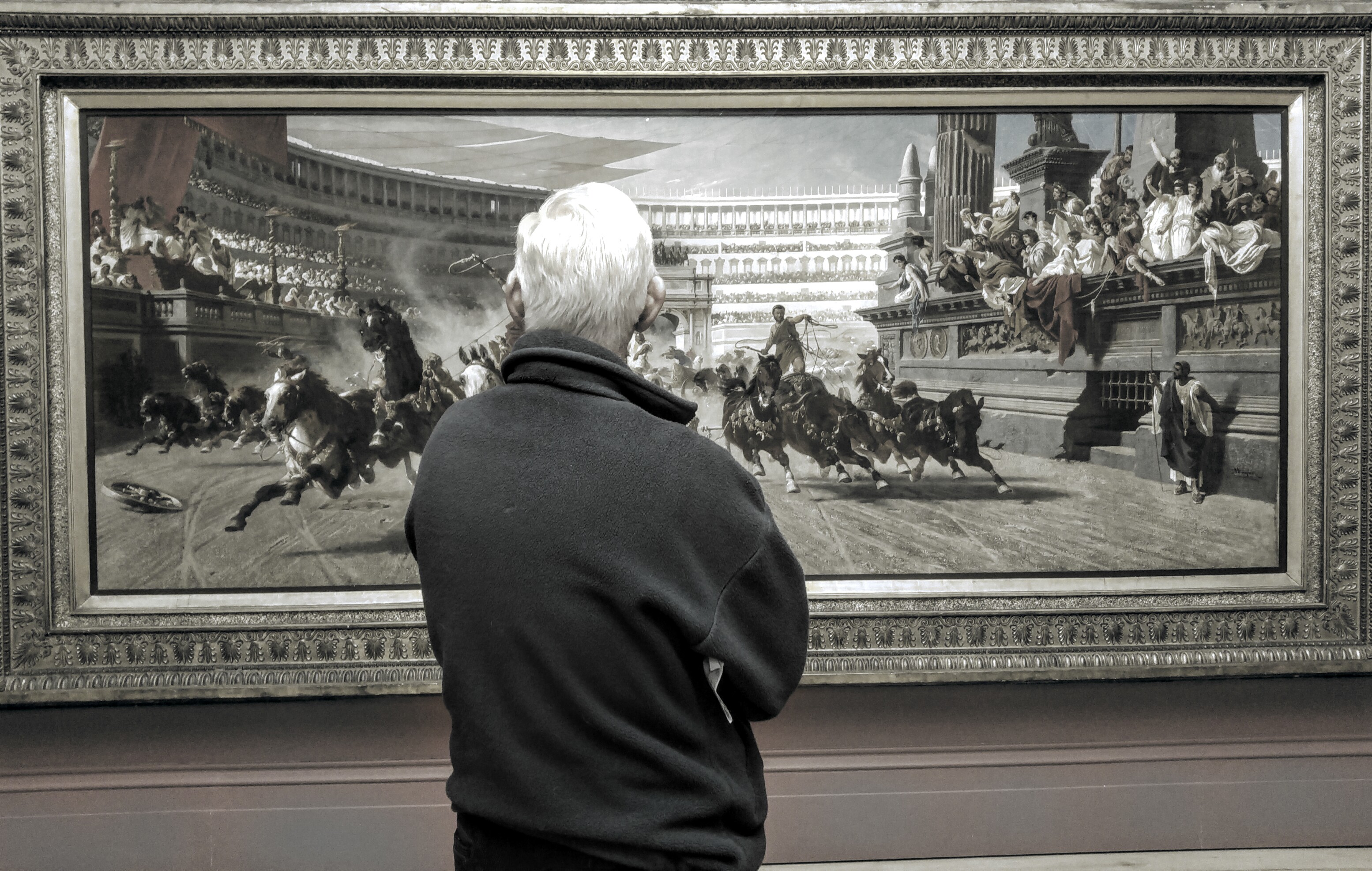 When needing to feel some inspiration, or just wanting a quiet space to draw, museums and galleries tend to be my preferred space to do so. Popping into the Manchester Art Gallery allowed me the rare privilege to see one of my favourite paintings in the flesh – Charles Auguste Mengin’s ‘Sappho’ – which was breath-taking and significantly larger than I’d imagined.
 The depth of the darkness in Sappho’s gown cannot be done justice with a digitized image, and the highlights looked iridescent in some spaces. Sappho, so often presented longingly and wistfully, is shown powerful, dark and mourning. Her angst and colour palette was a natural favourite for me in my high school goth years.
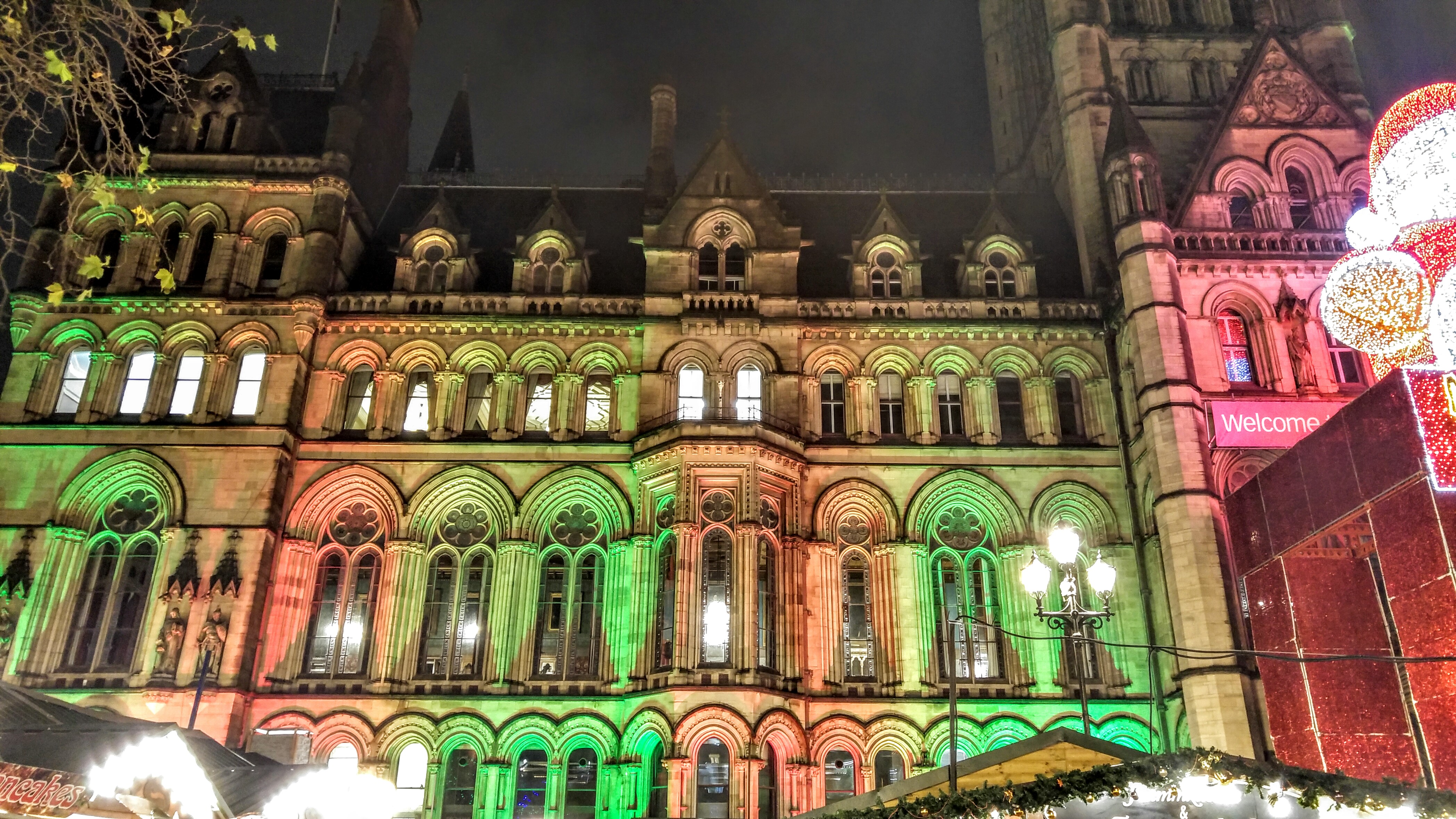 3. Nightime Walks and Christmas Markets
 While making me homesick, one of the perks of living in the United Kingdom is the on-point Christmas markets. The smells of meat, waffles and mulled wine were amazing. It required all the will-power I possessed not to buy adorable kitsch ceramics, and eat all the treats.
 Onward through town we went, eventually settling into a pub near the university. Ample political debates, methodological discussions and general nerdiness ensued.
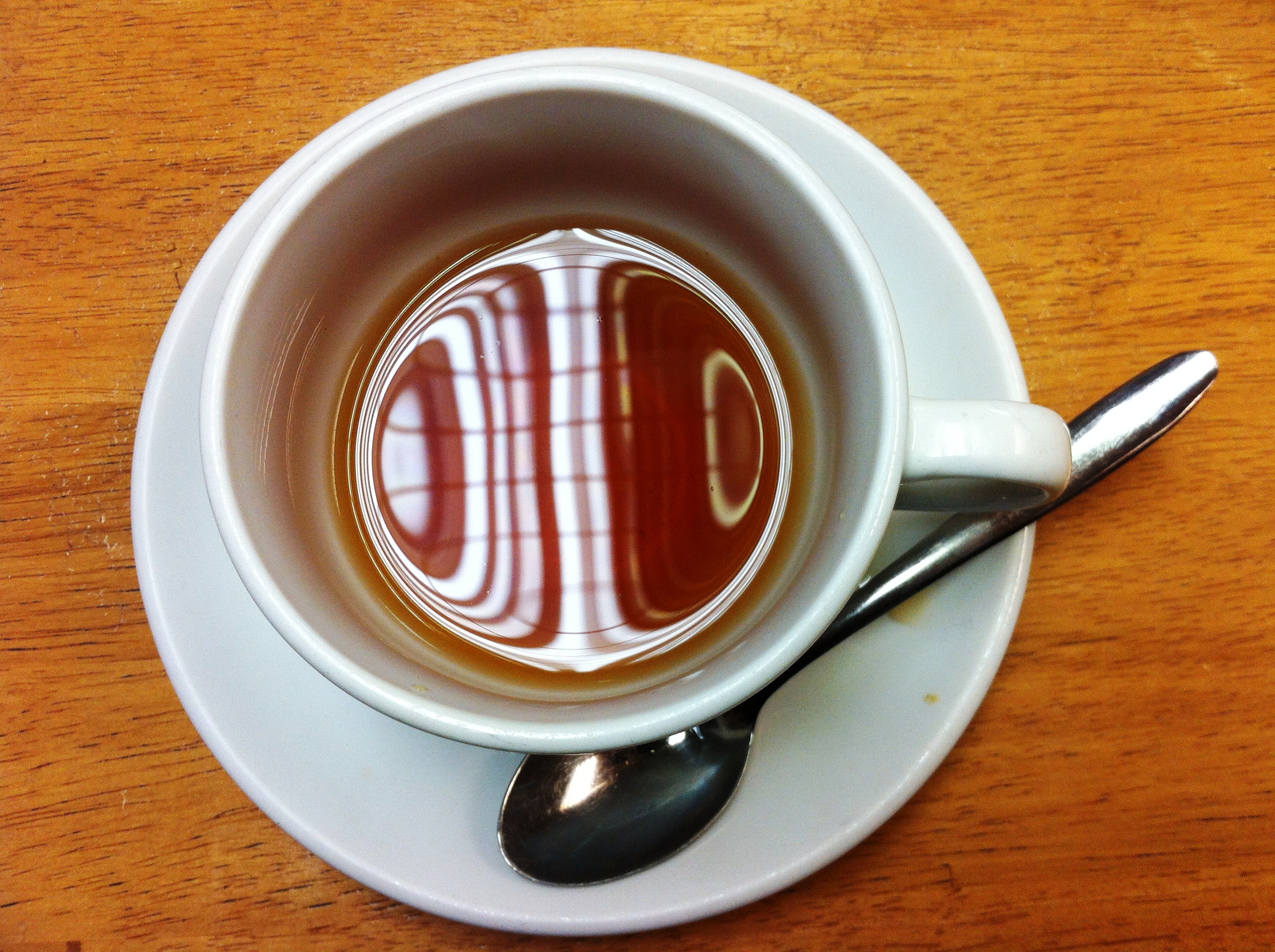 This might seem fairly obvious, but taking 30 minutes out of the day to have a leisurely coffee or popping into a print shop and finding Liam Gallagher greeting cards (nailed it, Manchester) is sometimes the treat you need to clear your head. It doesn’t have to be a big production, but leaving the to-go cup behind and just sitting in nice spaces with friends (or alone) is one of my favourite parts of a solo journey. Seldom do I plan a trip without packing as much as possible into the schedule, but trying it out this month was really rewarding and relaxing.
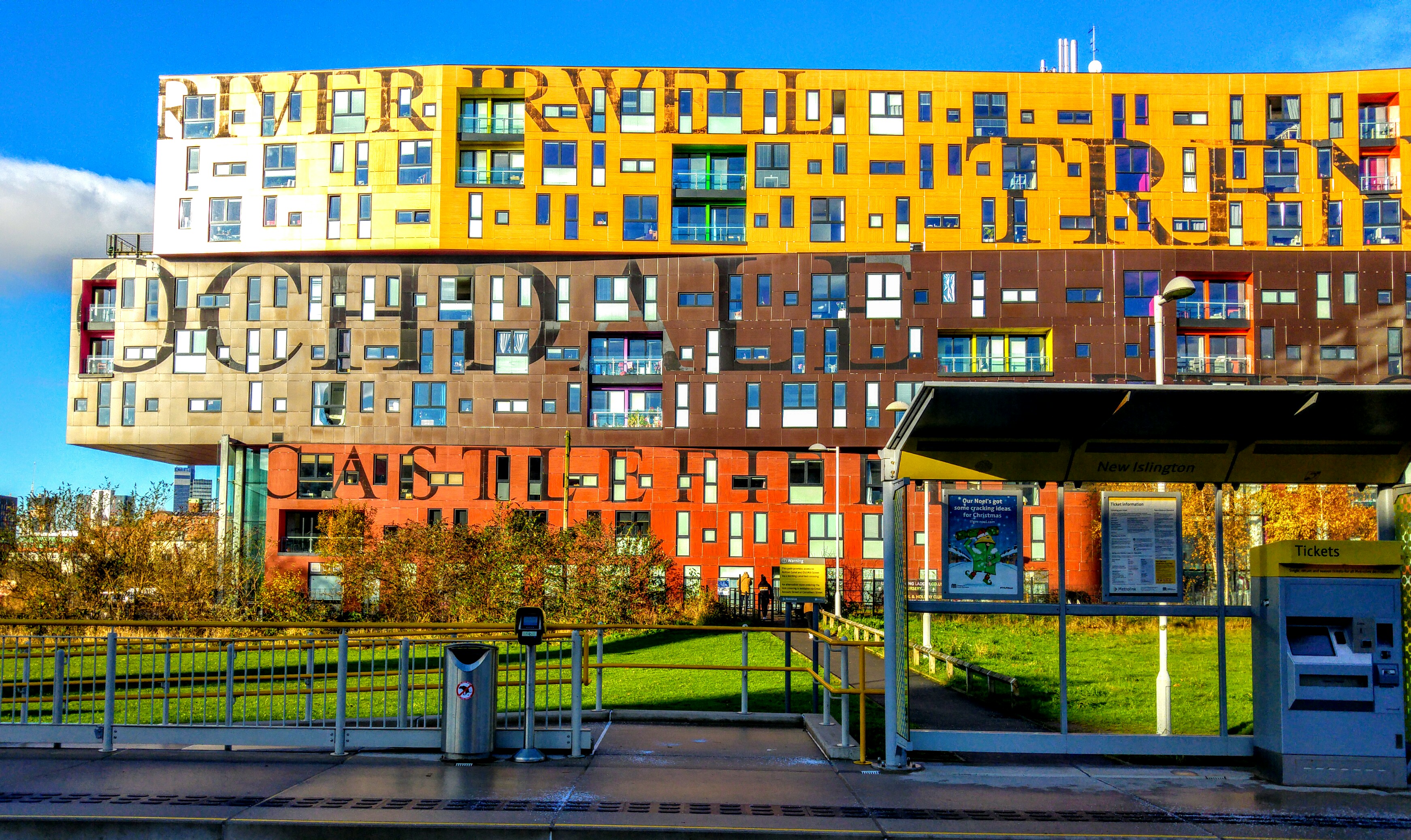 Taking stock and heading home, I was thoroughly impressed by the juxtaposition between new and old buildings in the city. There is a lot of effort to create dynamic visual landscapes, which living in the historic neighbourhoods of Edinburgh, I occasionally forget that skyscrapers, tower block flats and vivid colour are normal to see. Shaking off the last few weeks of 14+ hour work days, and stress that ate normal stress for breakfast, I definitely came back feeling more refreshed, and through that, optimistic. Though only a few days, it was a wonderful stop.
 Next stop: BRUSSELS! 48 hours later, my partner and I jumped on a plane and were en route to Eindhoven for a week


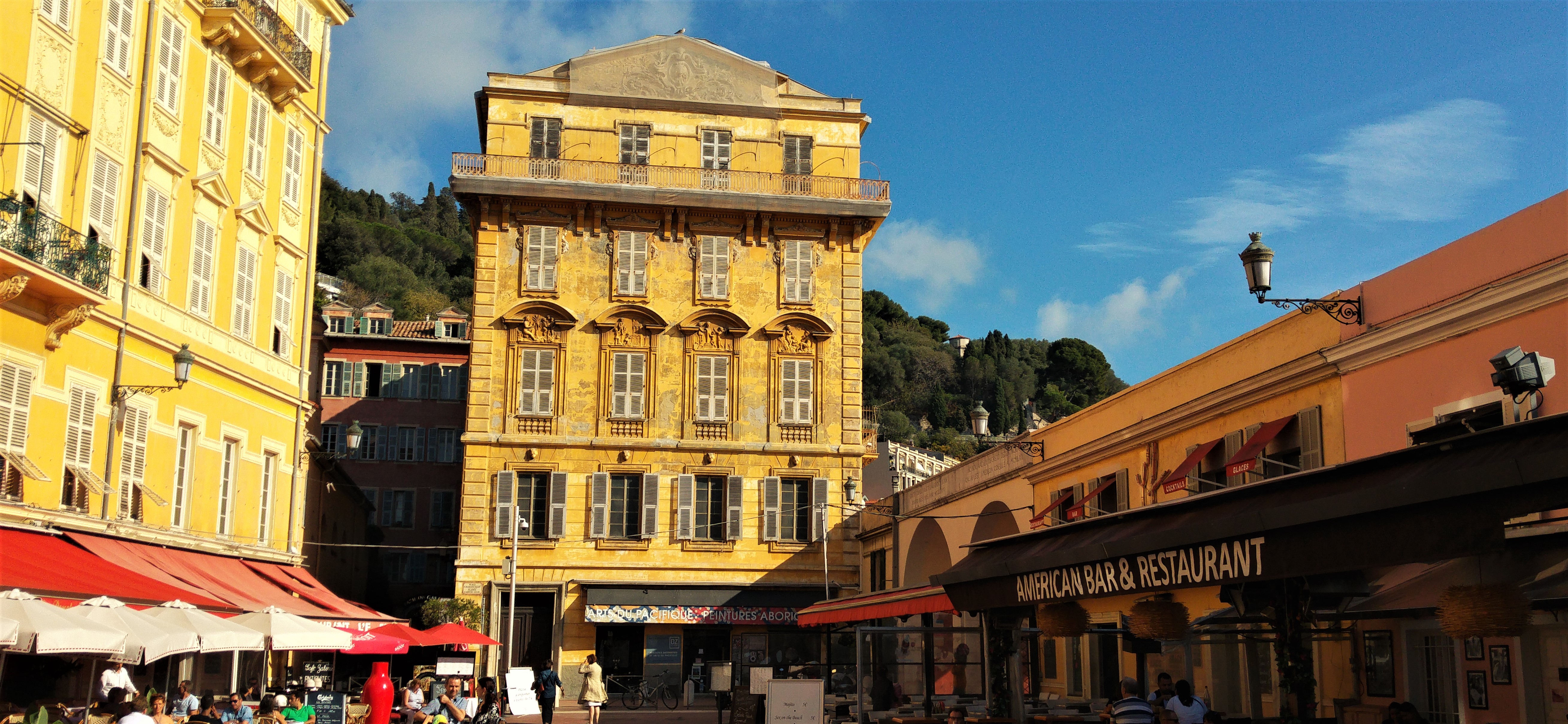 I wish I could say that I studiously read up on much of the history of Nice, but that would be a lie. We came for sun, beaches and the famous cuisine that characterize this gorgeous little spot of paradise.
 The open-air markets had spectacular varieties of sea salts and spices, with dried herbs and lavender filling the air in the narrow winding streets.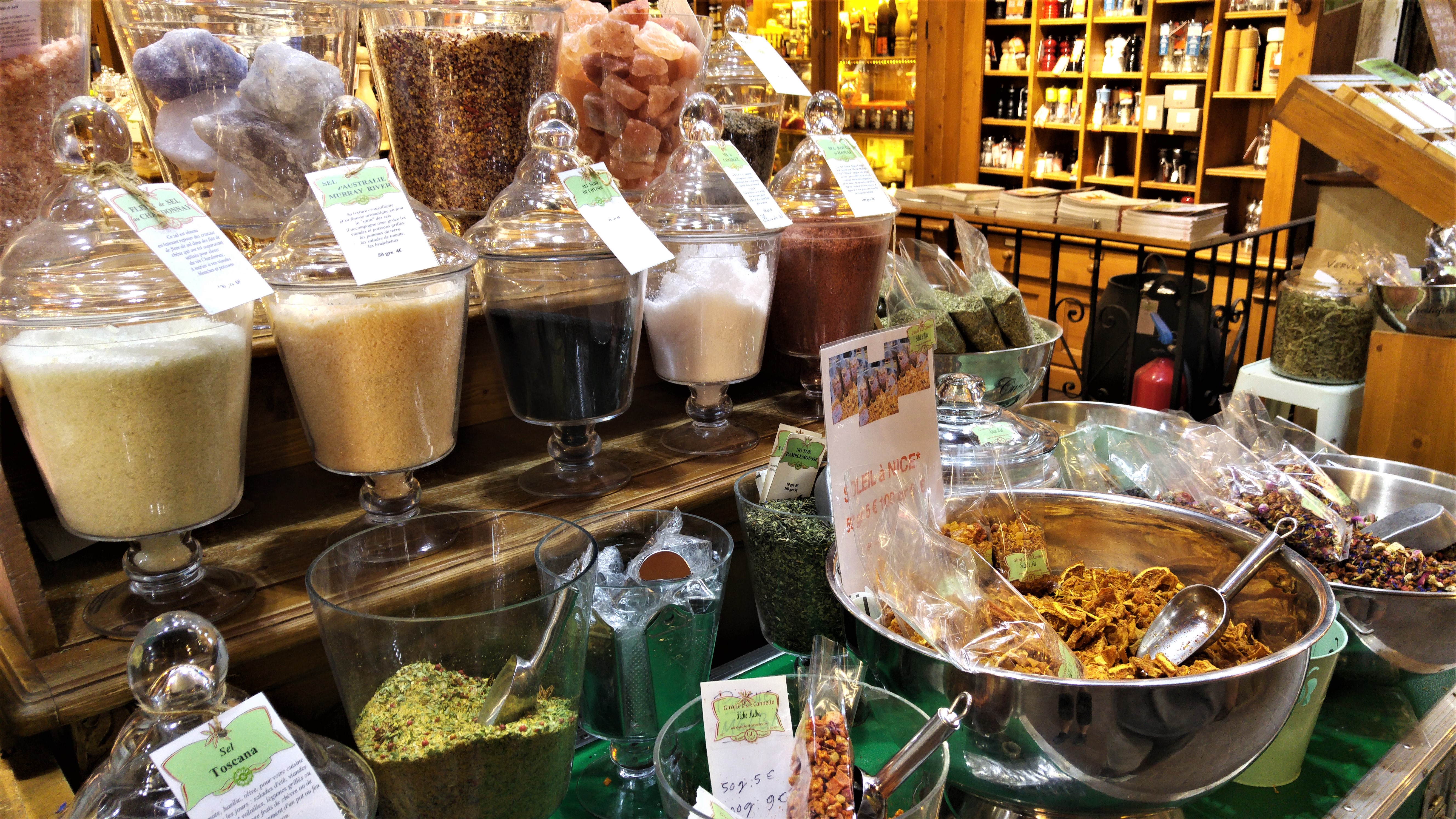





 I wrote a post in July for the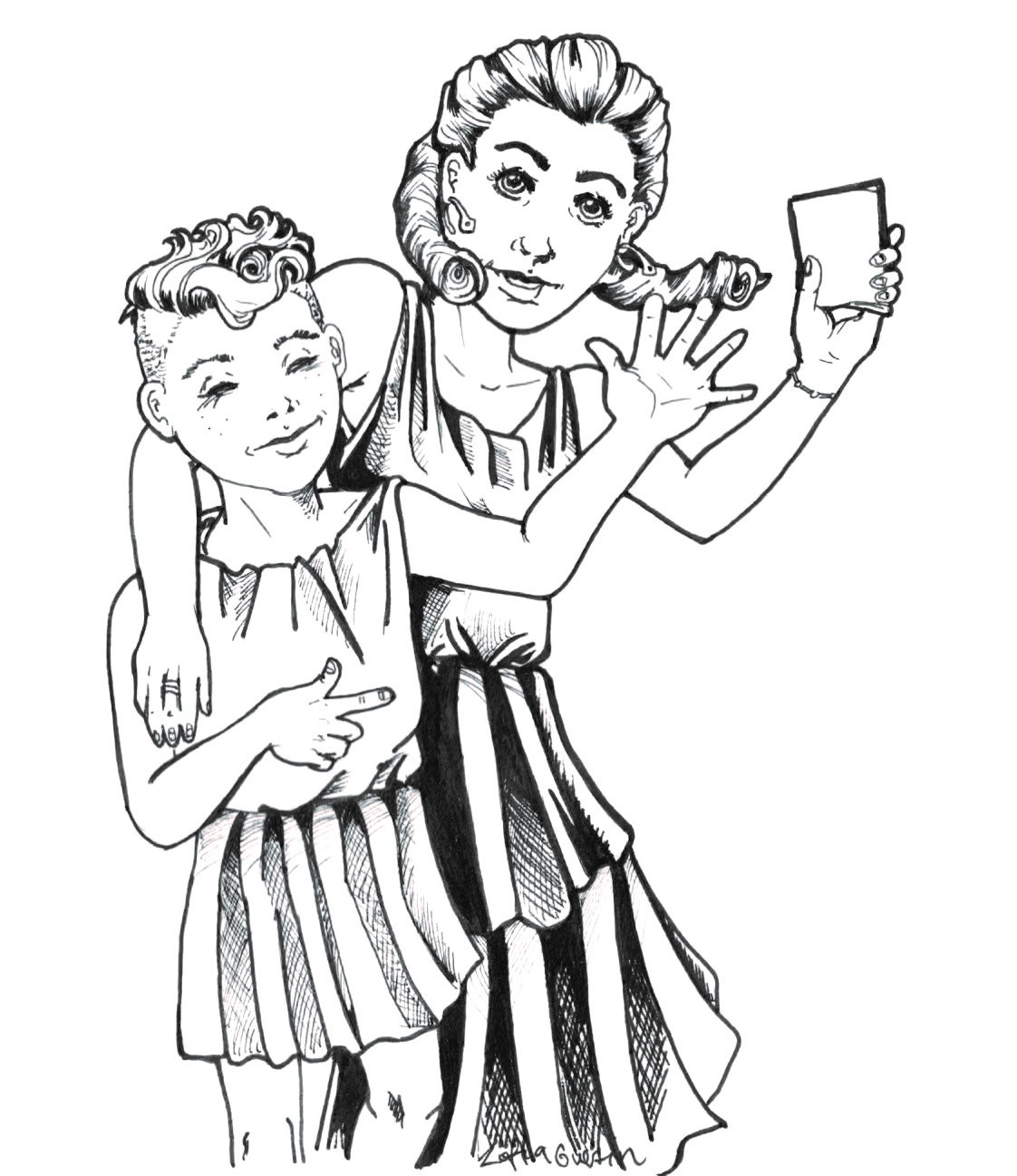
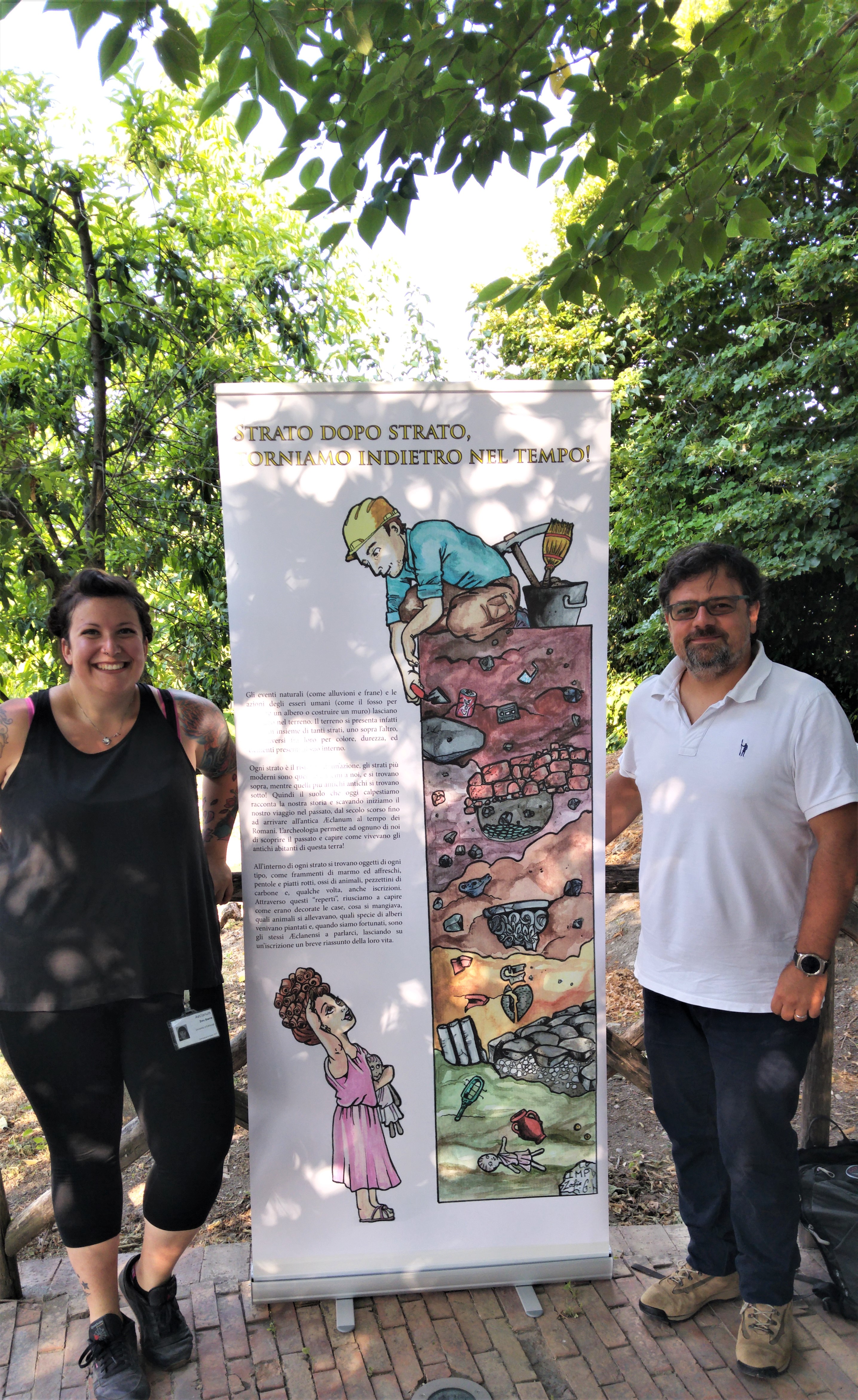
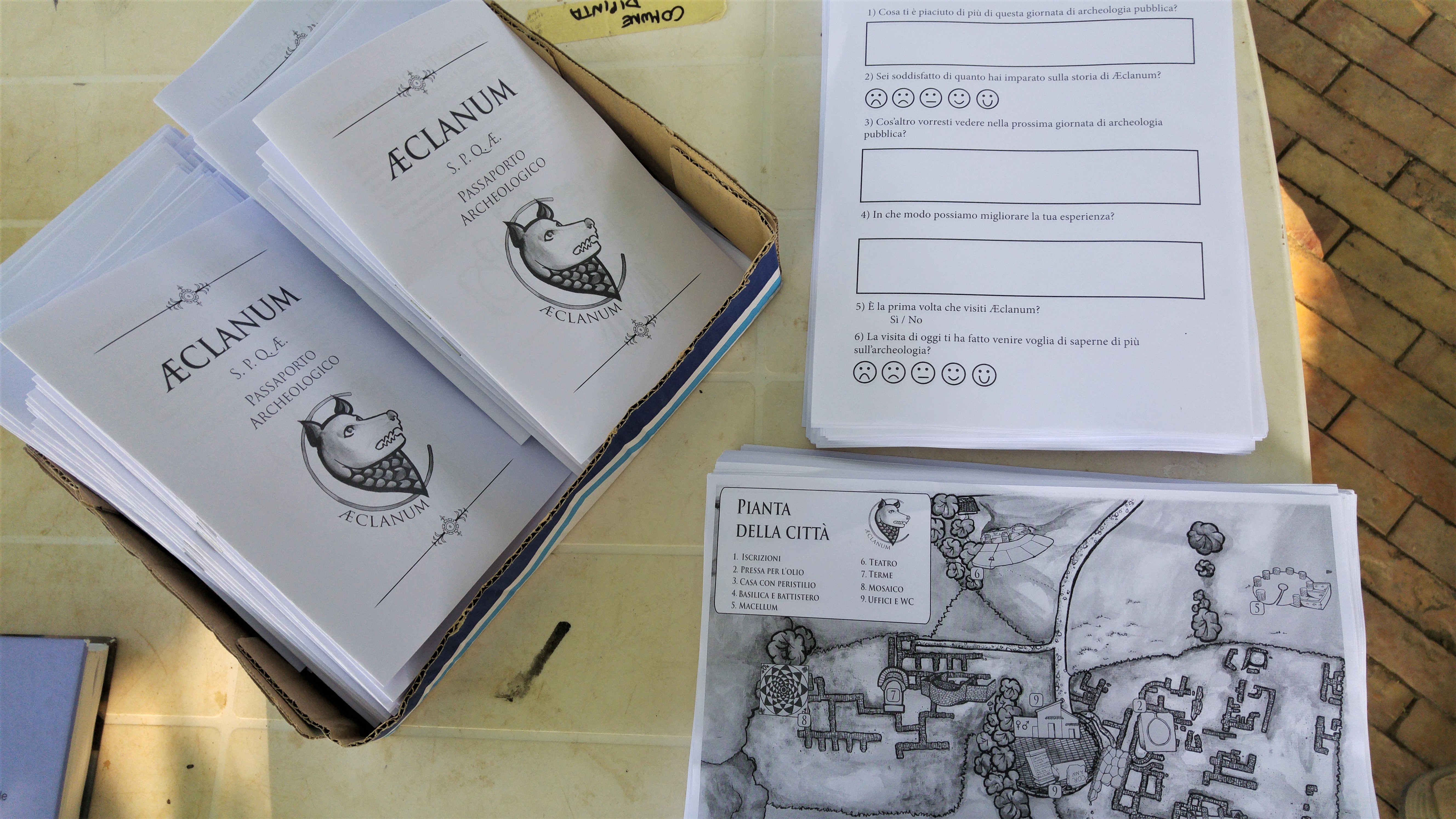
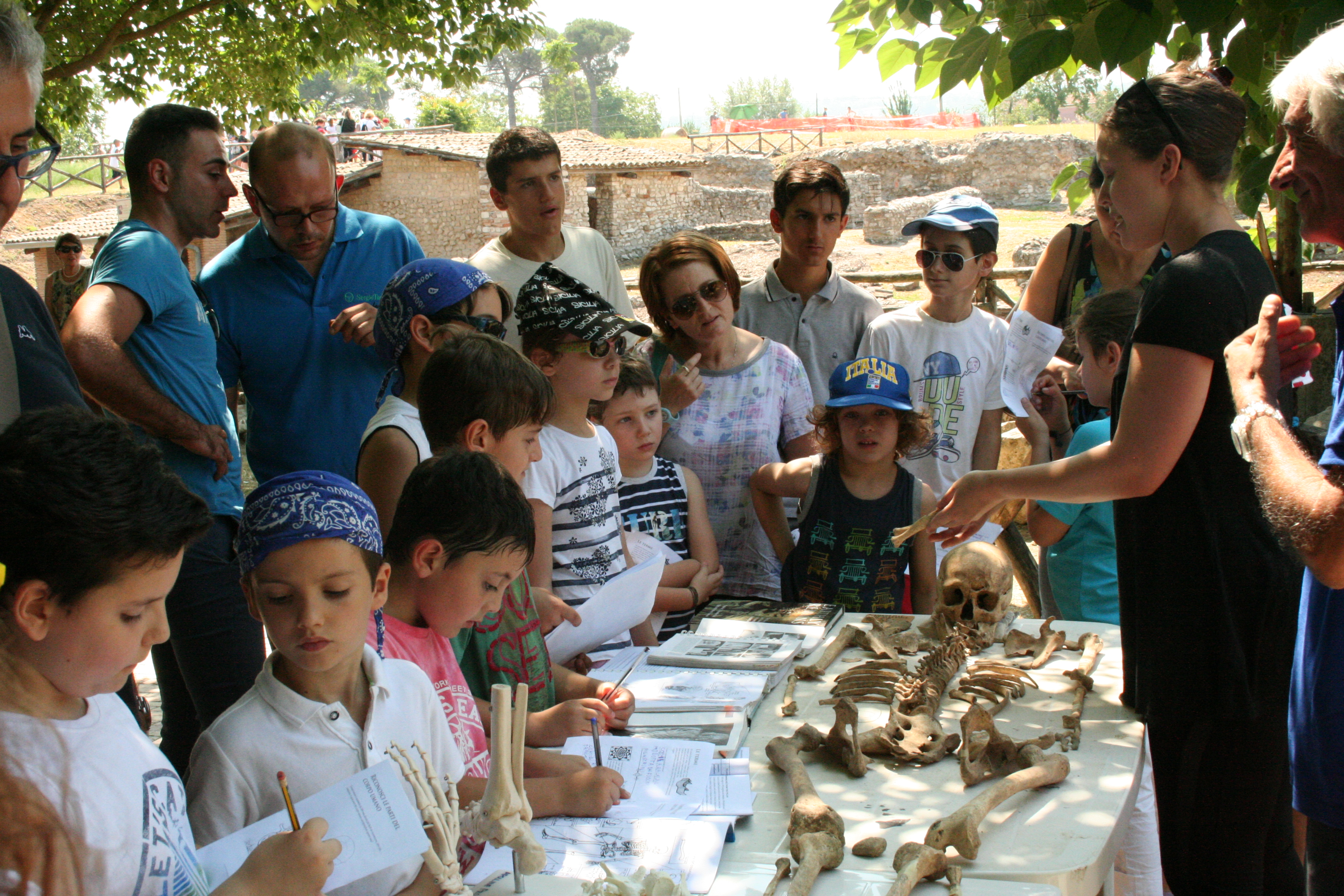 With many enthusiastic young visitors (and adults!) arriving to the site, the team at Aeclanum put on an awesome display. The efforts made by students and specialists were incredible!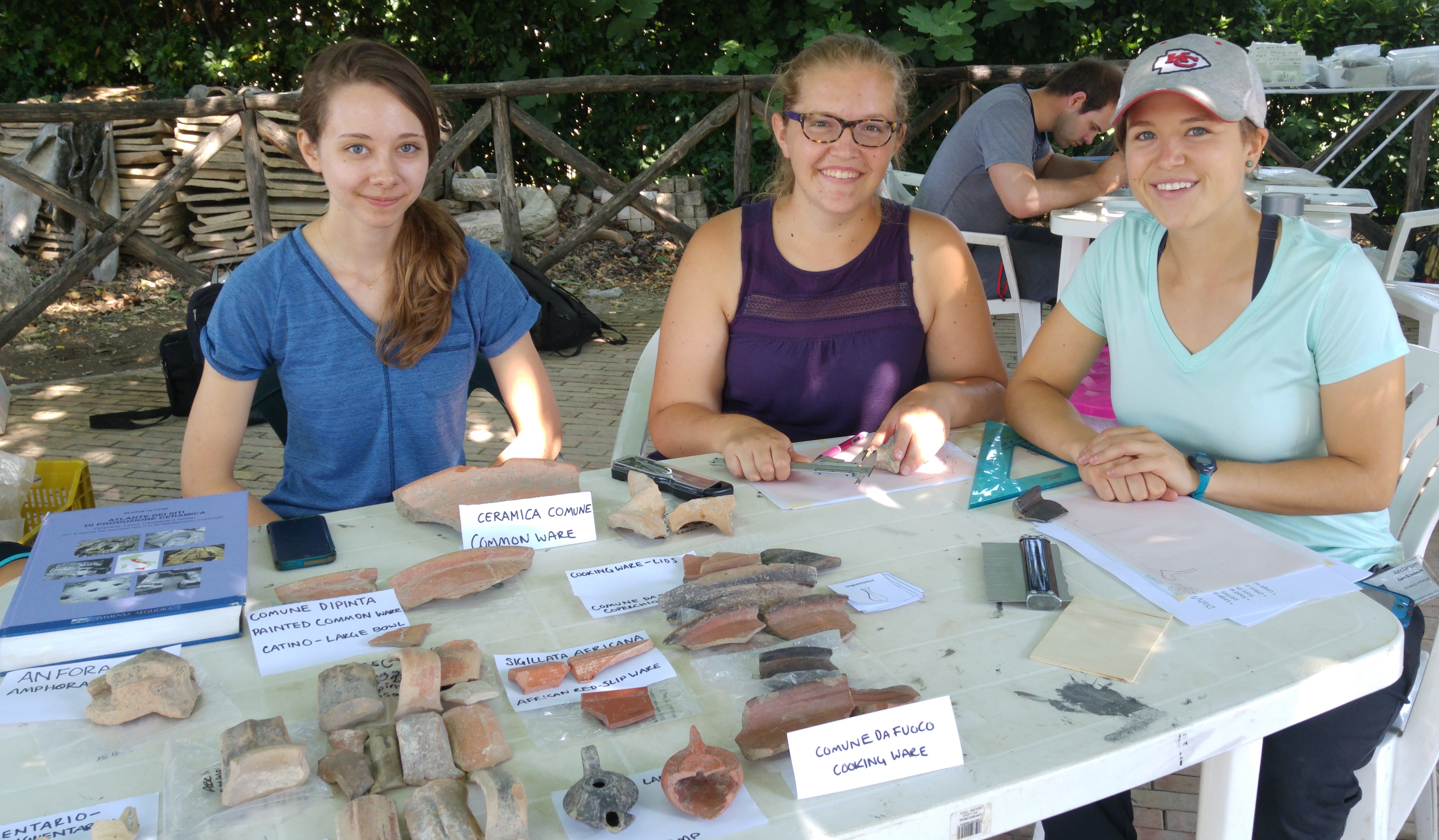
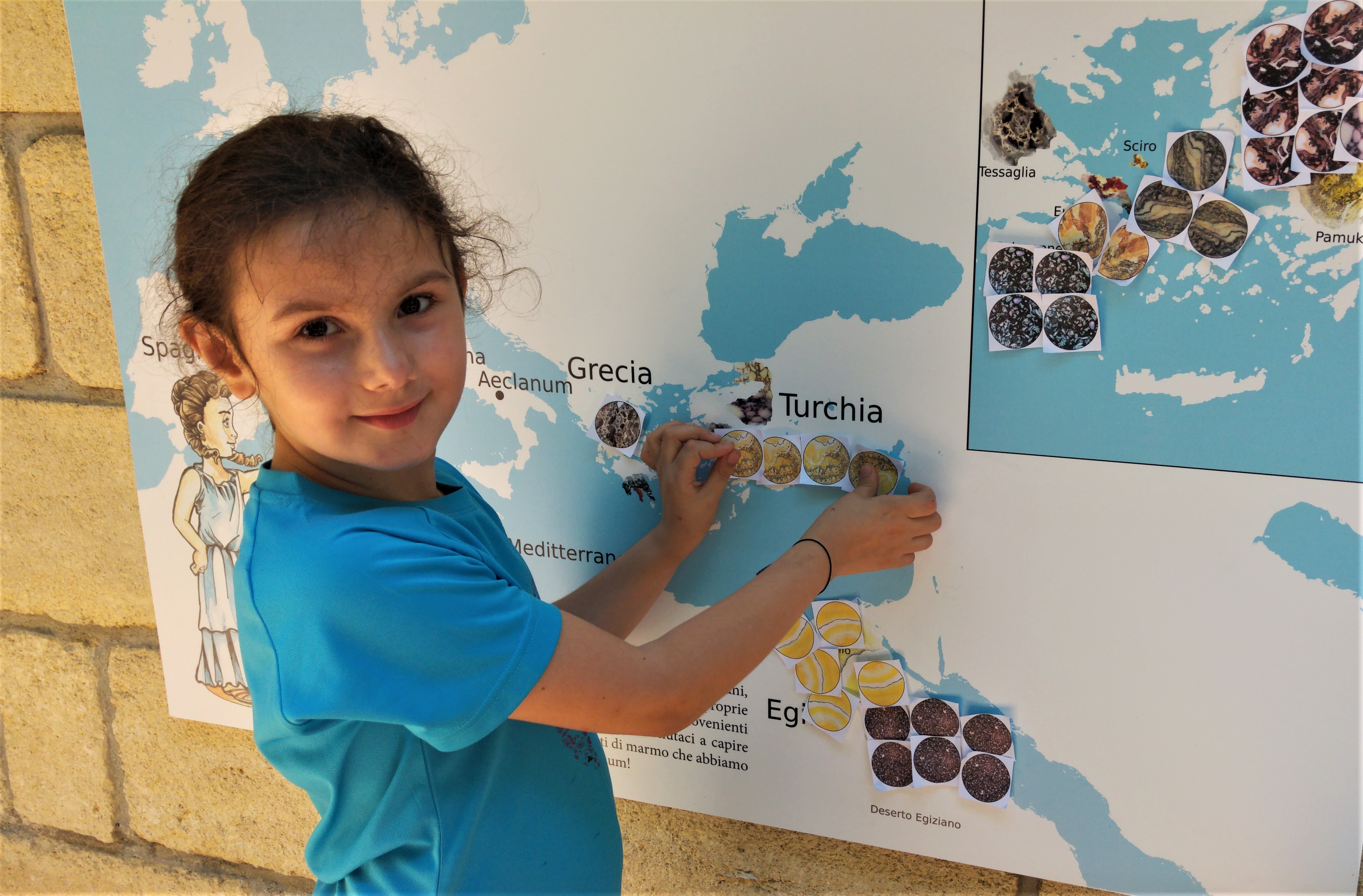
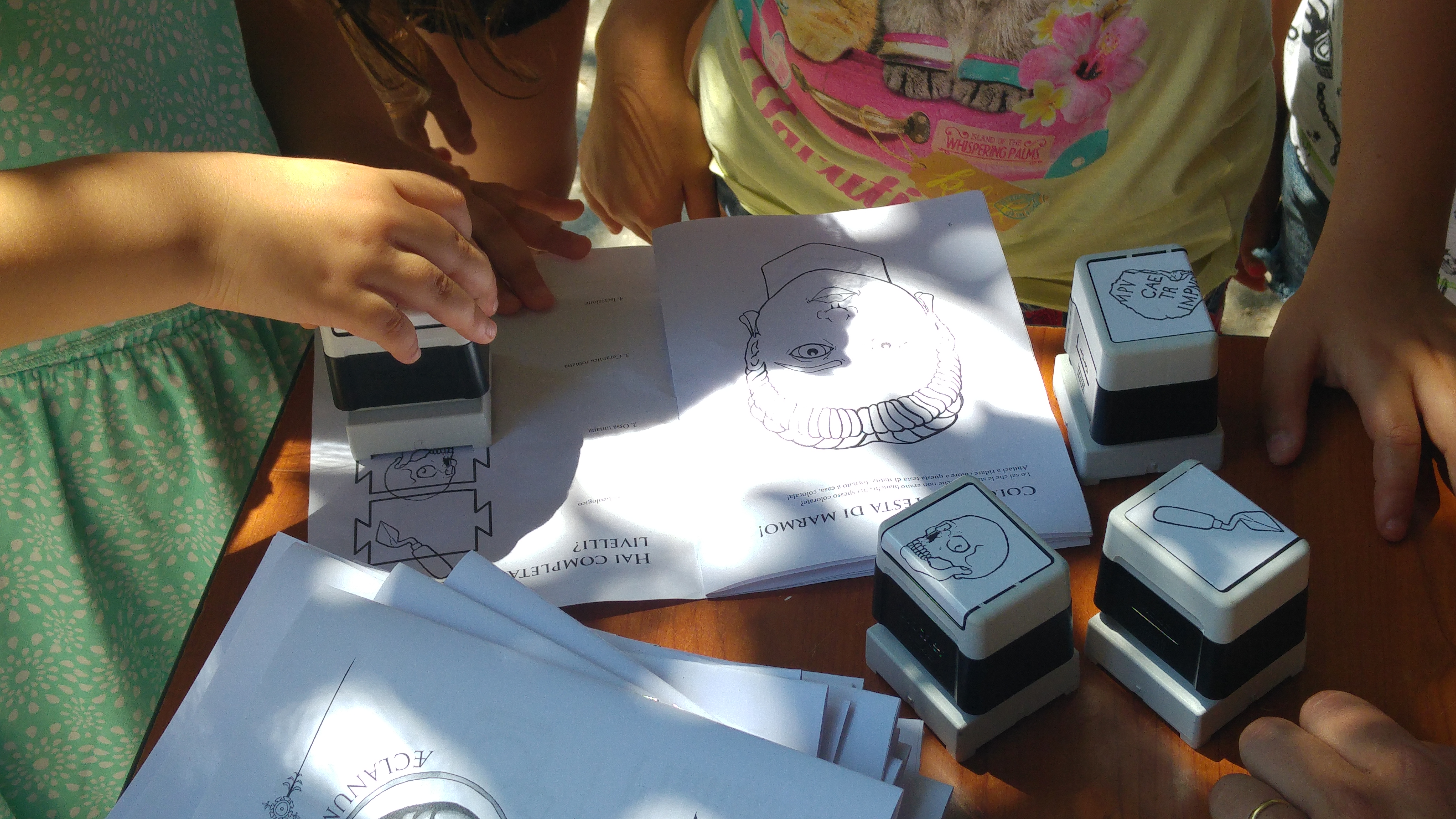 Custom made stamps for the Open Day, each relating to a particular area of Archaeology.
 With the conclusion of the excavation, there was a lot of momentum to continue developing the educational and public engagement materials. There are several engagement events upcoming in Italy, helmed by Dr. Girolamo Ferdinando De Simone, which may result in some exciting possibilities for collaborative projects with local companies and schools.
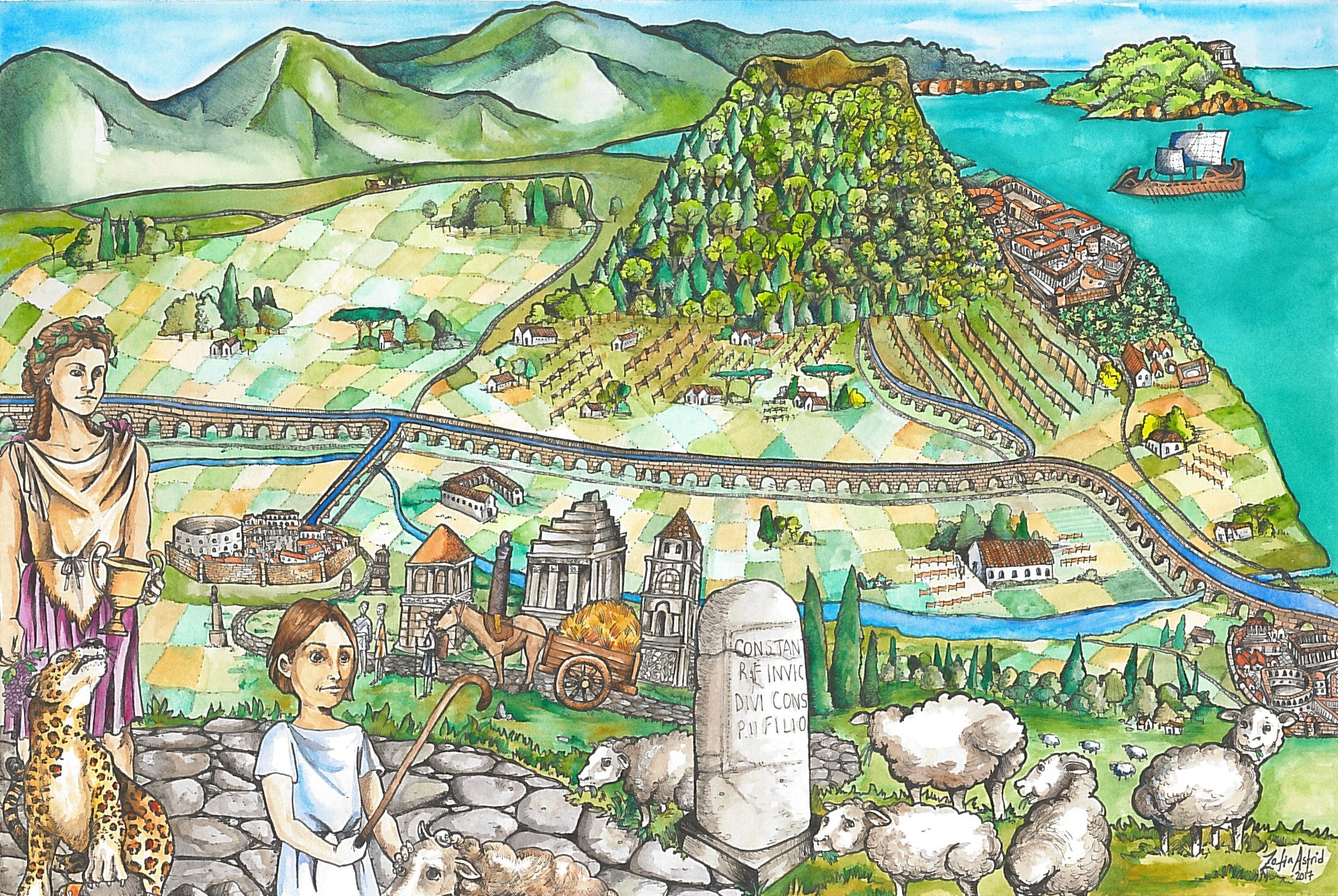 Working in collaboration with Dr. De Simone, on a vibrant image of the communities and natural environment of the north slope, is one piece of the puzzle in developing visual aids to better understand the context of the area during the Roman period. Visualizing the presence of roads, rivers and settlements in the shadow of Vesuvius, shines a light on the areas that have been largely ignored. By creating these new materials, hopefully it will paint a more complete picture of the region and how interconnected the communities were.
 The idea of connecting young and old to the history of their region, leaving more knowledge behind than you take away, and continuing to build on the foundations each year going forward, is the approach that I am taking from this year and will bring forward into future seasons. There is much to do and as many approaches as can be imagined.
 “I divided the earth from the heaven. I showed the paths of the stars. I ordered the course of the sun and the moon”. (Kyme Aretalogy in honour of Isis)



 My Masters at the University of Edinburgh was spent exploring the Greek and Hellenistic routes of the cult, from multiple angles, to start filling in the picture (and creating many of my own pictures).


 There are still so many sites, statues, and sistrums to see in my journey into my studies of this Cult of Isis!

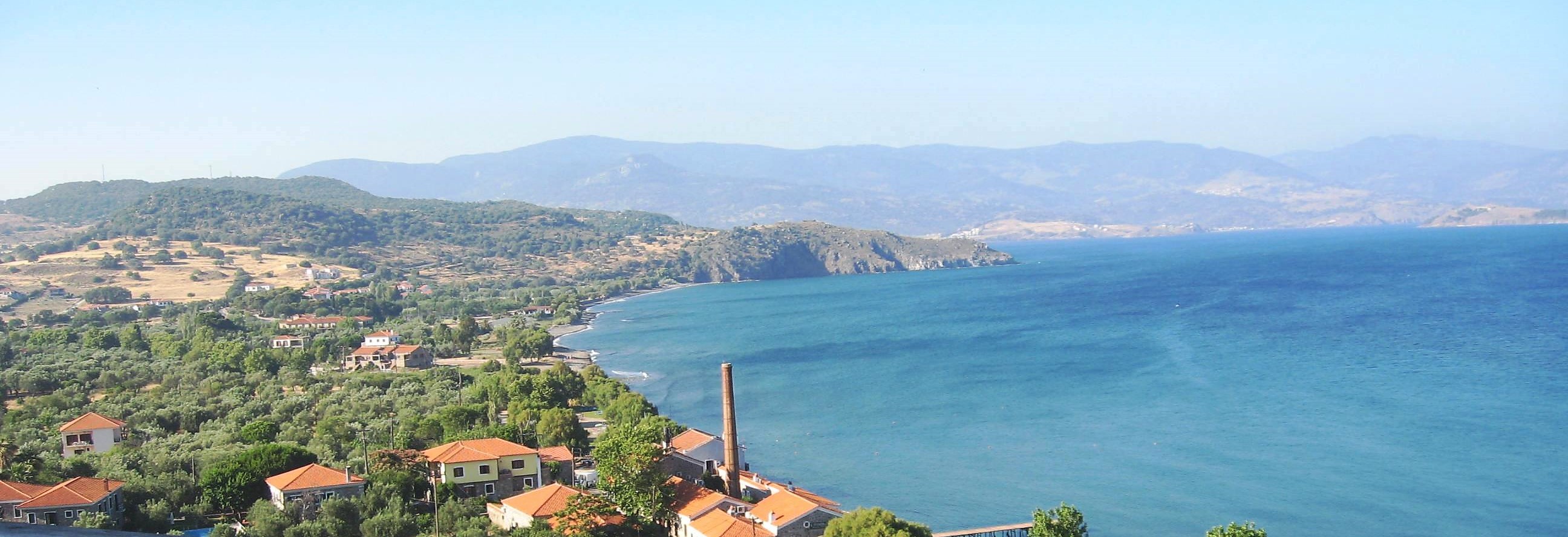 As one of the largest Greek islands, and the nearest to Turkey, there is a remarkable amount of cultural fusion and warmth that shaped my experience of living in Mithymna (Μήθυμνα / Molyvos) for several months, some years ago.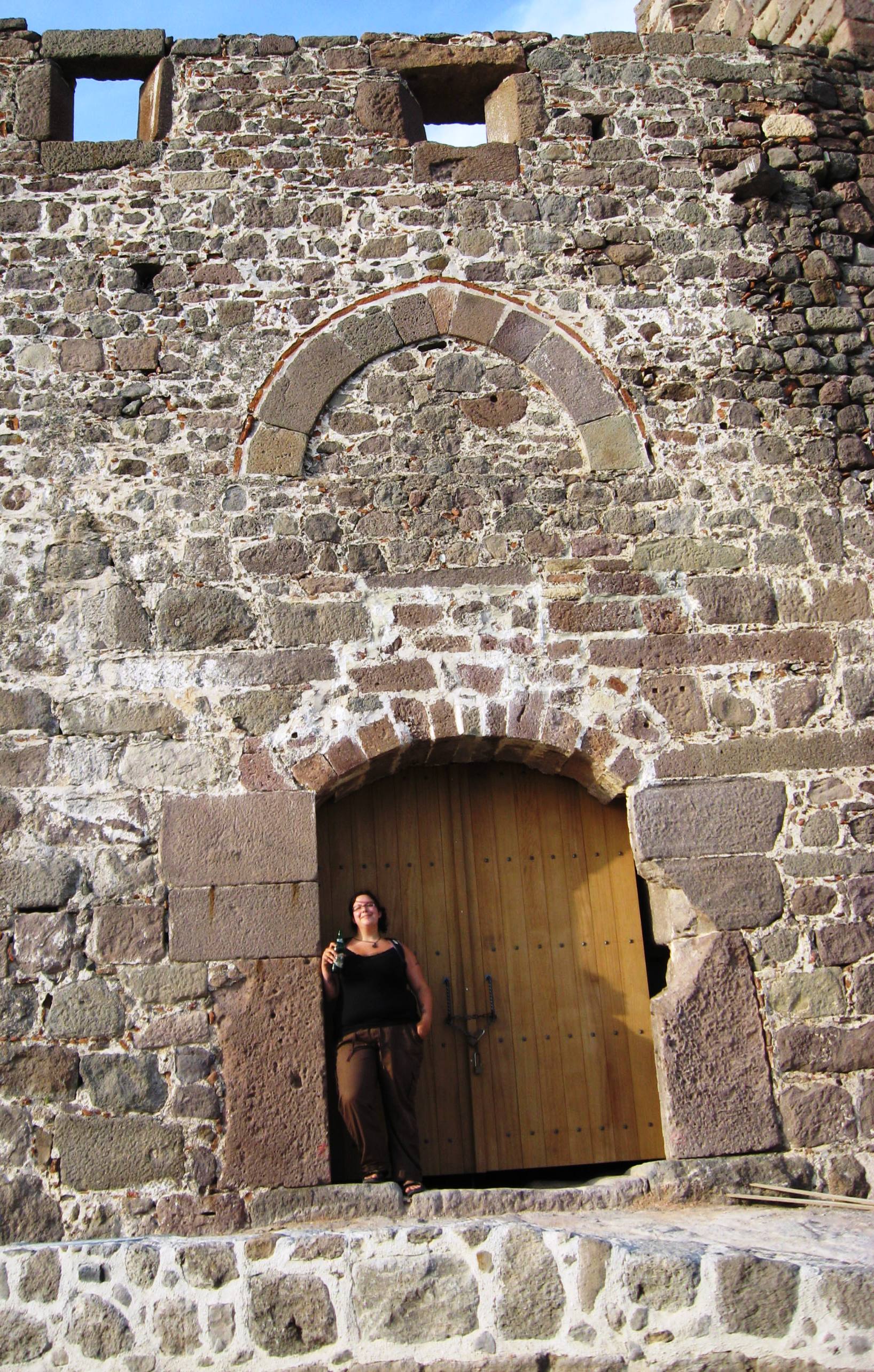


 Like many ancient city centres, Mithymna has a foundation story whose characters possessed the very names of the location – in this case, Mithymna (daughter of a mythical son of the god Helios) who was married to the personification of Lesbos. Hard to prove, so I’ll take the Oxford Dictionary of the Classical World’s word for it.
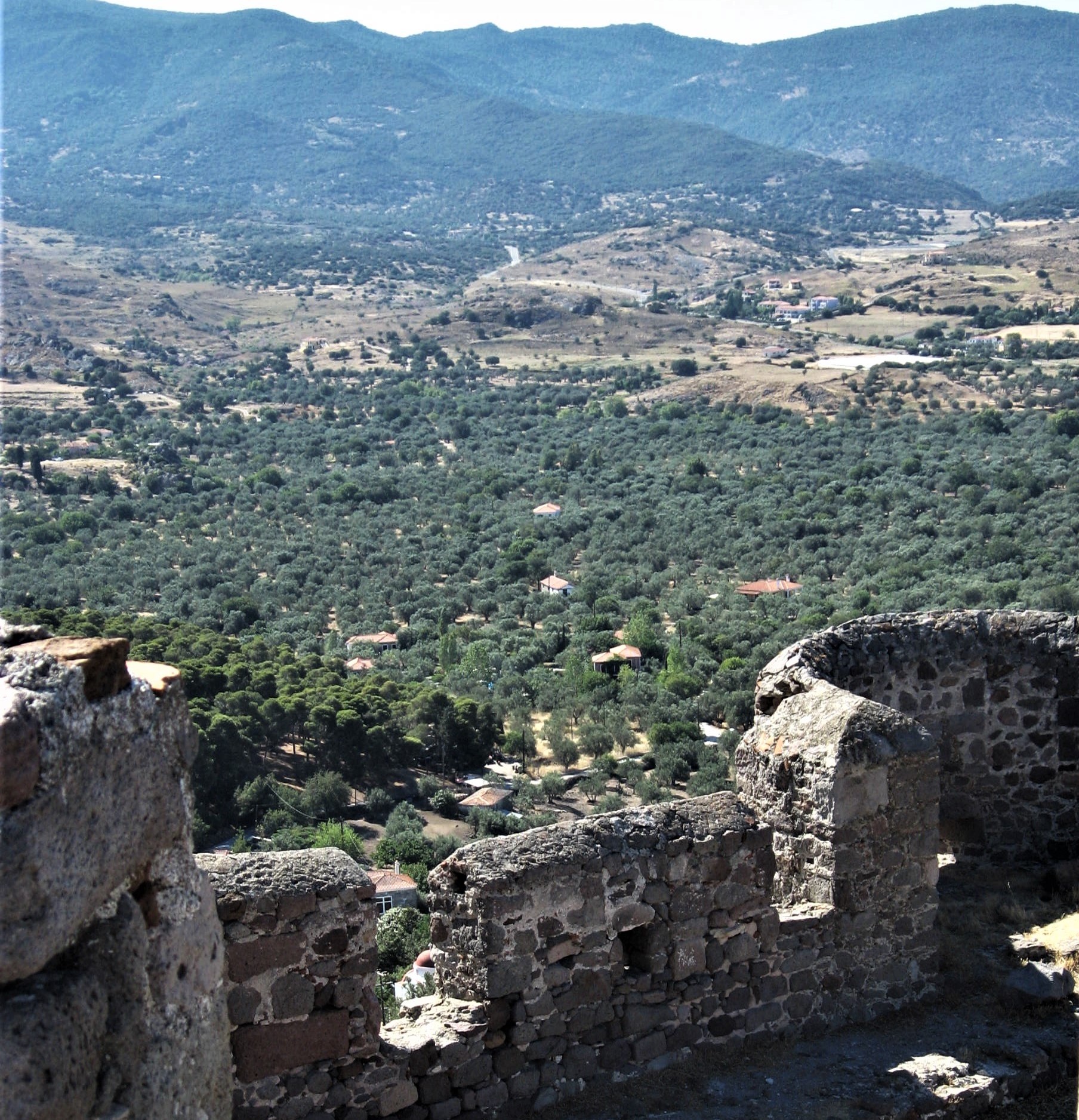
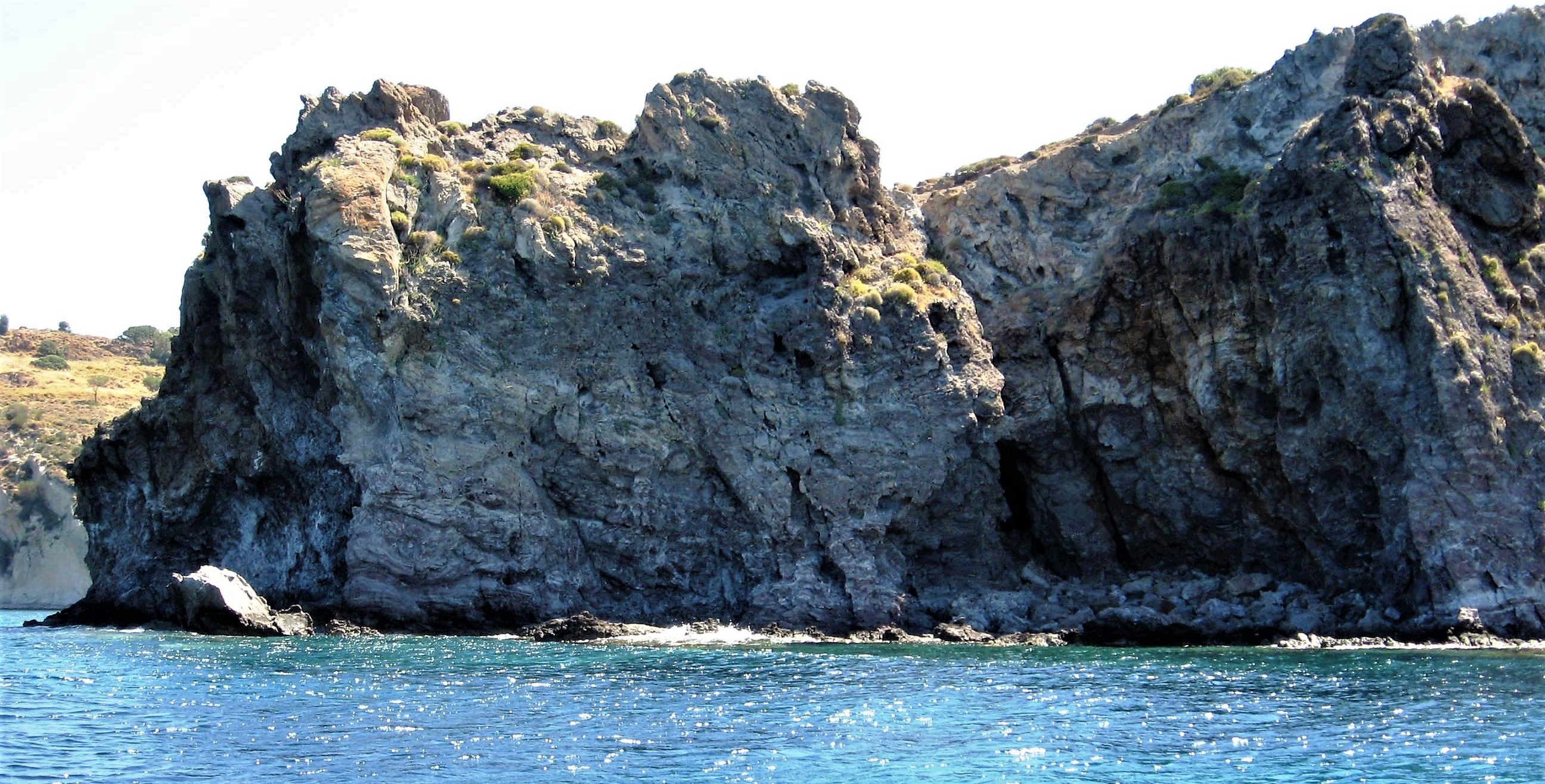 Mithymna and Mytilene had a solid rivalry throughout this conflict and beyond, which I will go into when I post about Mytilene. But for the time being, some dark business went down during this three decades long war, and Mithymna and Mytilene had some serious issues to work out afterwards.

 The formal alliance between Rome and Mithymna was dated by an epigraphic source to 129 BCE. The Roman poets and writers spent many words to describe the quality and superiority of Mithymnian wines.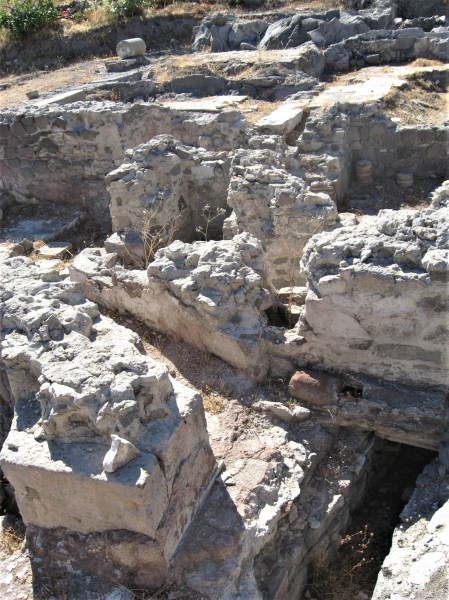

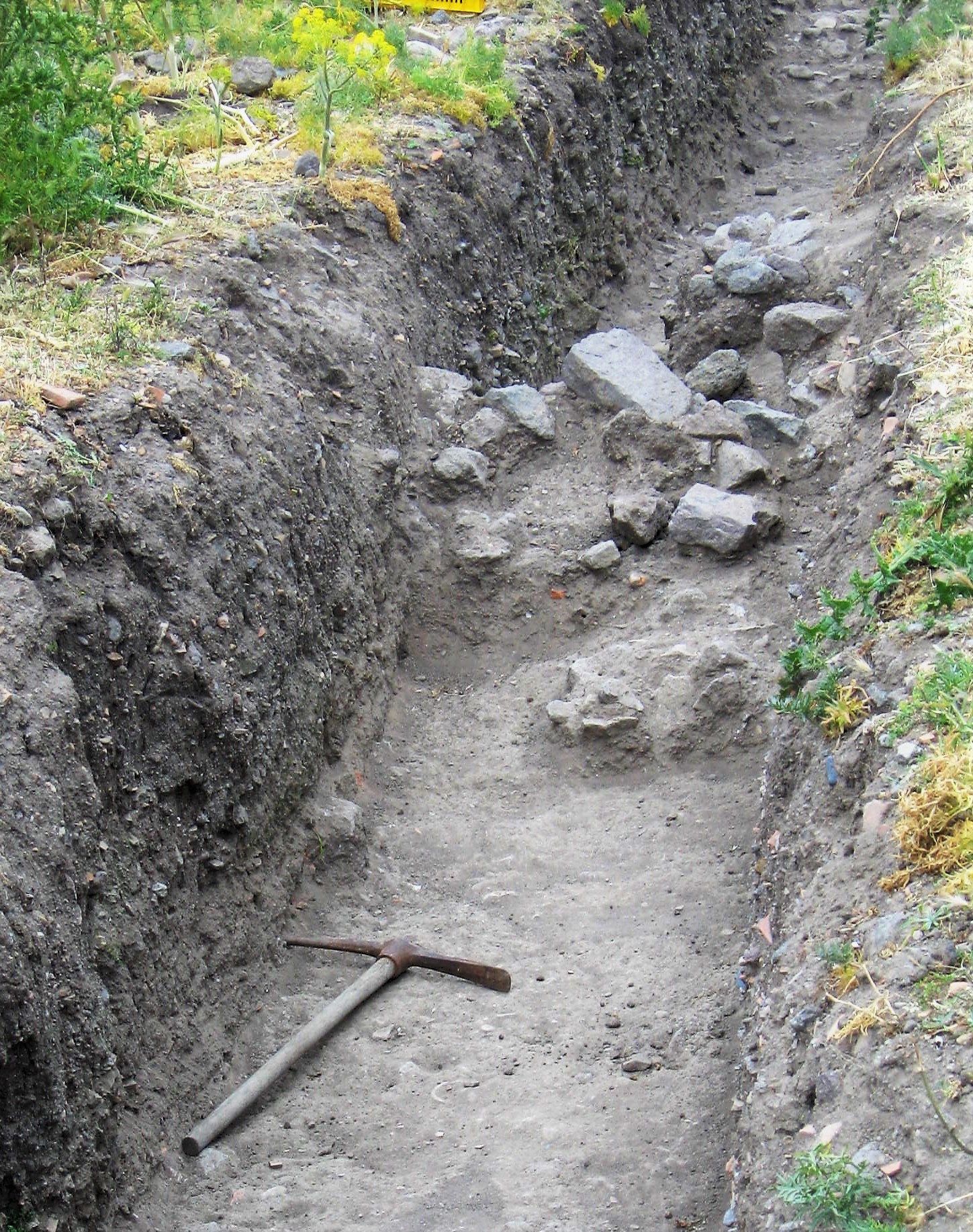
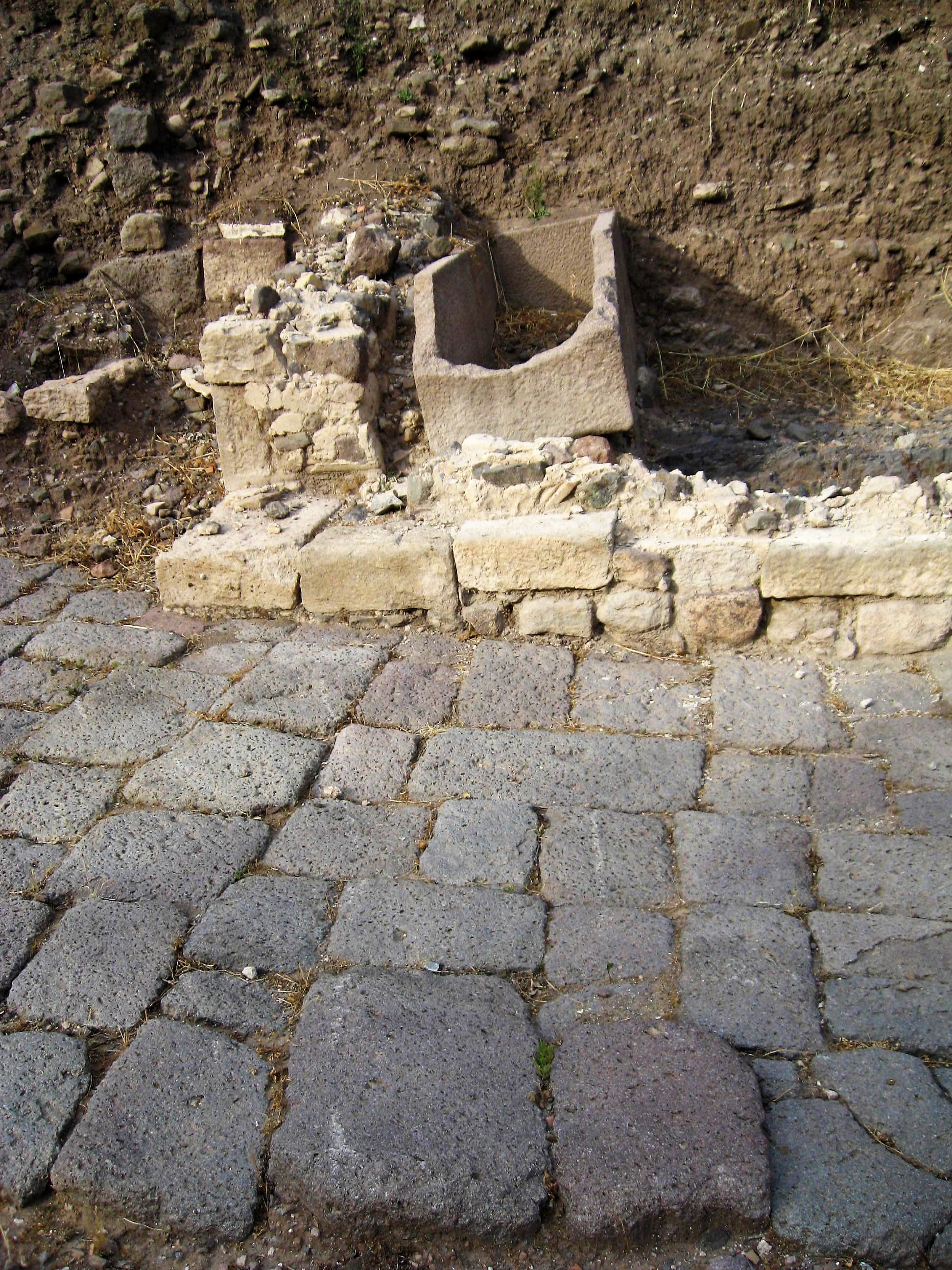 With the political upheaval in the 5th century AD of the western half of the Roman empire, Lesbos fell into the orbit of political authority from the Byzantine power-base of the eastern empire. This orientation affected the flavour and practices on the island as Christianity became the prevalent belief system and religious power throughout the empire.
  Thank you for reading my blog!




 ArchaeoArtist
You must be logged in to post a comment.