17. Illustrating for Public Archaeology

Passport_FINAL_Page_01
The Aeclanum archaeological activity book

The last 12 months have been eventful, with a lot of incredibly life-changing things on the horizon to look forward to. Last week I officially starting my PhD at the University of St. Andrews, and with the other interesting creative academic projects that have come my way, it is a very exciting time. Most of these creative projects have stemmed from the work which I was engaged in this summer in Aeclanum. Over the summer, I shared many images on my Instagram and Facebook pages of the public archaeology project that I was working on this season in the Roman town of Aeclanum (near modern Mirabella Eclano, Italy). AECLANUM _Open Day Banner_2800px (3)I wrote a post in July for the Day of Archaeology annual community outreach publication, discussing some of the surprises and challenges along the way.  The aims and plans being developed for this site were fascinating to work on, with much to consider and research.
Passport_FINAL_Page_02 cropped new
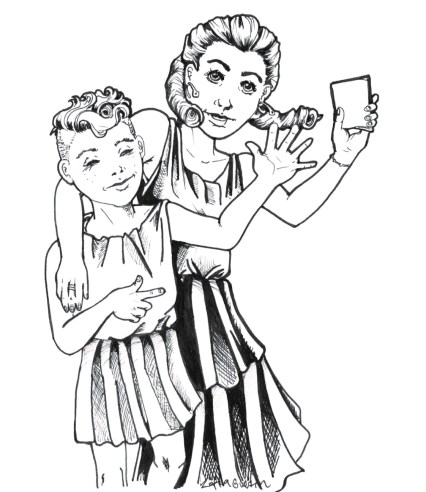
Caius Eggius Rufus and Neratia Prima, our ancient Roman characters who explore daily life in a Roman city.

For me as an illustrator/artist, coming up with the first crack of public engagement materials was really fun and incredibly rewarding. The directors at Aeclanum, Dr. Ben Russell and Dr. Girolamo Ferdinando De Simone, offered guidance into their objectives and vision with the programme. Foundational research was needed, and for me, many visual references, as understanding how to approach a long-term project like this requires a lot of discussion.

20170714_083939
Dr. Girolamo Ferdinando De Simone and I with the stratigraphy roll-up 🙂

Dr. De Simone had spent a lot of time developing the approach he wanted to take, with significant experience for how to engage with the public on these topics, so I was able to learn a great deal about the concerns and approaches that are successful. All of which has led to many avenues for it to continue growing and branching out next year, and thereafter.

Preparation for the Open Day20170714_084541
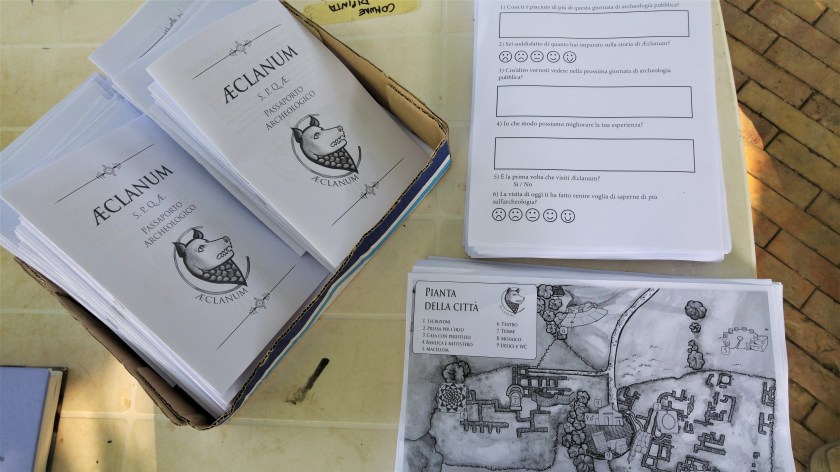
The brand new Aeclanum activity book and site map!

With a big project like this, having students involved was essential. Due to time constraints (excavating and processing finds all day), most of the work we would do together was at night in the accommodations. The students worked very hard, and came up with some really great ideas (pottery games, stratigraphy exercise, etc) and a lot of good research on Roman baths and roads.20170711_115717
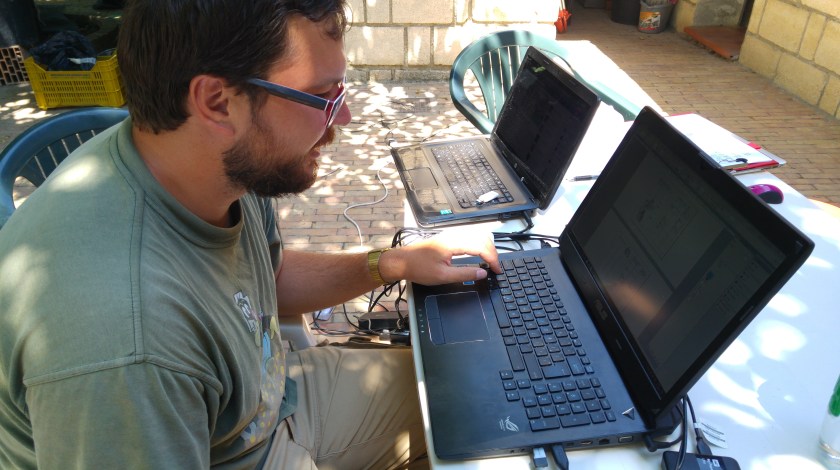
Josef Soucek, digital wizard, here working on the Aeclanum activity book

We were ambitious with the variety and number of activities and materials planned, which inevitably led to some ideas or planned activities being cut or re-configured. Some of the most indispensable collaboration was with the digital specialists, Lucia and Josef. Both are so incredibly talented in a variety of platforms, that for me, it was so exciting to work with them. Taking an idea from discussion to illustration to digitized form, and then adding that into a poster, all at the speed we managed, was really cool!

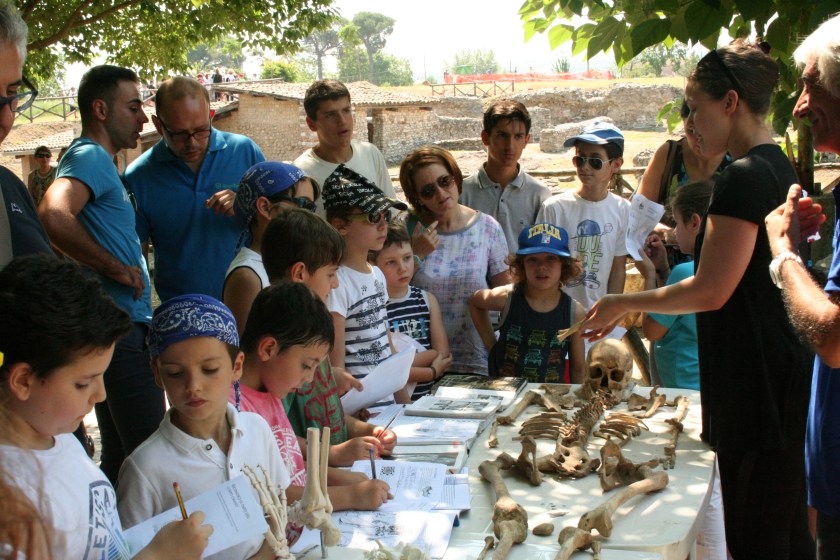
The Open DayIMG_6997With many enthusiastic young visitors (and adults!) arriving to the site, the team at Aeclanum put on an awesome display. The efforts made by students and specialists were incredible!20170714_100139
Our crack team of pottery specialists-in-training (from left: Alexandra French, Amy Rabenberg, and Caity Concannon).

As we were somewhat limited by our linguistic abilities, those who spoke Italian guided the children and gave them an opportunity to ask questions and explore.

20170714_103027
Alex Slucky, in green, describes flotation to visitors

What was fascinating to see was, regardless of gender or age, the participants connected immediately with the activities and were very hands-on.
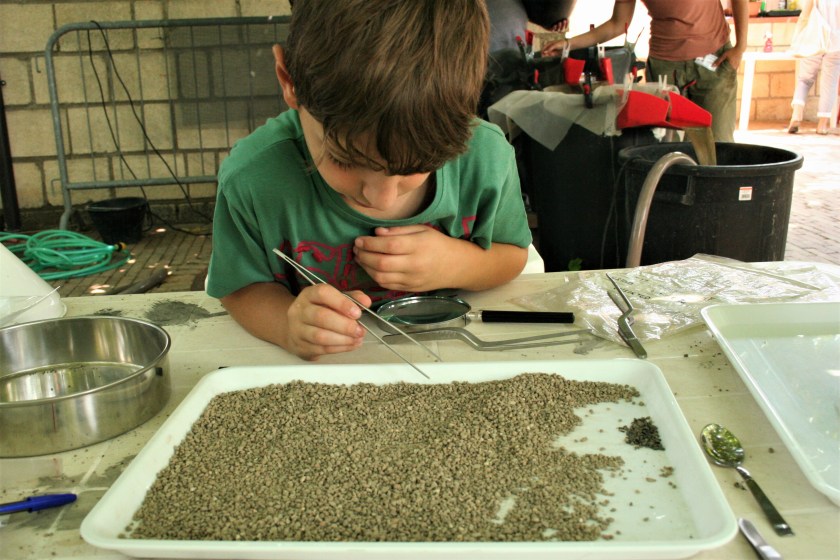
IMG_7056
This young archaeologist skillfully picked through dried flotation specimens looking for seeds!

Encouraged to explore several facets of the work, they became quite empowered and very good at spotting the elements they were tasked to find. 20170714_120004
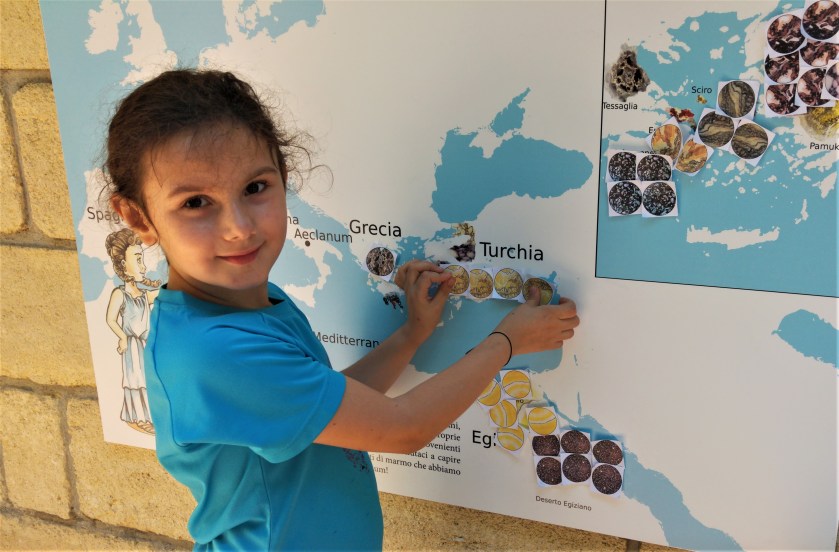
Even students less comfortable speaking in Italian found a myriad of ways to communicate practices, like flotation, pottery washing and excavation. Games that had gone from brainstorm to reality in 30 days were a huge hit with the kids.20170714_103759

The activity book which they could take home was a big hit with kids and parents.

What we were able to produce for our first event was only the tip of the iceberg. Several energetic students volunteered their time this year, and hopefully we will be seeing them again next year to continue developing this programme. 20170714_114317Custom made stamps for the Open Day, each relating to a particular area of Archaeology.

What is happening next?20170924_193837With the conclusion of the excavation, there was a lot of momentum to continue developing the educational and public engagement materials.  There are several engagement events upcoming in Italy, helmed by Dr. Girolamo Ferdinando De Simone, which may result in some exciting possibilities for collaborative projects with local companies and schools.

The dark side of VesuviusDark Side Vesuvius -CLR JPG (1)Working in collaboration with Dr. De Simone, on a vibrant image of the communities and natural environment of the north slope, is one piece of the puzzle in developing visual aids to better understand the context of the area during the Roman period. Visualizing the presence of roads, rivers and settlements in the shadow of Vesuvius, shines a light on the areas that have been largely ignored. By creating these new materials, hopefully it will paint a more complete picture of the region and how interconnected the communities were.

What is next?IMG_6871The idea of connecting young and old to the history of their region, leaving more knowledge behind than you take away, and continuing to build on the foundations each year going forward, is the approach that I am taking from this year and will bring forward into future seasons. There is much to do and as many approaches as can be imagined.

Ciao!


16. Studying the Regina Caeli: the journey so far into the cult of Isis.

Isis Bar“I divided the earth from the heaven. I showed the paths of the stars. I ordered the course of the sun and the moon”. (Kyme Aretalogy in honour of Isis)

Since backpacking in Europe in 2001, I have been drawn to images and archaeological sites relating to Isis. There are some things that just strike the right chord for you. My first experience with Isis (in a Greco-Roman style) was at the Capitoline Museum in Rome.

IMG_6957 (2)
Capitoline Isis, Rome (2014).

The statue fit my understanding of what classical sculpture was, and simultaneously had something a bit unusual. The features were so exquisitely carved, and the goddess’s accoutrements were unlike anything I had seen before. While visiting Pompeii during the same trip, I didn’t quite make the connection between the figure in the statue that I’d seen in Rome and the temple in which I had been standing.

During my undergraduate studies, I came across her again while reading Lucian’s ‘Metamorphosis (The Golden Ass)’. My attention was drawn to the way that Lucian described the power of this mysterious foreign goddess. What was so brash about Lucian’s novel was how much he subtly revealed, through winks and nods, about the mystery cult. He described esoteric celebrations, events and magical healing, all the while saying, ‘but it’s a secret, so I can’t really talk about it’. The story is familiar, in a Shakespearean kind of way, through all the hubris, metamorphoses, changes of fortune, and bawdy humour.

20170324_131121
Isis-Thermoutis, Musee des Beaux Arts, Lyon (2017).

I was fascinated by this religious movement and how it functioned within the religiously pluralistic Roman society. Isis and her cult would ultimately provide some of the foundation of early Christian practices such as baptism, in addition to the depictions with Horus (the infant nursing on her lap is a dead ringer for the baby Jesus), presaging the metamorphosis into the Virgin Mary.

zofia and greg eurotrippin p.2 458 (2)
Isis (holding the snake) and Io (sitting atop the shoulders of the personified Nile) wall painting, Museo Nazionale Napoli (2014).

Jumping in with both feet, I was excited and wanted to understand more about this deity. However, my introduction to the topic began at a much later point in the history of the Cult of Isis; to understand the cult and its significance, I would need to go farther back and approach it more broadly.Scanned from a Xerox Multifunction Device002-1~2My Masters at the University of Edinburgh was spent exploring the Greek and Hellenistic routes of the cult, from multiple angles, to start filling in the picture (and creating many of my own pictures).

Isis Bar2
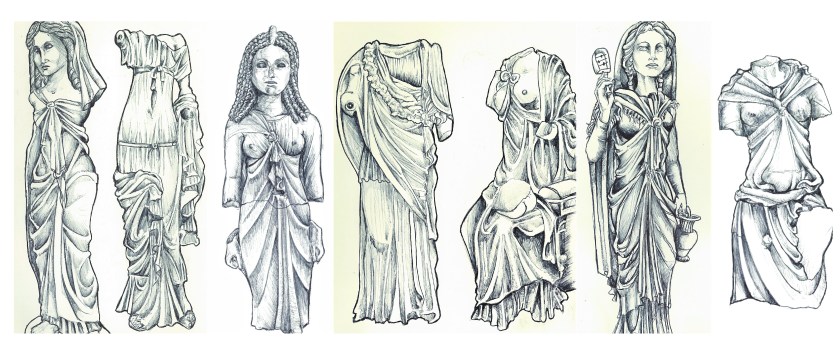
Some of my sketches of Isis statues over the last 4 years.

Isis’s power as a deity in Egypt rested in being the wife of Osiris and mother of Horus. She bridged the continuity of kingship from one king to his descendant. Her original function as the literal and symbolic role – as the throne and king-maker in Ancient Egypt – changes quite dramatically once the cult is exported into Greece and Italy.

QUEEN Isitnefret as Isis-Hathor MET.XL.00867.01-1304-1237 bce, EGYPT
Isis cradling Horus – from the MET archives.

While the period of Isis worship in the pre-Hellenistic era (before 323 BCE) is interesting, what has captivated me more specifically is what happens with the cult in the Hellenistic-to-Roman period. Like a character from Sailor Moon, she gained many headdresses, wands, tools, and visual associations with other deities (Demeter, Aphrodite, Athena, Nike).

This is the period that I focused on during my MSc, researching the symbols and iconography over time, with an emphasis on the tiny figurines used in her worship. What I discovered was that her strength was in her flexibility. Her image could be adapted to all needs, wants and interests. She could be a local or international deity. She could be closely affiliated with a particular ruling dynasty, or one specific location.

Another investigation looked at the cult’s relationship with Athenian government in Delos, and some of the territorial quarrels that occurred between temples run by different factions on the island. The evidence of a push and pull scenario between Delos’ new overlords (the Athenians) and the previous residents, in the mid-second century BCE. Running cults was big business and politically useful to establishing ones career, and the Athenians had no interest in allowing an Alexandrian ‘Egyptian’ to maintain a monopoly on the worship of Isis in this economically powerful port.

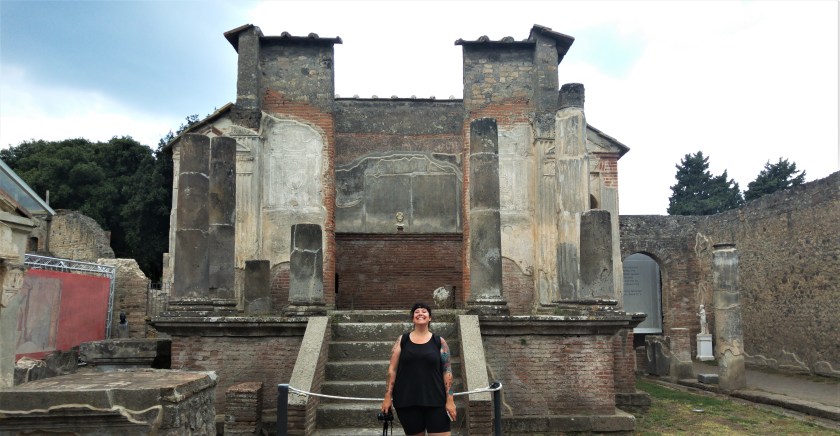
While few temples of Isis remain in even remotely good shape, Pompeii possesses on of the most famous examples.

20160911_121435 (2)
Temple of Isis and her #1 fan, Pompeii (2016).

Pompeii had one of the best-preserved temples (though most of the decorations were long since removed and put in museums). It was fascinating to see the spread of Egyptian-looking artefacts which tend to denote cult membership. The items that were recovered from Pompeii are varied and showed decorations and materials of incredibly high quality that were made for, and used by, the Temple of Isis.

Another leg of the journey in my first large research project involved a trip to Palestrina (ancient Praeneste), some 40 km east of Rome. Part of what I wanted to see was the Egyptian artefacts, which remain some of the most exquisite examples of mosaic work from ancient history.

2014-04-23 14.57.04
The Nile Mosaic of Palestrina, Italy (2014).

The Nile Mosaic of Palestrina was breath-taking in person and represented an interesting fusion of culture and appropriation of the Hellenistic Alexandrians and the native Egyptians. Although it is an uneven cultural balance, with the prioritising of the Macedonian elite over the native Egyptians.

It is a rare gem of the exquisite mosaic work that was part of art market in Italy, before the Rome dominated the Mediterranean. It highlighted aspects of Egyptian cult which would find its way into Italy, though altered for Italian tastes.

 So, what is next?

20160903_162123 (2)
Isiac procession relief, Palazzo Altemps, Rome (2014).

This September I will be stepping into the subject and delving deeper into urban design, Egyptian architecture and the art styles that appear in Roman cities. There are so many aspects and angles to investigate with this topic, and being able to work on a PhD toward this end is like a dream come true. 20160610_150009There are still so many sites, statues, and sistrums to see in my journey into my studies of this Cult of Isis!
Thank you for reading my blog!

A bientot!

Save

Save

15. Mithymna: the Fortress on the Hill

Picture 398
Roman ruins at the north end, facing Turkey.

There is something breathtaking about the shores, mountains and harbours around Lesbos. Mithymna is a gem of a town, with all the fine features you hope for as a tourist destination, but a significant amount of history is embedded in every corner.  928 (2)As one of the largest Greek islands, and the nearest to Turkey, there is a remarkable amount of cultural fusion and warmth that shaped my experience of living in Mithymna (Μήθυμνα / Molyvos) for several months, some years ago.
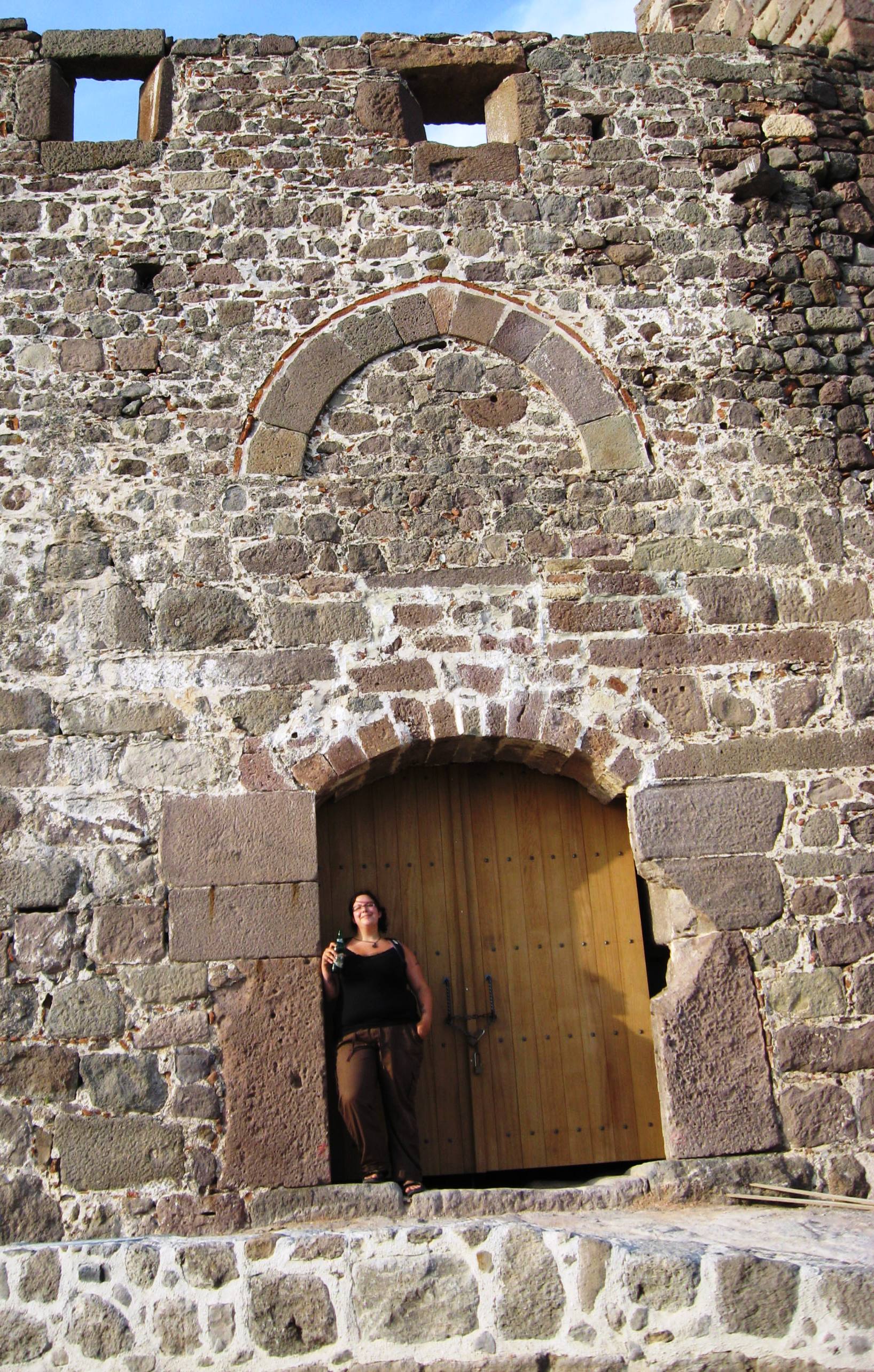
Greece 591
Taking a libation at the Mithymna castle.

While being housed during the spring months in Mithymna, I explored the winding cobblestone streets, photographed dangling flowering plants and occasionally sampled the vibrant restaurant scene at the harbour.

Greece 039
Mithymna harbour

These elements, along with adorable roaming stray cats and dogs (some of whom we adopted), formed idyllic scenes that made it a beautiful and tranquil location to study some Byzantine History and Reception Studies (in effect, the study of modern interpretations of the ancient world) during my undergraduate degree.

Greece 001
A charming painting in the old schoolhouse where we took lessons.

What a draw for a historian!Greece 608Like many ancient city centres, Mithymna has a foundation story whose characters possessed the very names of the location – in this case, Mithymna (daughter of a mythical son of the god Helios) who was married to the personification of Lesbos. Hard to prove, so I’ll take the Oxford Dictionary of the Classical World’s word for it.
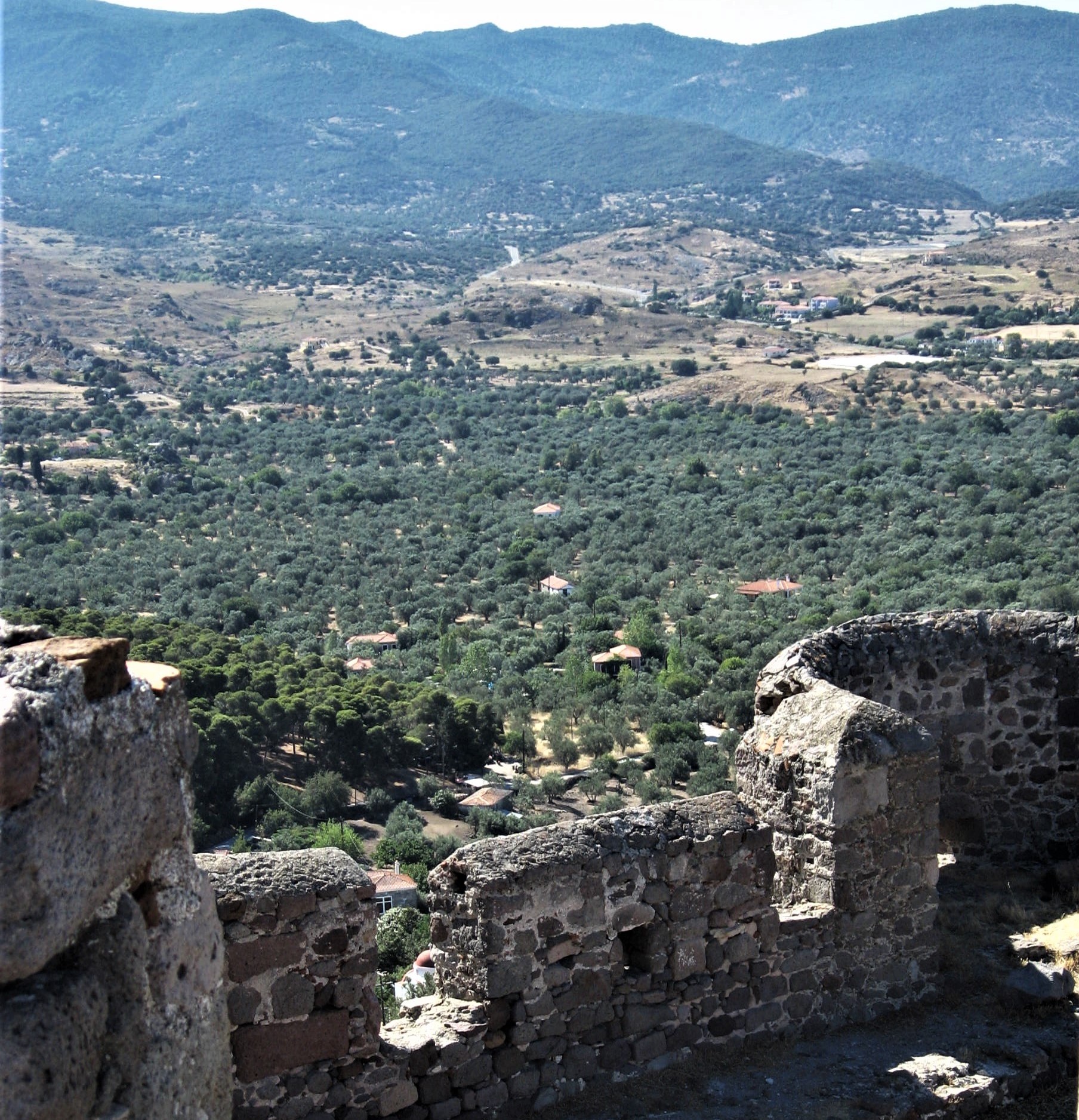
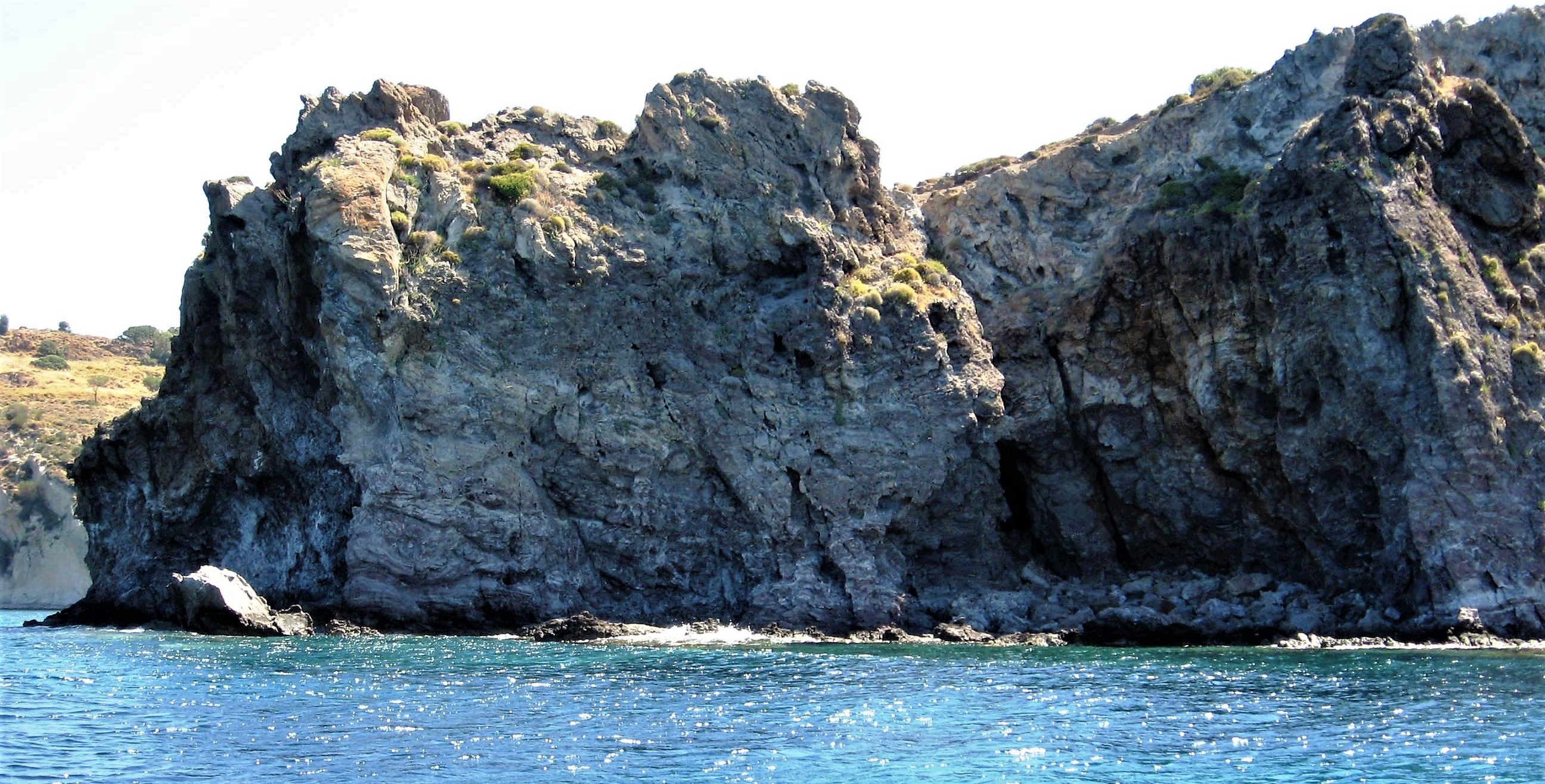
Greece 594
Mithymna Castle

The history of Mithymna is actually the stuff of legends, literally. The Bronze Age warrior Achilles was said to have breached the fortifications of Mithymna due to the amorous machinations of King Peisidikis’s daughter.

castle
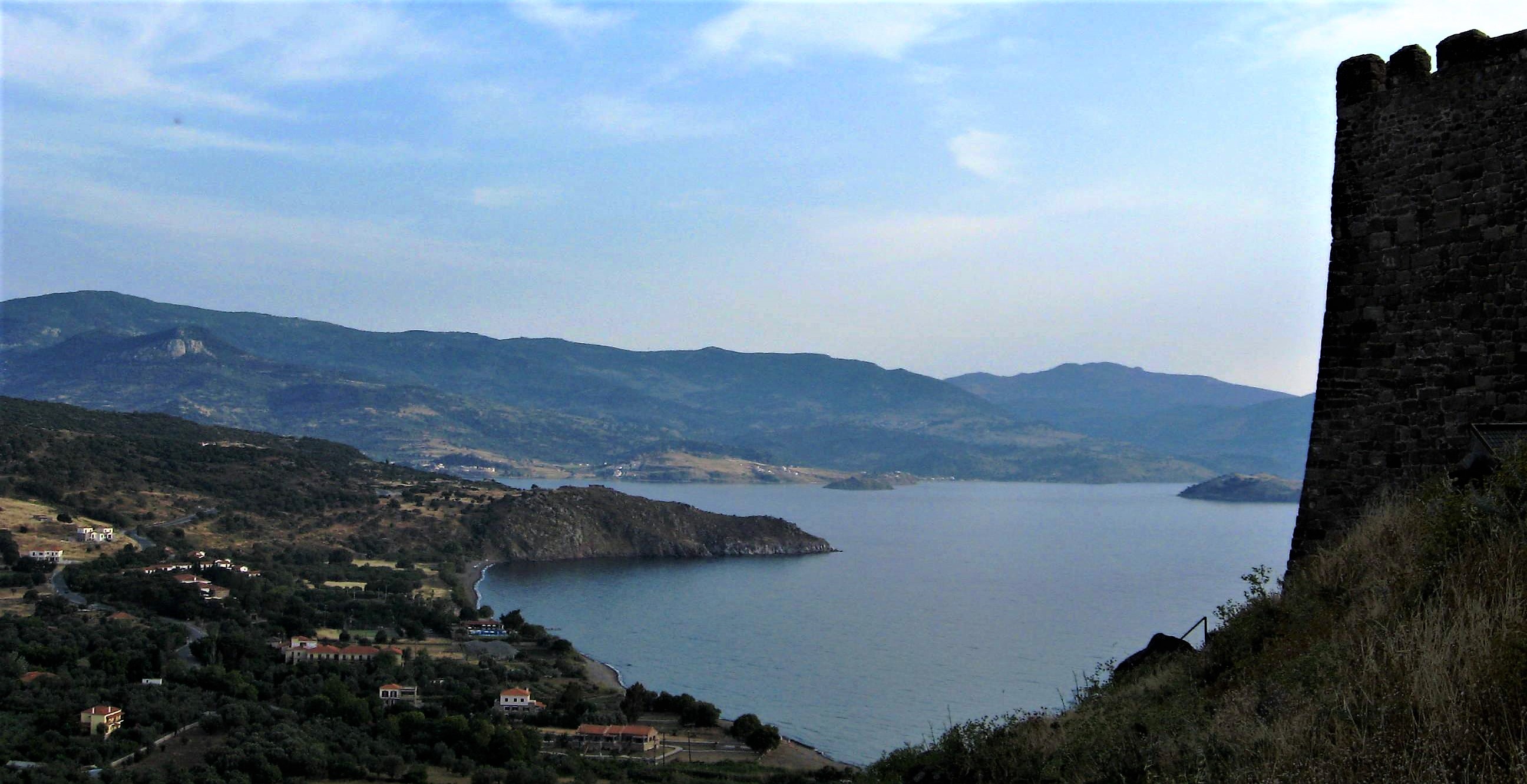
View from Mithymna castle of Efthalou.

The city fell to the Achaeans, as the events of the Illiad take place not far away across the water (you can see Turkey from the shores of Mithymna).

Mithymna had been an important location in the Classical period as it was caught  between the Athenians, their ally, and the Spartans throughout the Peloponnesian War (431 – 404 BCE). To and fro, the balance of power shifted from Athens to Sparta, and back again throughout the war; and smaller allied cities were caught in the fight, or served as proxies for the conflict. 957 (2)Mithymna and Mytilene had a solid rivalry throughout this conflict and beyond, which I will go into when I post about Mytilene. But for the time being, some dark business went down during this three decades long war, and Mithymna and Mytilene had some serious issues to work out afterwards.

Picture 1071
Splendid isolation on the beach

Remaining significant throughout the Hellenistic period, Mithymna played politics as it was captured by Macedonian forces and Persians, with tyrants ousting and aligning themselves with the conflicting superpowers when they gained control of the island cities. With the division of Alexander’s brief empire by his successors, King Lysimachus and later Ptolemy would control the island. With the influence of the Ptolemaic ruler, my academic obsession, the cults of Isis and Sarapis were introduced and worshiped.

Which brings us neatly to the Roman period.

Roman Tombs Molyvos 2
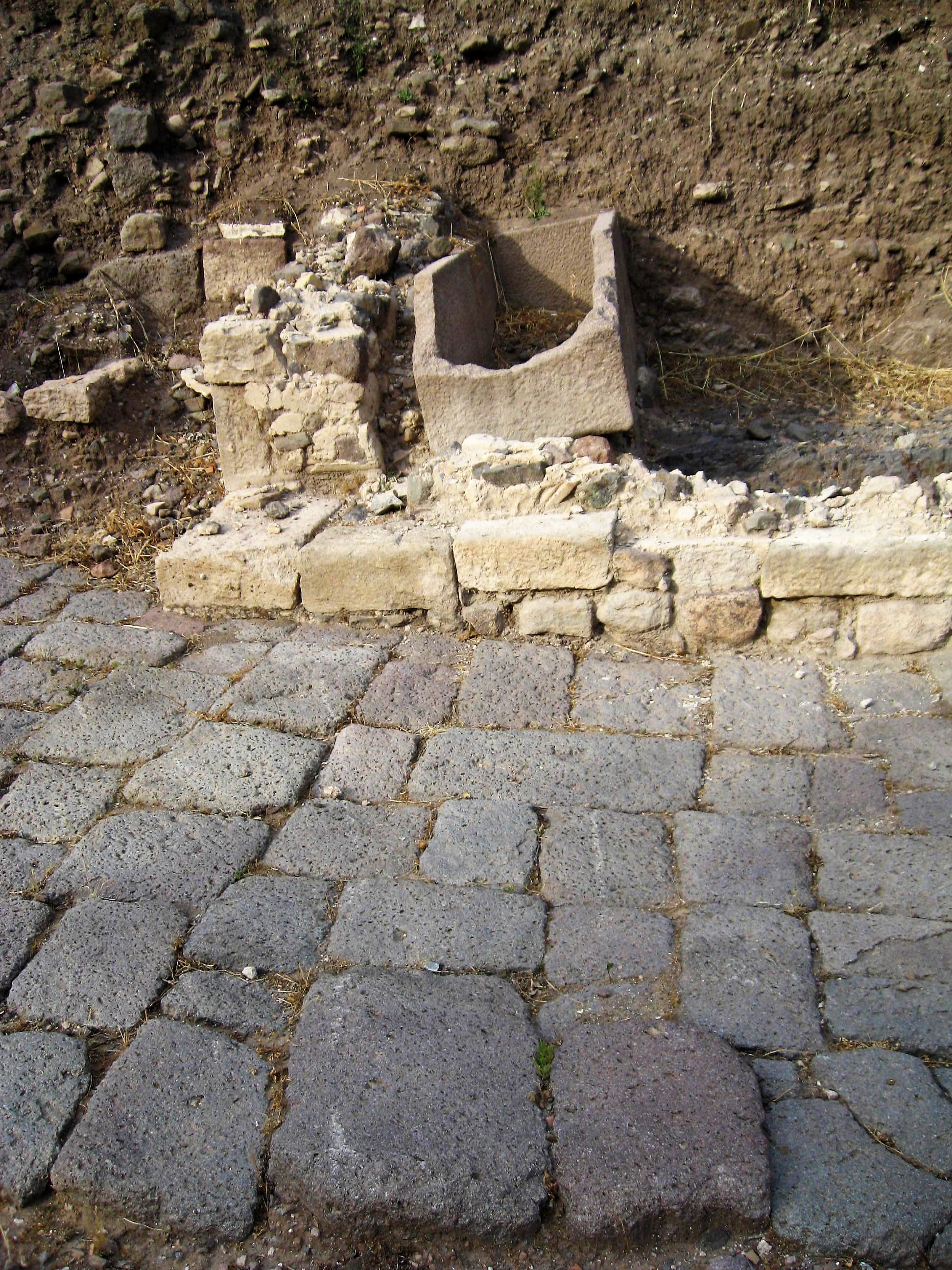
A bit of Roman road and tomb.

Sprinting through so much history, I can barely touch on how many fascinating moments in ancient history in which Mithymna has played a part, but one of the elements which leaves a physical trace, which I was thrilled to see, was the Roman archaeological remains dispersed throughout the city.Roman Tombs Molyvos 3The formal alliance between Rome and Mithymna was dated by an epigraphic source to 129 BCE. The Roman poets and writers spent many words to describe the quality and superiority of Mithymnian wines.
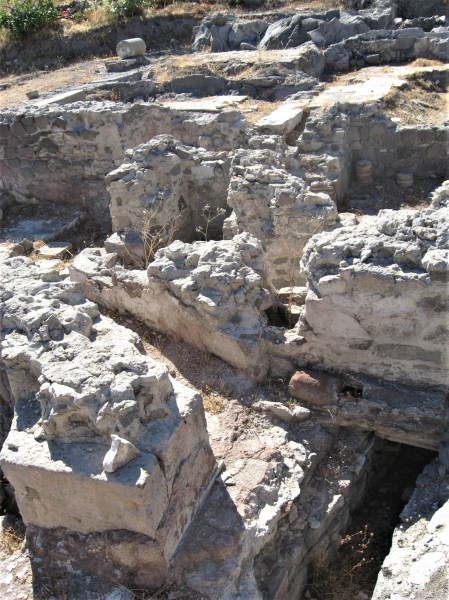
1051
Picture 610

While staying in Mithymna, I was fortunate enough to meet a local archaeologist who gave us a small tour of the closed excavation.

Picture 401
Finds from this trench were rich in pottery and sea shells.

At that point, they had a great deal of pottery and many interesting rubbish dumps from the Roman period. It appeared that they were producing pottery, and likely distributing the wines in vessels made at this centre.Roman Tombs MolyvosWith the political upheaval in the 5th century AD of the western half of the Roman empire, Lesbos fell into the orbit of political authority from the Byzantine power-base of the eastern empire. This orientation affected the flavour and practices on the island as Christianity became the prevalent belief system and religious power throughout the empire. Greece 012Thank you for reading my blog!
Save

Save

14. Starting a PhD: a non-linear approach

2014-01-18 23.52.40
St. Andrews Cathedral…be seeing you soon.

For the last few months I have taken a hiatus from writing my blog to focus on applying for a PhD at the University of St. Andrews. What a harrowing adventure! From start to finish, it was a good 3-month process with dozens of re-writes, stress and the agonizing wait to hear back. Even starting early, and following advice from friends and online, there were so many unknowns going into it. There were many moments of self-doubt, which had the uncanny ability to creep in when I needed it the least. With the support of some amazing teachers, mentors and friends, I managed to get someone interested in the incredibly nerdy stuff I love – Roman Aegyptiaca. In a post coming soon I will write about what that is, but for now…I will be studying Egyptian-looking things in Roman cities.

2014-04-23 15.00.19
Khoiak Procession from the Nile Mosaic of Palestrina, Italy (2014)

While the outcome might seem straightforward, (person X likes (topic), studies Y = goes on to PhD) the path is rarely as clear as this. An interesting part of the curation on social media, is all of the crap that you don’t want people to see can easily be ignored, not reported or underplayed. I focus and emphasize the things that I am most proud of, that arguably demonstrate a clear connection to my goals and objectives. It’s not always a conscious choice, but it excites me to share upcoming adventures (research trips, excavation work, conferences etc), and even if those activities are the exception to fairly humdrum periods of time, I try focus on the positive and engaging elements in my life. That curation presents a deceptively well-planned and linear pathway however.

IMG_7555
Roman road excavation. Merida, Spain (2014)

Like many people in the ‘millennial’ category, I have taken a strange circuitous route to finding a path. For many years I was uncertain what it was I wanted to do, or how I would even get there. My professional or academic shortcomings would emerge when I contemplated pursuing any concrete direction. Supporting myself through school involved things that looked remarkably unrelated: Italian train information CSR, custom picture framer, freelance artist, call centre CSR, book and video store sales person, maternity store sales clerk, telecommunications CSR, office administrator for an engineering firm, work-study intern with a museum, housing assistant, university credit secretary, repairs assistant, catering delivery driver, and endless amounts of ‘exposure’ work (free) and side-hustle to get through.

IMG_1975 (2)
‘Work for exposure? Oh can I?’ Roman wind chime. Merida, Spain (2014)

Despite working in areas that for many would happily suffice as a career, I have always been half in and half out. Every work placement is an opportunity to learn useful skills, but nothing had any real resonance to me or inducement to stay long term. I always had an eye to what might be ahead and to apply to any and every opportunity, often ending comfortable employment for a scrambling uncertainty.

20161031_134735 (2)
Egyptian relief. Louvre, Paris (2016)

Sure, I love ancient history, archaeology and art…but what can I really do with all this?
Throughout all of that, I knew I wanted to spend my life studying and sharing aspects of ancient history through art and writing, but unsure as to what my mixed-bag of skills would allow me to do. When I drew all of my work experience, hobbies and passions together a picture emerged that put the question to rest: I want to be an educator of Ancient History. Fundamental to this was attaining a PhD, and getting more focused and industry specific work experience.

2014-01-05 14.03.55-1
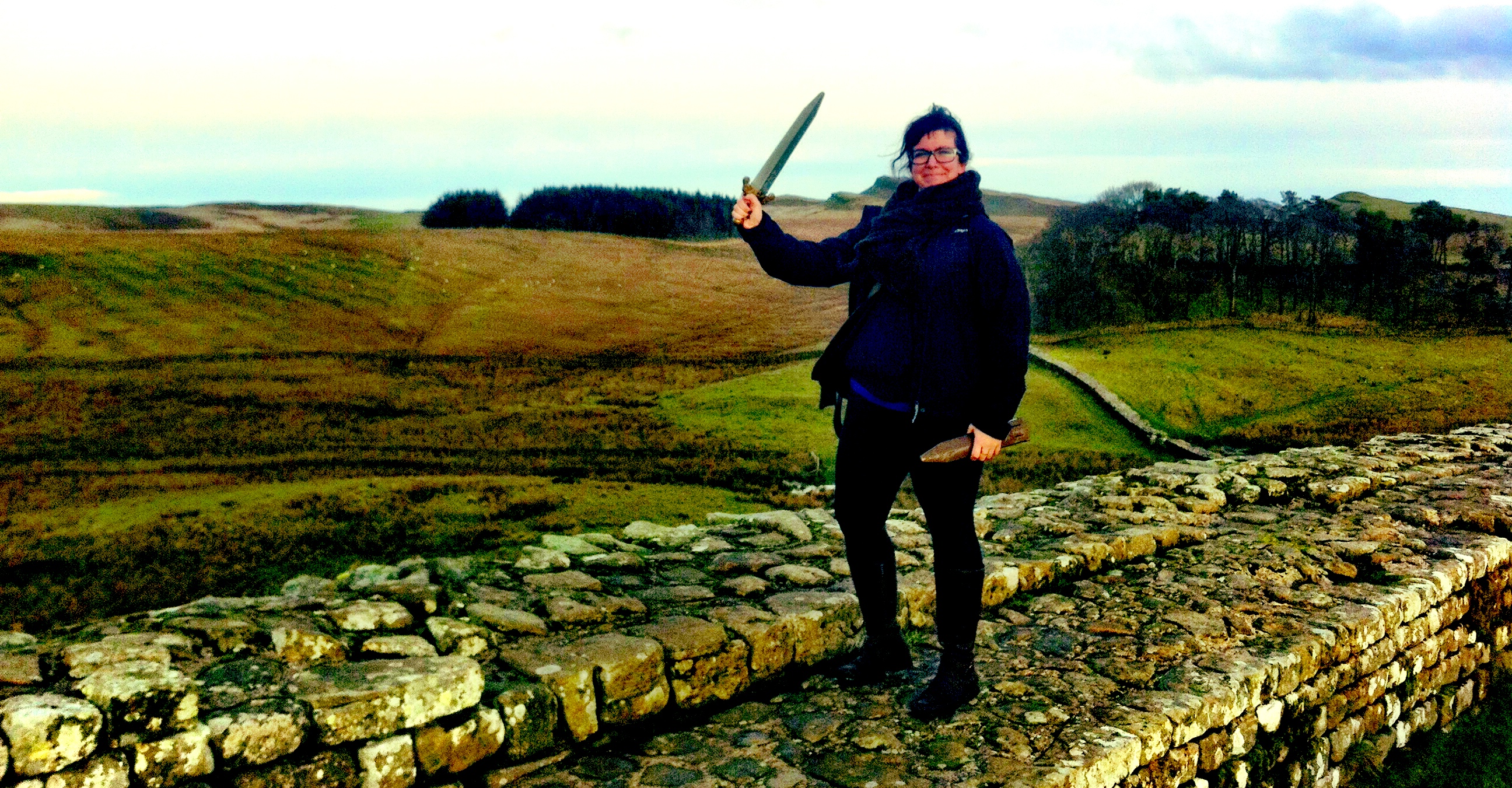
See? So much time spent on ancient walls. Hadrian’s Wall, England (2013)

Having been accepted to St. Andrews, I now have several months to plan and prepare – skills my varied work experience has hammered into me. Much of the existential angst of ‘what will I do and where will I be next?’ can finally be put to rest for the next few years. With the patchwork of experience that has sustained me, now behind, I look forward with more clarity and focus.

Save

13. Behind the Scenes: Learning to Supervise in Aeclanum

Learning to train archaeologists

After the two-month excavation in Policastro Bussentino last year, I was keen to improve on the skills I had learned. I had discovered during that excavation that I was actually really interested in taking more of a leadership role, but was not yet sure how much I knew, or yet needed to learn, to do so. A fortunate meeting with my former teacher, Dr. Ben Russell from the University of Edinburgh, alerted me to a dig that would be happening in Aeclanum (modern Mirabella Eclano) for September 2016. The excavation is an ongoing joint-venture with the University of Edinburgh and the Apolline Project(http://www.apollineproject.org/) with co-director, Ferdinando De Simone.

Dr Moodie-Currie, Dr King, and Me (from left) surprisingly clean !

With this in mind, I had been anticipating an exciting few weeks with two of my brilliant friends, both currently undertaking PhDs at the University of Saint Andrews and Edinburgh University. Packing for the trip (both passports in tow!) is one of the best parts…slowly I am getting more and more efficient.
With a few days spent adventuring and relaxing in Rome beforehand, we were all ready to get our hands dirty.

One of the most interesting parts of getting involved in a dig like this is that while the directors and supervisors were well-seasoned, the site itself was essentially starting in many areas with virgin soil. Previous excavations had been carried out several decades before (in a few areas), and more recently a commissioned archaeological dig had been done by a commercial unit. But a variety of reasons, the work being done in this season could be viewed as the ground work for the future of the site. That is an exciting prospect for anyone to be a part of, but I was especially keen since my understanding of how to supervise a trench was somewhat problematic. I was fairly sure there was a lot that I did not yet understand, but was keen to get in and learn.

Coming to train on this dig, I was pretty keen to support younger students and help them feel confident. One or two items tend to come up whilst excavating in field schools which I tried to be mindful of. Traveling alone for the first time and living in a large group can push peoples comfort boundaries (shocking, I know). So with experience traveling quite a lot in Italy, and the last six months of working for Italiarail (the American vendor for the train network in Italy, Trenitalia), we were able to give advice and help sort out peoples’ logistical issues fairly easily! All these things in mind, it was a grand opportunity and beautiful location.

The Site
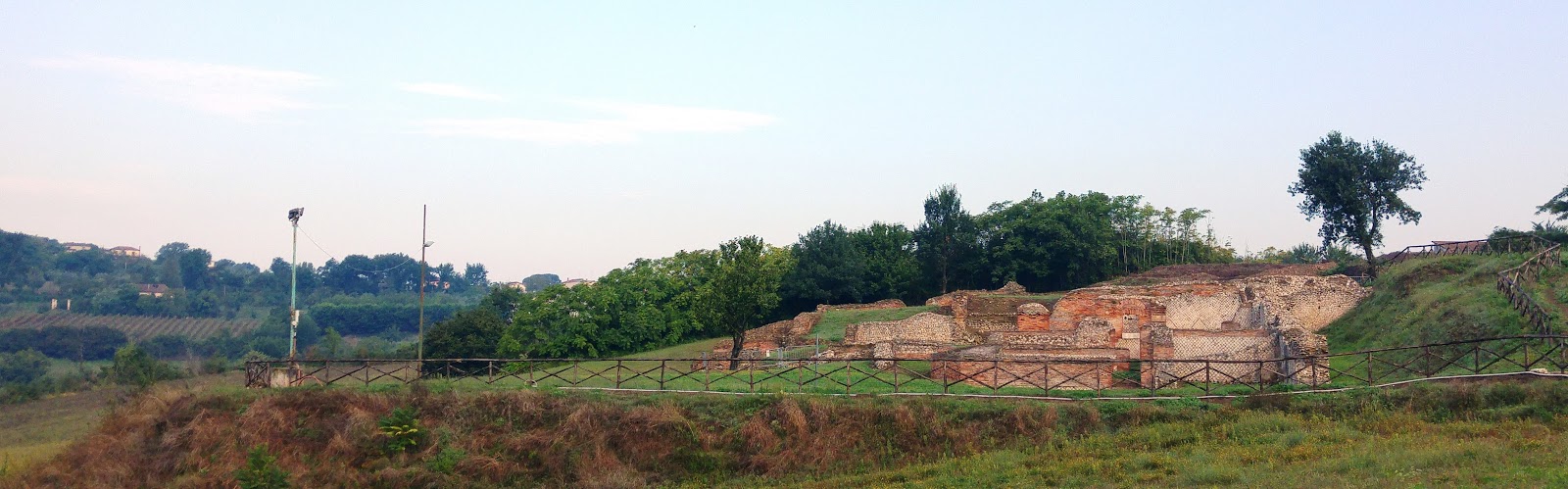
Aeclanum is situated in modern Mirabella Eclano,  Irpinia region of Campania (inland). Connected by the legendary Roman road-building, Aeclanum was situated in a central point along the Via Appia. During the Social Wars (around 89 BCE), Aeclanum had been sacked by Sulla’s forces. It was rebuilt, and seemingly flourished in the 2nd CE when it became the Colonia Aelia Augusta Aeclanum. There is evidence of many phases of rebuilding, additions and repairs/re-purposing until Aeclanum sort of disappears from history after 662 from the campaigns against the Lombards of Benevento.

The site itself was set within some idyllic green hills and edible vegetation was scattered throughout. Quite a few buildings were excavated and reconstructed already on the site, which drew tourists to this lovely town. Some building identifications are being reviewed, as new methodologies and interpretations were being applied to this site. There were number of specialists on-site to do digital mapping, ceramic analysis, and even drone photography (which took brilliant photos)! There were many types of dwellings, buildings and some roads visible. The scope of the site is not yet fully known, but there were many intriguing possibilities.

Our group was a mix of University students from all levels and people who came on this dig to get experience for a career shift as they sought to start a new direction in their lives, which is always commendable!

The energy and efforts of the students was amazing. Rain or shine, our team of Saggio Cinque was a hard-working group, and hilarious. My senior supervisor (who I tried to learn as much as possible from) brought very approachable and engaging teaching methods to the site which was a huge help.

Of course! The work is so beautiful on its’ own that it seems a completed decoration. Though I cannot do the architecture justice through simple quick pen sketches in my Moleskin, I do keep trying!

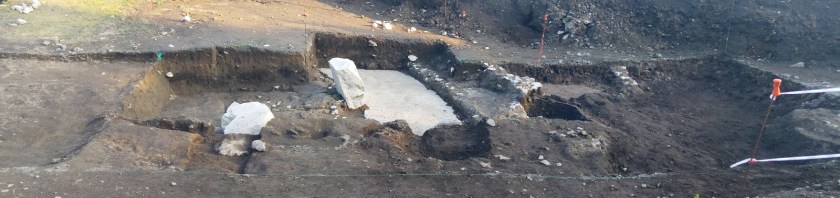
All in all, these were not box-ticking learning objectives, rather an attempt at trying to give a taste of the concrete outcomes they needed to start a career in archaeology. I may have only a few weeks as a junior supervision, but it was incredibly informative right away being on the other side of a field school.I can’t go in to much detail, or perhaps shouldn’t, as it is an evolving and ongoing project and season, so what I can say about what we encountered in Saggio Cinque (now famously under the hashtag #SaggioCinque) was the following.

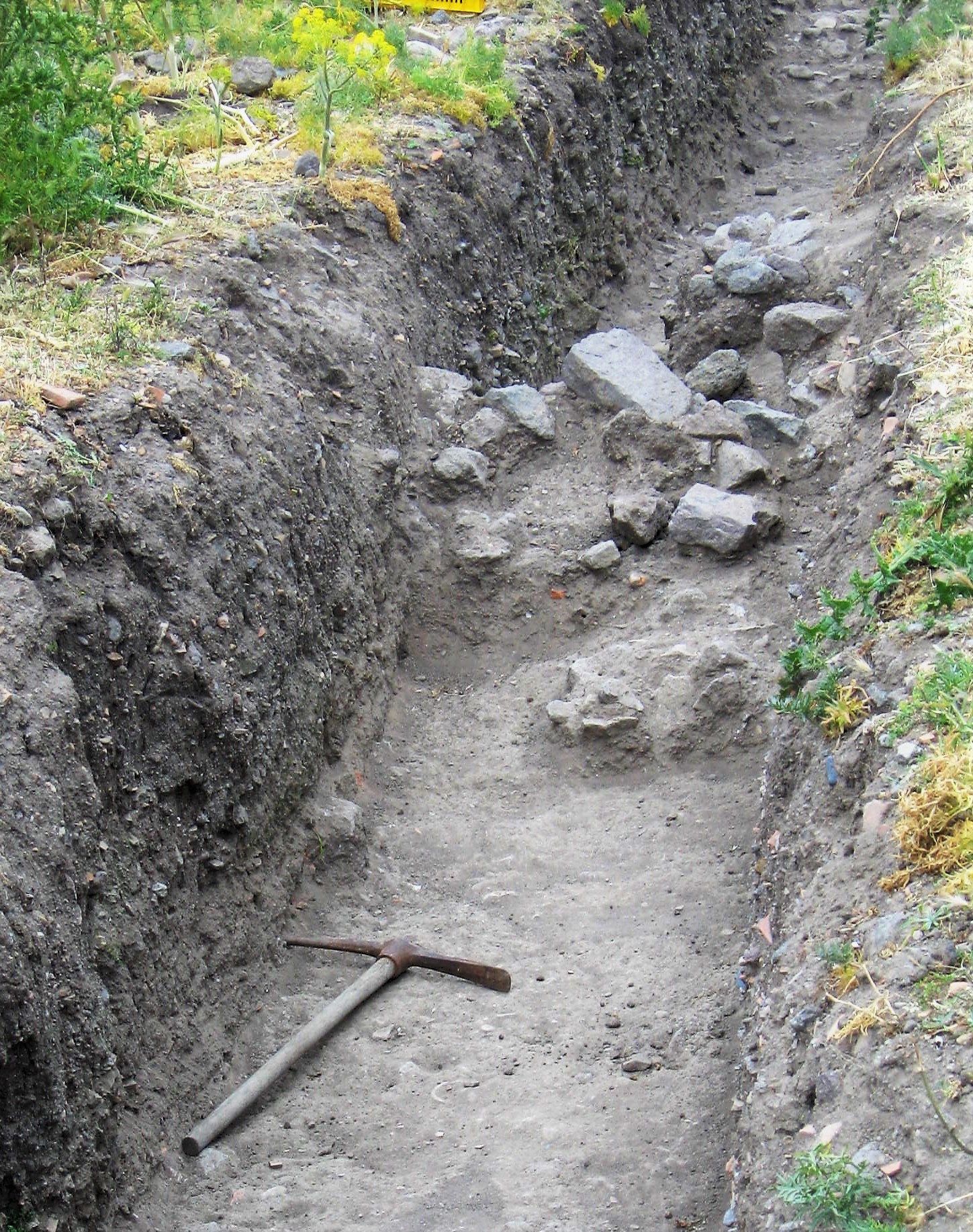
My previous dig experience in Greece included evidence of ancient and modern grave robbing. Working on a salvage dig was fast-paced and quite hush-hush about what we found, since the graves were near the surface and not hard to spot. Whereas, what was surprising in Aeclanum, was seeing the evidence of someone trying to remove the massive limestone slabs (unsuccessfully) and apparently giving up. Poaching finished building materials and re-purposing them for newer buildings was pretty standard practice in antiquity,  but it was interesting to see evidence of a failed attempt.

Local politics and archaeology
Whilst our archaeological field school lodged in Mirabella Eclano, there was a bit of a press furor going on around us. A sign was put up near the site, “Archaeologists in the Nursery, Moms in Revolt”, publicised a local misunderstanding about our accommodations. This strange bit of press, while seeming contentious, actually gave the opportunity for some interviews on site and publicised some of the exciting things we were doing. 

To hear an interview with our site directors, you can check out this Sound Cloud link: https://soundcloud.com/airadioariano/aeclanum-sta-per-concludersi-la-prima-fase-della-campagna-di-scavo

Mirabella Eclano 
The town of Mirabella Eclano was full of affordable little restaurants and bars, beer festivals, and very pretty views. The people of Mirabella Eclano were always very kind and gracious. I had a lot of great conversations using a mixture of French/English/Italian with quite a few locals. There were some real gems of cafes and restaurants; my favourite cafe, Zucchero e Vaniglia, served some incredible pastries and perfect portable coffees- superior additions for a dig break. Our main port of call, however, was the cafe/bar at Hotel Aeclanum. Many drinks, chats and post-dig hangouts took place at this hotel bar.

If you are curious and would like to find out more or maybe get involved, please check out the Apolline Project Website: http://www.apollineproject.org

Ciao for now!

11. Roman Glass

Roman glass collection at Three Hills Roman Heritage Museum – Melrose, Scotland 2016

Spending time in museums throughout Europe, you frequently see examples of ancient glass. When I started to look through my photos, I noticed that I am consistently drawn to the delicacy and incredible skill of glass objects. Egyptians, Greeks and Romans achieved incredible feats through their splendidly colourful, highly decorated and inventive glassware. As broadly as we might imagine using glass objects today, there were items for specific purposes (perfumes) or more banal uses (water). From the most utilitarian to the highest prestige item, the presence of Roman glassware is one of the most enduring, yet delicate, symbols of empire that remain.

The Portland Vase, British Museum. 1st century CE cameo glass, 2016.

Early glass production was an elite (read: desperately expensive) tradition from the Hellenistic period, inherited from the Egyptians, which involved densely coloured glass. The small faces below give you an indication of the opaque colors, often used in beads and small functional objects d’art.

Small glass theatre mask ornaments, Museum of Egyptology of Turin, 2016.

The consumption of glass items before the 1st century AD, would have been limited by cost and access to skilled artisans. The Romans incorporated previous techniques and over time made it’s production truly their own. Interestingly, however,  at this point there was still no Latin word associated with it.
Through changes to techniques of manufacturing glass, new styles and skills were developed in Italy.

Roman Vessel, British Museum, 2016.

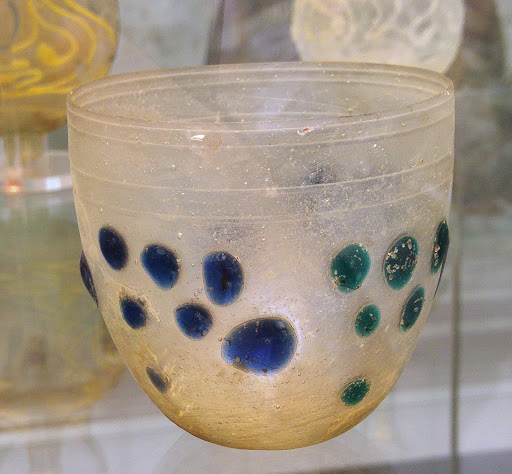
The production of glass during the 1st century CE was so ubiquitous that the ‘Aqua’ and clear coloured glasses produced within the empire were priced into common consumption. Glass was no longer simply a decorative series of beads on elite necklaces, or thick-walled vessels of the Hellenistic period into the late 1st century,. With Roman inventiveness, soaring thin-walled vessels which used pigments and lines display the skill of the craftsmen to show pearl hues, and movement on the vessels’ surface.

The dexterity, grace and occasional silliness in the manufacture of Roman glass products is a overlooked aspect of the study of Roman material culture. Not ignored, but next to a beautiful statue or sword, a tiny perfume bottle might not seem that interesting.

Roman Perfume holder, Museo di Antichità Turin, 2016.

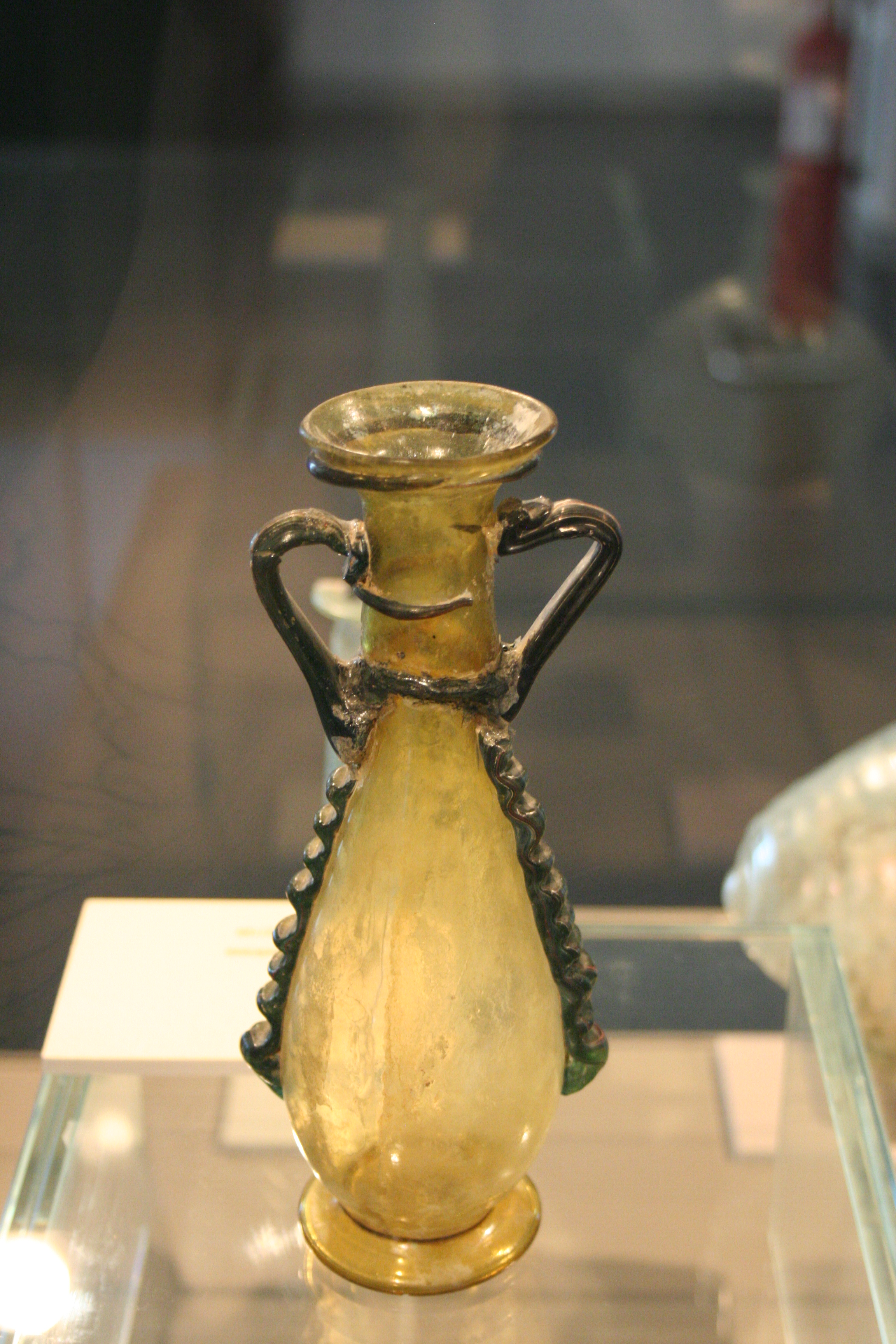
These small vials contained perfumes and precious oils, chalices for fine mixed wines, and other vessels for elite good. Sometimes I wonder if they were show-pieces or of a more personal nature perhaps?

Portrait on glass , Naples National Archaeology Museum, 2015.

The cost of the items would suggest they were probably kept on display, but it is hard to know. Serving items would imply a public-use, and thus on show, but perfume bottles for a woman’s toilet could have been a more private piece of consumption.

These gorgeous glasses were made of combinations of these elements pictured below, with added including colourants:1.Sand; 2.Potash; 3. Seaweed ash; 4.Lime; National Museum of Scotland.

The Cage-Cup
On a recent visit to Milan in April, I had the incredible fortune to not only meet up a burgeoning academic in the fields of religion and slavery in the Ancient World, but also a local expert of Milan’s historic sites! Ambra Ghiringhelli, an PhD student with the University of Edinburgh, showed me some of the wonderful archaeological sites in Milan with fantastic local details. One such item she drew my attention to was the cage-cup of Milan.

Cage cup of Milan, Museo Archeologico Milano, 2016.

The striking combination of glass colours and types; geometrical patterns, in contrasting colours from the inner cup, sit on top with lettering. The skill required in putting together something like this would have been quite sophisticated. There are multiple techniques involved, which scholars are still not in total agreement on how this was precisely done.

Silver base cage cup in National Museum of Scotland, 2016.

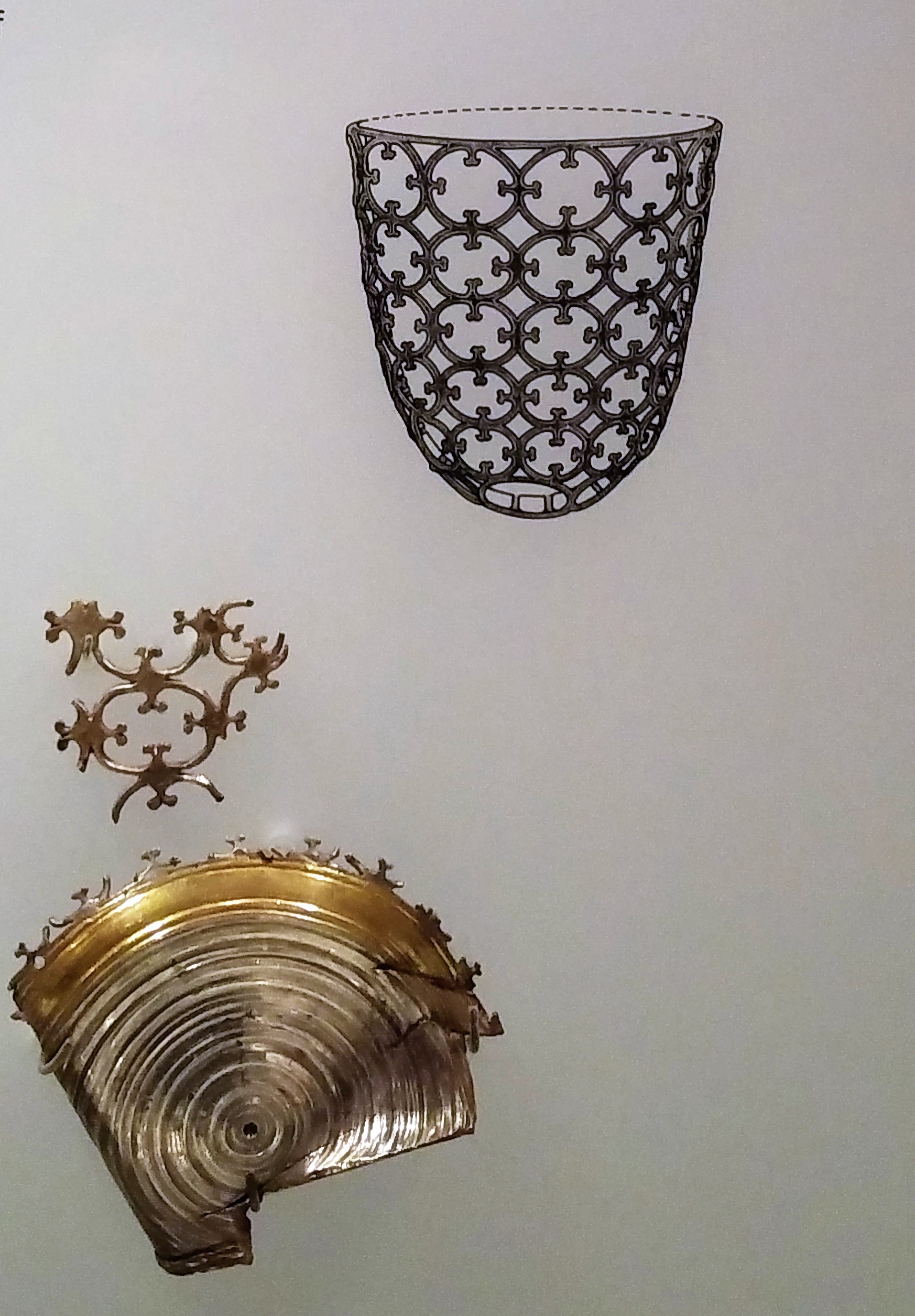
The National Museum of Scotland, in Edinburgh, has its own example of a Roman cage cup found northern province of Britannia. The Edinburgh cup is made from metal but follows the same principles.
There are around 50 examples of cage-cups examples found so far, though the Milan cup is truly a wonder of antiquity.

Thank you for checking out my blog, and feel free leave questions or comments!