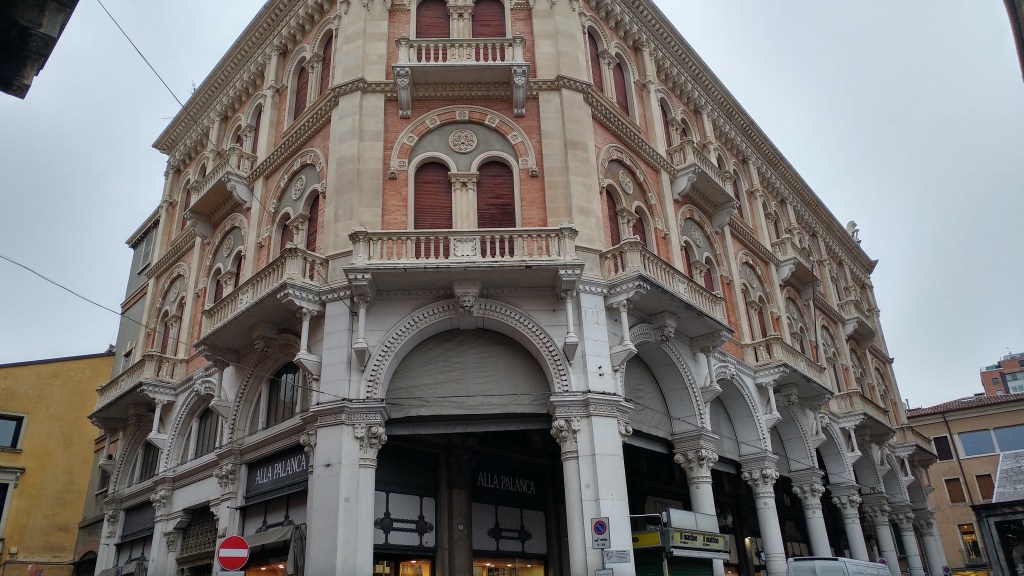
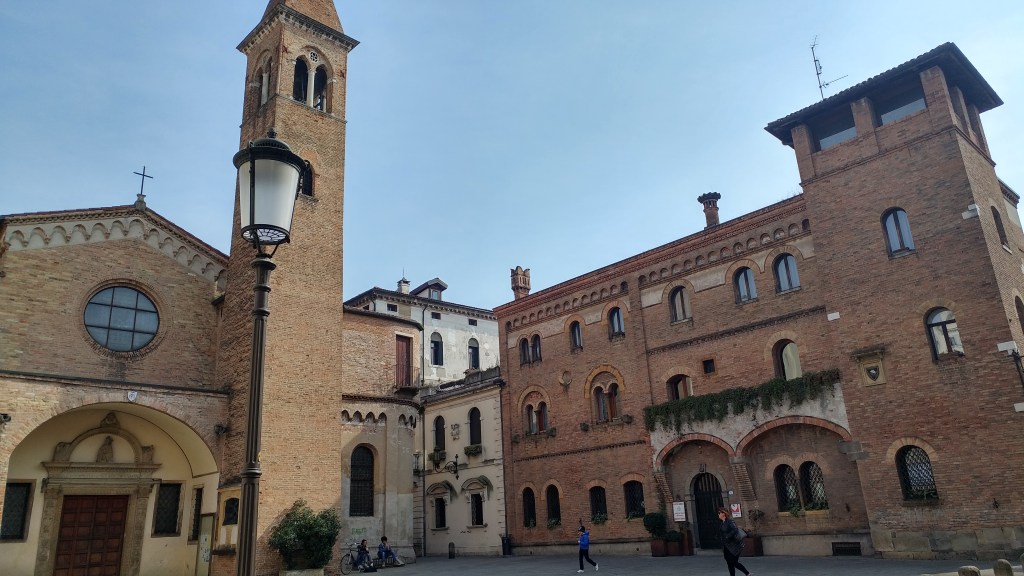
In fair Padua, where we lay our scene…My Shakespeare may be a bit dusty, but that is definitely maybe how that goes, right? There were certainly enough ‘Juliette windows’ to make you think you might be stepping into a Shakespearean play!
Until recently, Padua was an elusive northern Italian city in the Veneto on my list of places to visit, but I’d never quite made it up there. With very limited experience in northern Italy, I planned to surprise my husband for his birthday with a weekend in Padua. We packed our bags and hopped a flight with a friend and colleague, Dr Lucia Michielin, to stay a few days in her hometown and experience the city, the mountains, and her family’s gastronomic traditions.
Bacchiglione River
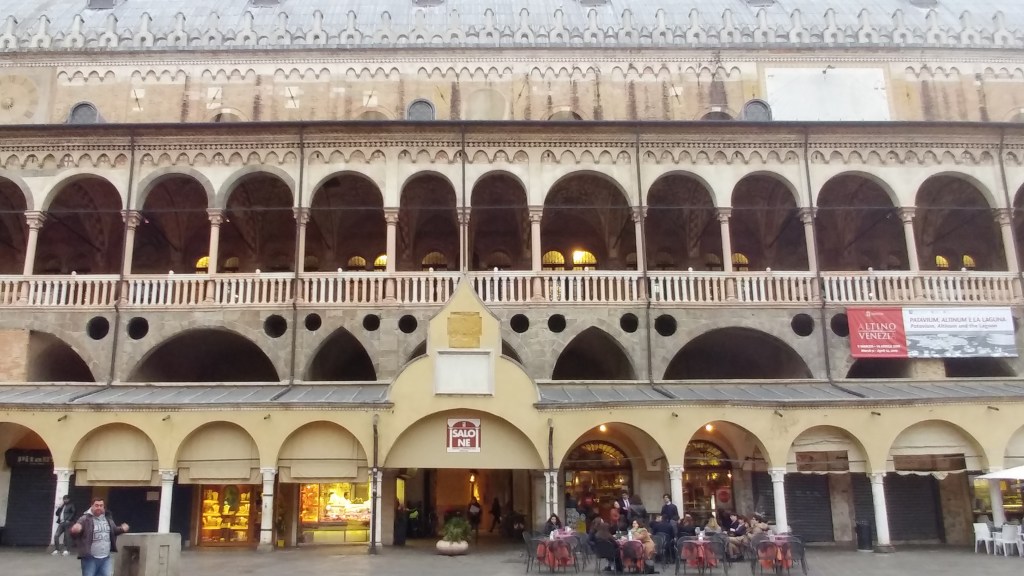
Padua is radiant, serving you sunshine with arcaded walkways and boutique shops for days. The history of Padua is etched into the very walls of the shopping areas! Markers of older commercial activities, as pointed out by our knowledgeable local hostess, created in a few different shapes to suit several types of common products to make sure no one was getting ripped off.
Measurements for breads and presumably meats, carved into the old stone walls.
Piazza delle Erbe was a bustling residential area in pre-Roman era, then with intensification of urbanization, this area took the form of the piazza it is now by the 10th century CE. Within Piazza delle Erbe, the market is elegant and layered from the outside, and on the inside there are all sorts of traditional food items sold. The butcher and cheese mongers were mouth-watering.
Roman & Early Renaissance Padua
The archaeology museum of Padua had some Roman finds that I hadn’t come across before: a stargate- I mean, “well”! Obviously, we took silly pictures inside it.
Remains of an amphitheater are found in the city center near the Scrovegni Chapel and the Eremitani Museum of archaeology and art. Well worth a visit, though there was nothing pertinent to my research there, the banter is always fun when walking around an archaeology museum with a colleague.
Coming to Padua, we were most excited about visiting the Scrovegni Chapel with the famous fresco paintings by Giotto. Having studied this chapel in art school, I was really keen to see it in real life. Painted by Giotto and his workshop over the course of nearly two years, the chapel was consecrated in 1305.
The pictures don’t do it justice; the blues are electric and packed with detail. The vibrancy and realism for this period innovative, well in advance of when we would typically expect this type of work in the Renaissance. Giotto preceded them by 200 years!
From a heritage management perspective, the way they regulated tourism and its impact was clever. Taking small groups in at a time, allowing the temperature to acclimatize through a series of waiting rooms, visitors can explore but also preserve a fragile painted environment. It was a real privilege to see this chapel, and their conservation programme will keep it vibrant for years to come.
Some quick sketches from the trusty Moleskin
A drive to the mountains
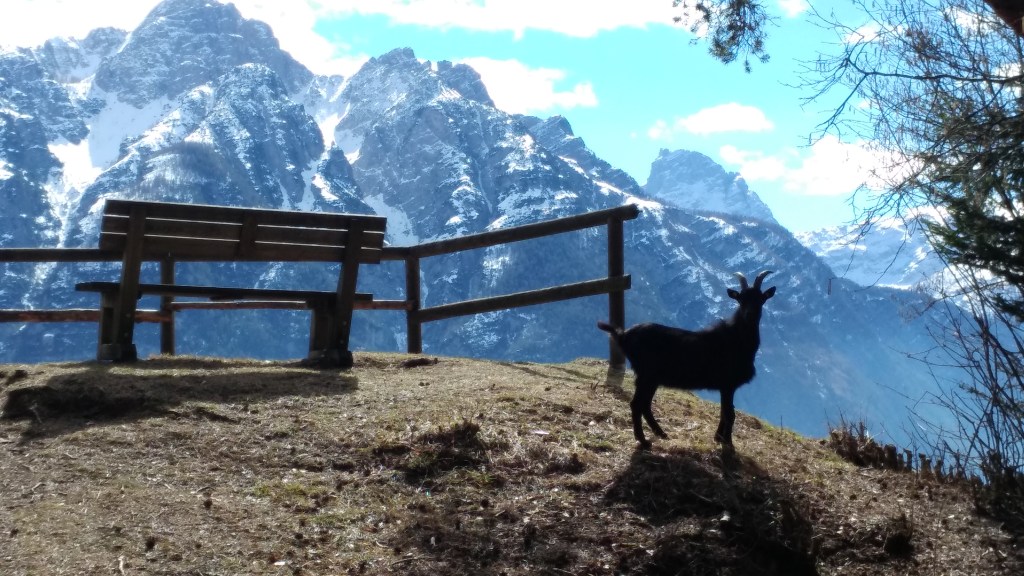
One of the spectacular views from the mountain trail.
Calazo di Cadore
After a day in town wandering and feasting, our hosts took us on a drive to their familial mountain home. The drive up was full of twists and turns, and the crisp air with gorgeous views was lit!
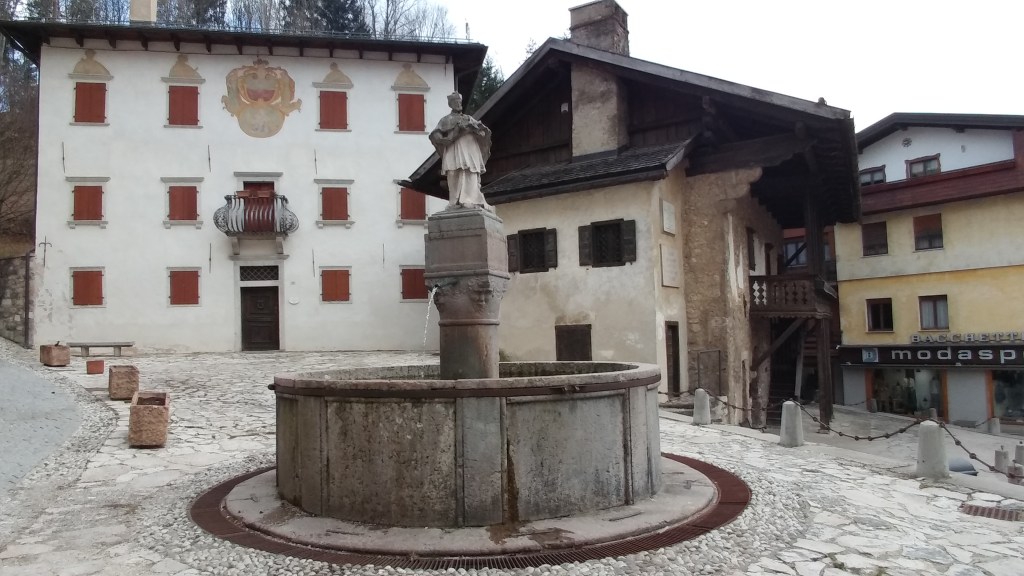
These gorgeous old buildings lined the road up to the family house above the quiet center of town.
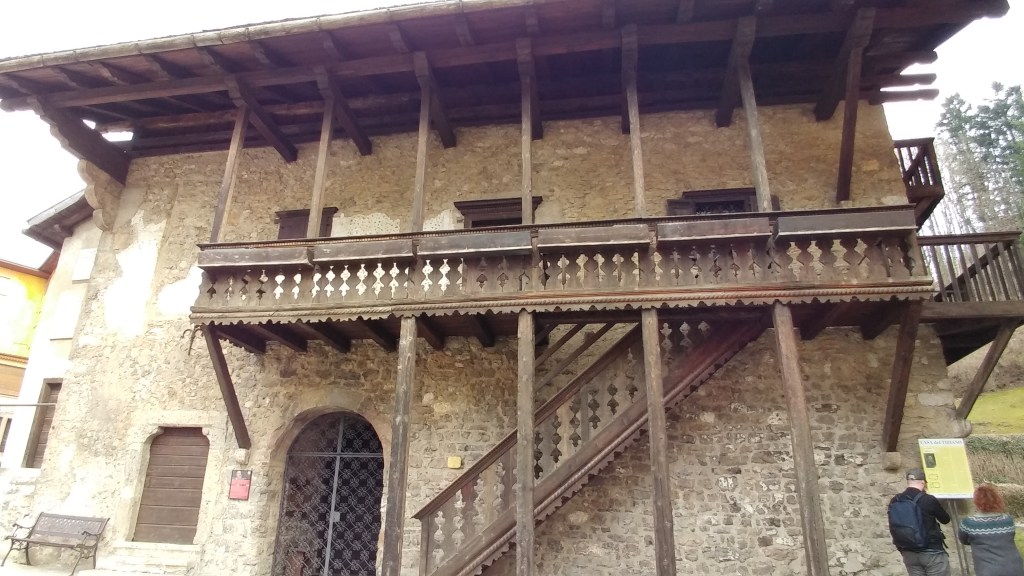
Scooting around Lago di Centro Cadore along the narrow walls of the dam I clutched at my pearls, it was beautiful and harrowing. I was grateful to not be the driver on this occasion! Whilst sauntering around the quiet and picturesque town center, we passed by the home of the famous painter Titian. Famous for the use of electric blues in paintings, extending the colour to subjects beyond the decoration of the Virgin Mary’s robes, one got the sense of how much this stunning blue was part and parcel of experiencing this area. The sky, the mountains and lakes were all so vibrant.
The house of Titian and an enviable balcony. Our horny visitor 🙂
Within this packed daytrip, we saw gorgeous mountains, walked around a park and had a gorgeous rustic little sammich with tasty local meats! I could spend a season tucked away in one of these historic cabin homes enjoying the view. As a girl from British Columbia, the mountains are always calling me, and these mountains did not disappoint.
Padua Foodies
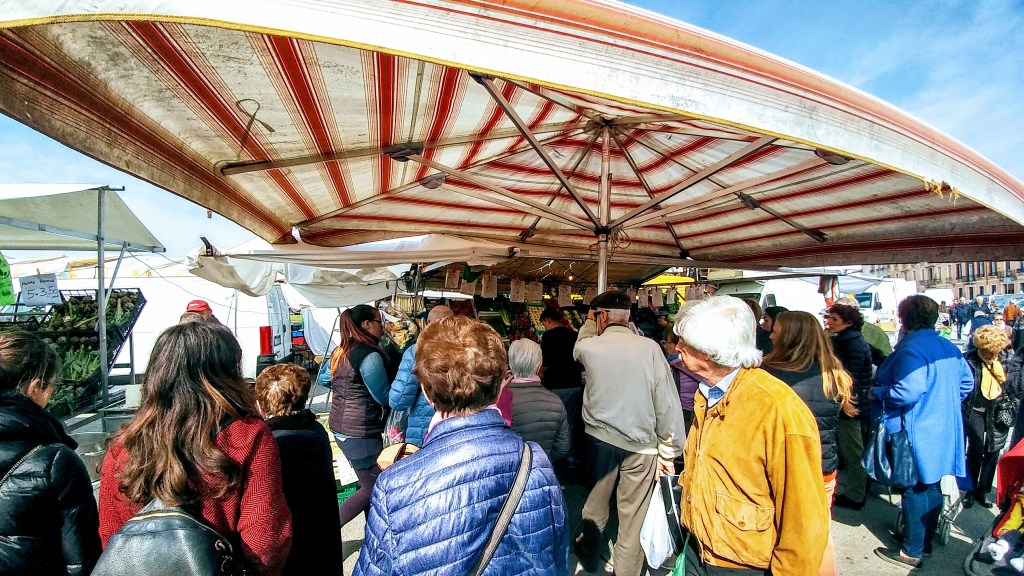
Wandering around the market area, I instantly regretted that I only brought carry-on luggage.
Within a 72-hour period, we sampled a significant array of incredible culinary delights. It seemed impolite to take photos at the dinner table, but I can assure you, each meal was like a delightful sampling of many dishes.
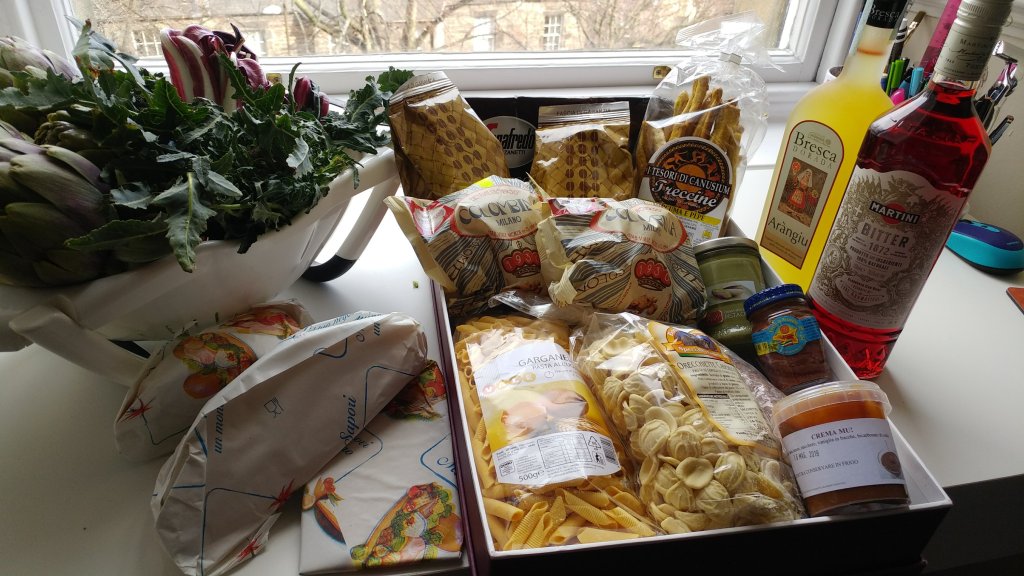
In my attempt to broaden my horizons in the kitchen and decrease general consumerism, I’ve taken to buying foodstuffs as culinary souvenirs. I am excitedly trying my hand at these dishes, and slowly learning about the ethos of Italian cooking. While I will NEVER give up my afternoon cappuccino no matter how many taboos that crosses, I am willing to abide by SOME culinary rules when the results are delicious.
The market had clothing, household goods and lots of gorgeous fruits and vegetables!
Our generous hosts took me to local farmer’s market, butchers and grocers showing me which ingredients to use to try and replicate the dishes they cooked. It was the most magnificent bounty I have ever seen; the blessings of Fortuna were upon us. The greens, artichokes, creme caramel, fresh cheeses and meats were probably the best souvenirs I have ever brought home.
Coming from Canada, I was mind-blown that we could bring back so many incredible fresh staples on a quick flight. Fresh ricotta in checked luggage? Yes please.
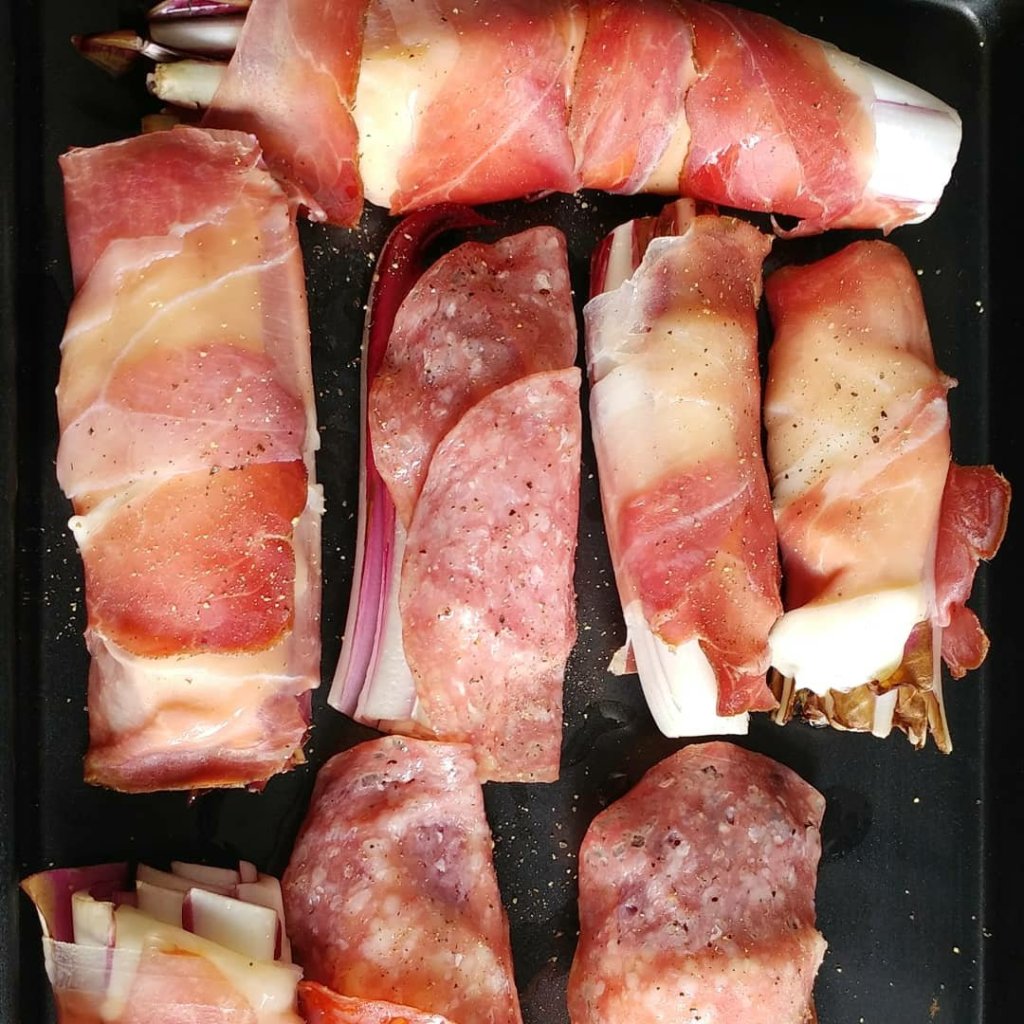
Once we were back in Edinburgh, I wanted to try my hand at a wee dish that our lovely hosts made one evening. Parma ham wrapped radicchio and local soft cheese.
The flavours of the fresh produce were fantastic, and being a heathen, I even played with other types of meat to wrap the radicchio and cheese.
The results were delicious.
Many of our trips take us to locations where we have friends and colleagues, which offers such a rich and interesting way of experiencing a place. Spending a weekend with the Michielin family made me fall in love with Padua and get a little more culinary confidence!
With the 2019 Open Day at Roman Aeclanum, this post reflects on the last three years of public outreach development I have worked on in Passo di Mirabella, southern Italy.
Frequently, I am asked what on earth I am doing in Italy. Why all the cartoons? What’s it all for?
In 2017, I was given the opportunity to work on an excavation with the Apolline Project and the University of Edinburgh in Passo di Mirabella, Roman Aeclanum, as the Public Archaeology Coordinator. This was an new direction for my work with a lot of exciting potential. The hobbies that I naturally gravitated towards ( included travel photography and illustrating, blogging and other forms of social media) coupled with the subject matter I enjoyed (archaeology and art history) formed a useful starting point for conceptualizing how to approach outreach for an archaeological site with minimal public exposure. Over the next three years, I worked towards creating interconnected projects that were designed to start a narrative of the history of the site and began the groundwork for Vita Romana: at the baths of Aeclanum. With support from the University of Edinburgh’s History, Classics and Archaeology department and the Institute of Classical Studies, I have been fortunate to share these public archaeology activities with the wider academic community working in Classical engagement.
Public Archaeology: why does it matter?
“Public archaeology is really just public relations. It is getting the public interested enough to care and those who care interested enough to engage.”
– Dr. Jody Steele is the Heritage Programs Manager at Port Arthur Historic Site Management Authority.
The role of public archaeology, within the umbrella of specialisms of archaeology, is finding relevant and interesting ways of communicating the research objectives and material remains of the site. The sub-discipline is still new, and as such, still strives to justify itself and the importance of the work. Future funders, archaeologists, politicians and so on learn about the importance of heritage as children in most cases and as such, continuing to hone and develop how we deliver these messages about the importance of heritage management and research is fundamental to its continuation. With no exaggeration, if people are not engaged and well-informed about the importance of archaeology, it simply won’t happen nor will it receive funding.
Running a public archaeology programme or project requires marketing and public relations work, it also is heavily reliant upon the skills, expertise and historical knowledge of the individuals behind the work. By focusing first on the relationships within the local community then translating those interactions and efforts more broadly, we managed to do some pretty cool and unique things!
Outreach materials are useful in a variety of contexts! This year, site specialists gave informal seminars to dig students, making use of the boards that we’ve used at previous open days!
These ideas were articulated by our site supervisors this summer in a video made by one of our student volunteers, Jazz Demetrioff. The research objectives set at the onset of the excavation shape the direction the excavation and thus outreach will take. The research questions are answered over the season through the material culture and structures discovered. I have spent a significant amount of time thinking about and trying to articulate why public engagement matters, and how the projects I have had the fortune of working on in Italy are helping me plan future outreach projects.
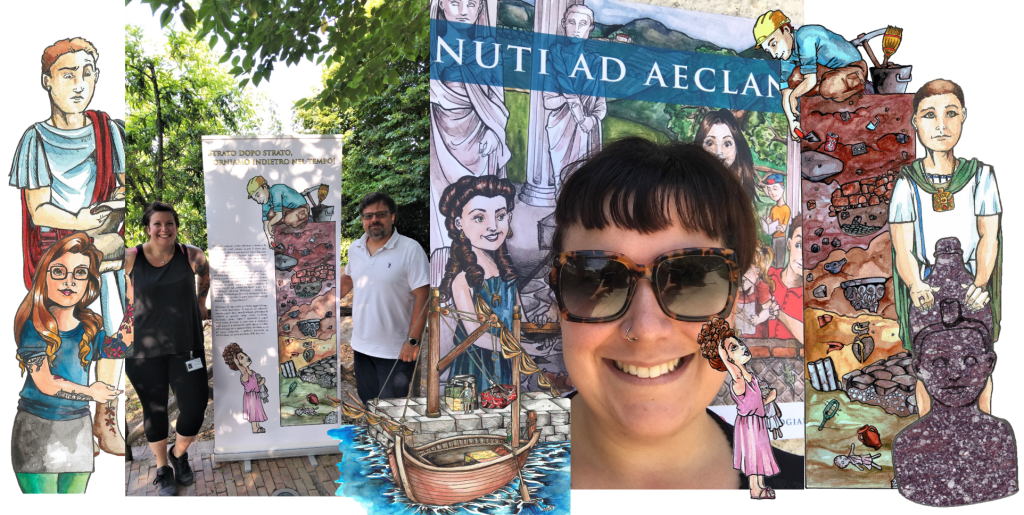
The progress of inking, watercolour then handing over to Josef to embed the real marble colours! These marble trading characters may or may not be based on Chris and I 😉
Public Archaeology in Aeclanum: 2017-2019
Archaeology Passport covers: 2017, 2018, 2019
First Year: 2017
The formative work with the archaeological site of Aeclanum was a mixture of reconnaissance and coming up with a cohesive set of materials we could begin presenting to the local community. When we arrived there was one pamphlet in Italian with very technical (scarce) archaeological maps, and no site signage or historical narrative for the site. The first steps, then, meant creating some basic materials for young visitors!
Second Year: 2018
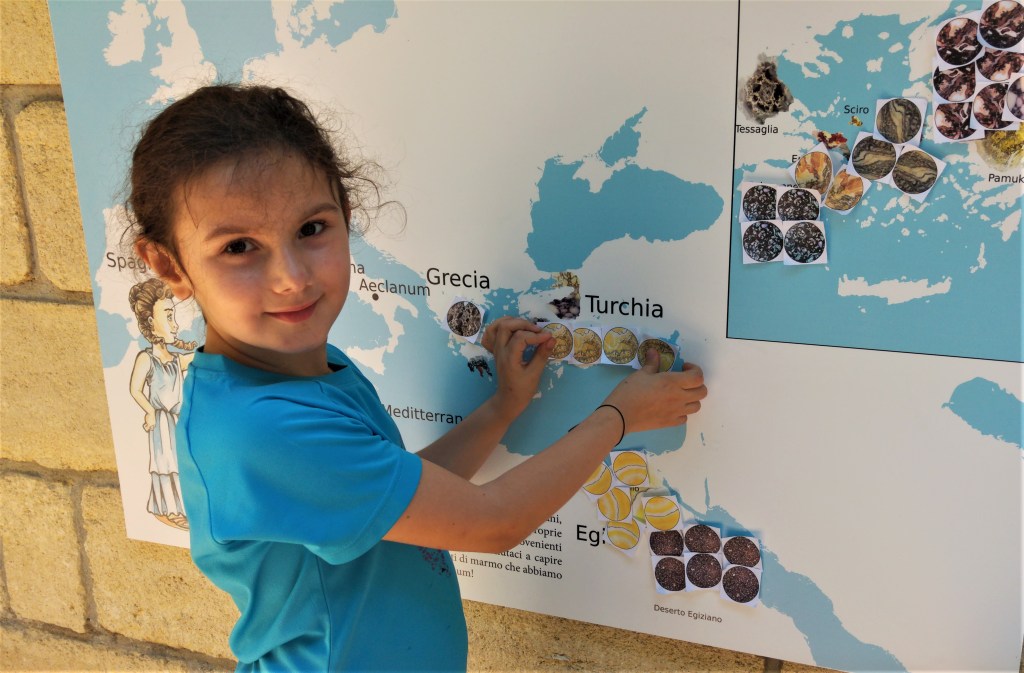
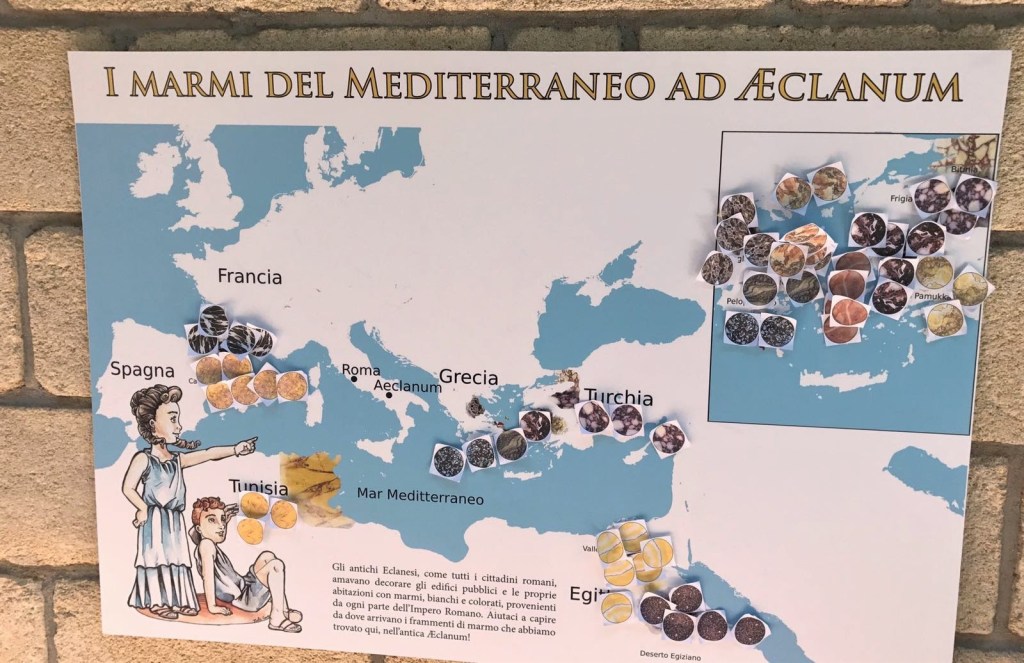
We produced outreach materials that focused on the multi-phase bath complex and the role of public bathing in Roman daily life. This included posters for adult audiences and young visitors to the site which reflected the finds that were excavated in earlier campaigns and the current research. A particular favorite was the marble map game, which encouraged kids to explore where the marble in Aeclanum came from! We updated the game in 2018 to include further details like marble traders across the Mediterranean!
Neratia’s Lost Ring: at the baths of Aeclanum
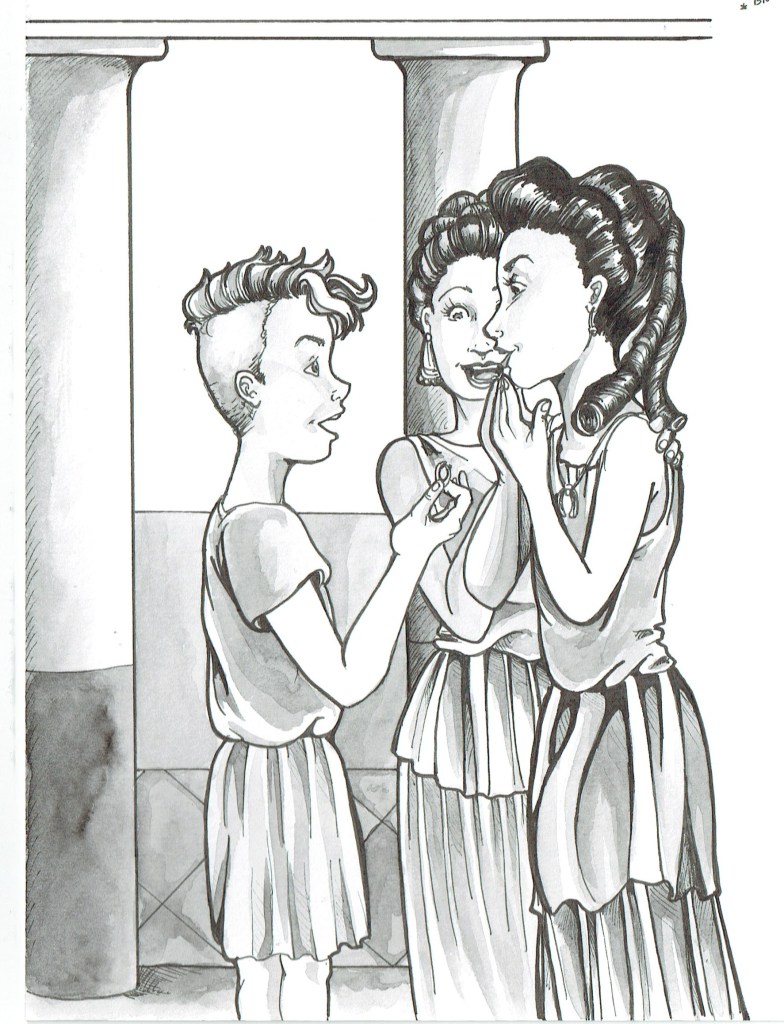
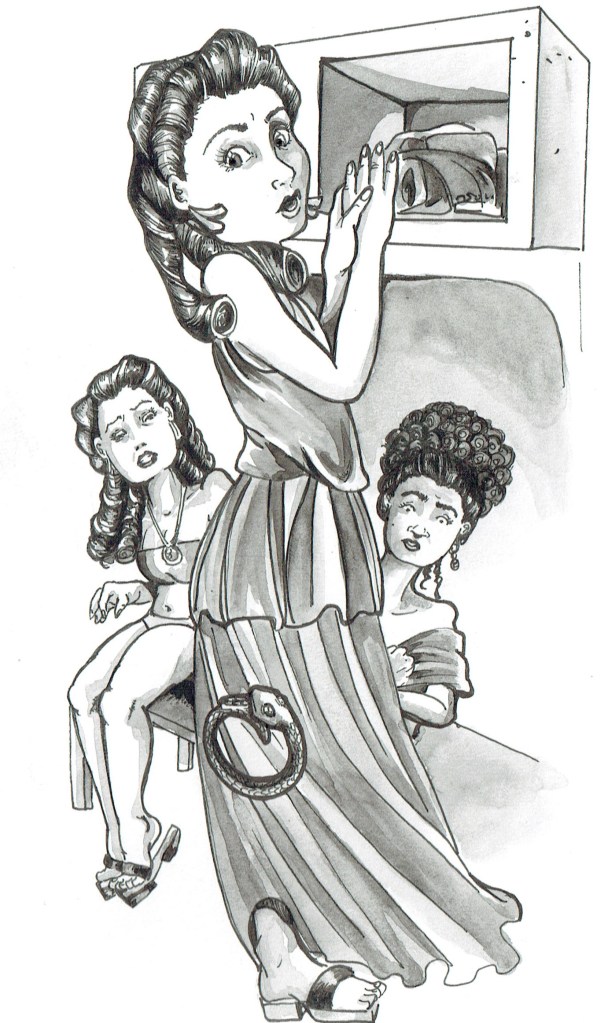
Emily Johnston, an excavation supervisor, worked on a public outreach project with the Apolline Project for 2018, Neratia’s Lost Ring: at the baths of Aeclanum. This exploration of Roman baths in a short-story format, allows the reader to get to know the space and customs as experienced by Neratia (wealthy patrician’s daughter) and Caius (freedman’s son). As the narrative follows the youths trying to find Neratia’s missing ring, the mechanics of the bath complex are explained. I supplied a few illustrations for her story, which were linked into the graphic novella! We are hoping to launch this short story for winter, 2019.
Caius finds the ring!
Quick! Catch the ring!
Neratia drops the ring her father gave her.
The graphic specialists on site, Lucia Michielin and Josef Souček, worked with me across almost every peice of art that was used for outreach. Their talents were widely appreciated, like finding a pretty rock but not realizing it was a gem till it was polished. Their skills with creating scientific panels based on the research, articulating the architectural findings and included 3D reconstructions of the significant archaeological structures reconstructions were essential to my comic renderings for Vita Romana: at the baths of Aeclanum. Due to the topography of Aeclanum, the bath excavated bath complex straddles a sloping hill and as such has distinctive buttresses, which when digitally rendered, provided helpful insight on how to include the city scenes around it.
Views of Aeclanum: bath complex, forum and theatre, temple and portico
Third Year: 2019
With the first two phases of outreach work at Aeclanum complete (panels, the short story, scavenger hunt and educational games), the next phase I was most interested to explore was getting feedback from the community and channeling this into a project that could capitalize on the knowledge of the team of specialists on-site and include up-to-date site interpretations, woven within the comic narrative. By concluding the 2018 outreach season with a survey and vote by the children from the local community who decided which style I would be drawing the comic in, I had my marching orders to get to work on the comic!
With Vita Romana, I wanted something that might help spark imaginations about how big and interesting this city was during its heyday through a stand-alone story, but grounding it in the real-world buildings and materials of Aeclanum. Also, I had never completed a comic book before and this was a challenge I wanted to dive into!
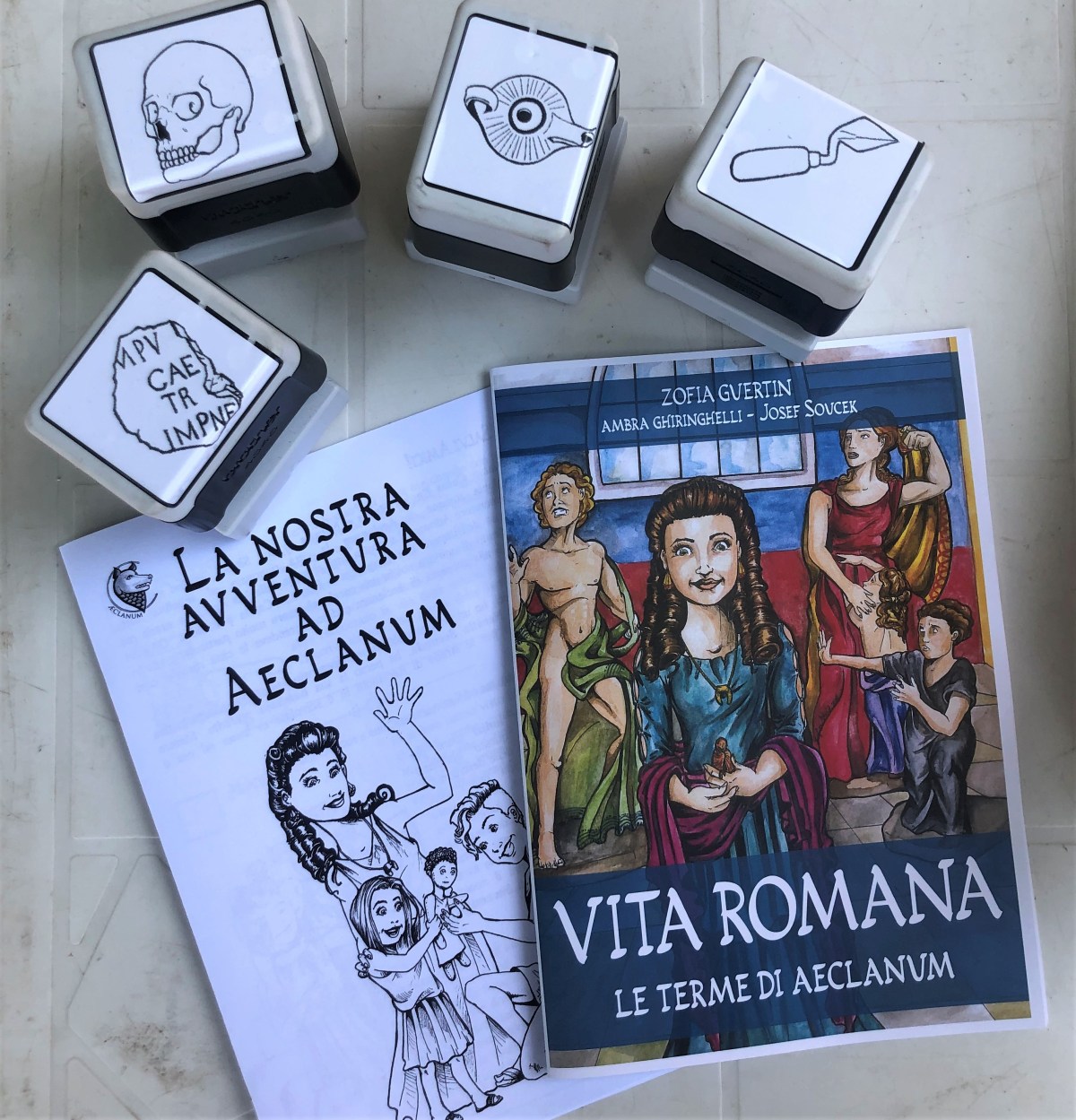
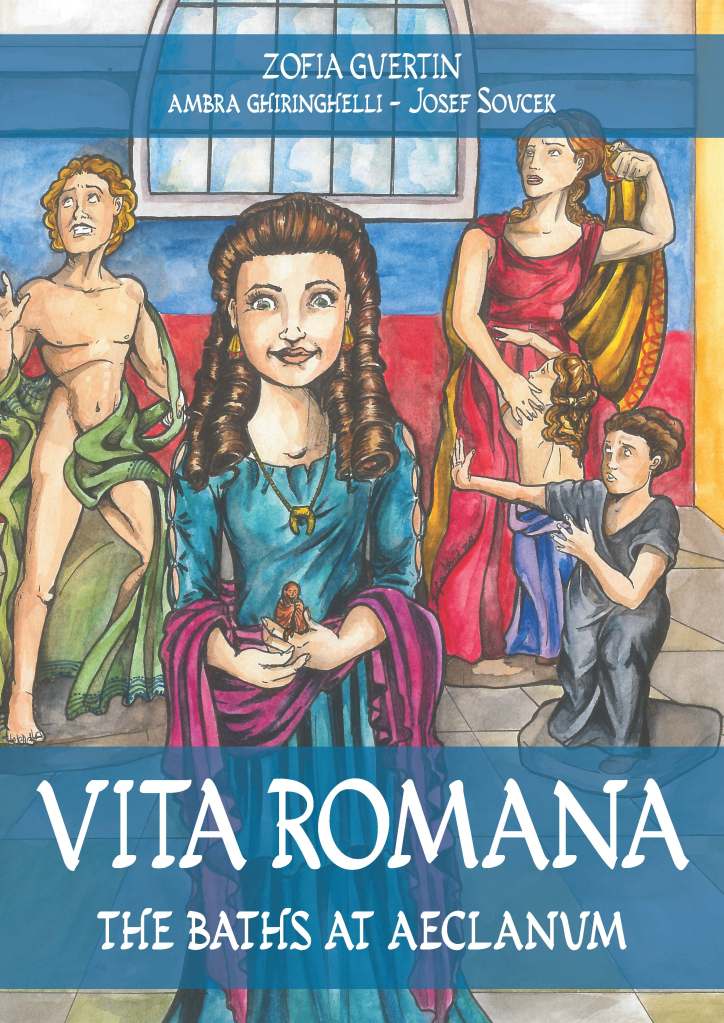
Vita Romana: at the baths of Aeclanum
Getting the gang together remotely meant that there was revisions and frequent dialogue. Ambra Ghiringhelli was like a fish to water getting the text written with care and historical consideration! Using an a-typical approach of having the storyboard roughed out and the text done afterwards, it was fascinating to see what joke she would come up with to match one of Neratia’s smirking faces or the right tone for a teenage daughter giving her mom some sass.
As this was my third year working with Josef, I couldn’t be more grateful for his ongoing collaboration. With his eye for details and in-depth knowledge of the subject matter, I could rely on him spotting all sorts of tiny details (and errors) that improved the whole project immensely. All of the images were sent to him to do his digital magic, fixes and formatting. You would be surprised how much work goes into making a comic look like a comic.
There are always many changes from start to finish!The polished final English version.
The breadth of things to consider when trying to create a graphic novella attempting to be rooted in archaeological and historical accuracy is astounding. This project has taken me on some really exciting turns which inevitably has meant that I am always learning, always questioning and trying to find evidence for the scenes I am creating.
The majority of influential imagery or material culture references were derived from the collections at the Museo Nazionale, Naples and the frescoes contained in the archaeological parks of Pompeii and Herculaneum. Social media outreach for these sites has been invaluable! With new discoveries coming all the time from Pompeii all the time, by following their Twitter and Instagram, I was able to integrate some of these exciting new finds into Vita Romana. Though Pompeii was covered by Vesuvius by the time our story in Aeclanum would have taken place, the tastes and styles used in decorating homes in these cities could easily be replicated by artisans in communities like Aeclanum. Indeed, the riches of Aeclanum could be much more akin to those at Pompeii due to their size and places along the road networks.
Rewards for completing the scavenger hunt!
Proud parents 😀
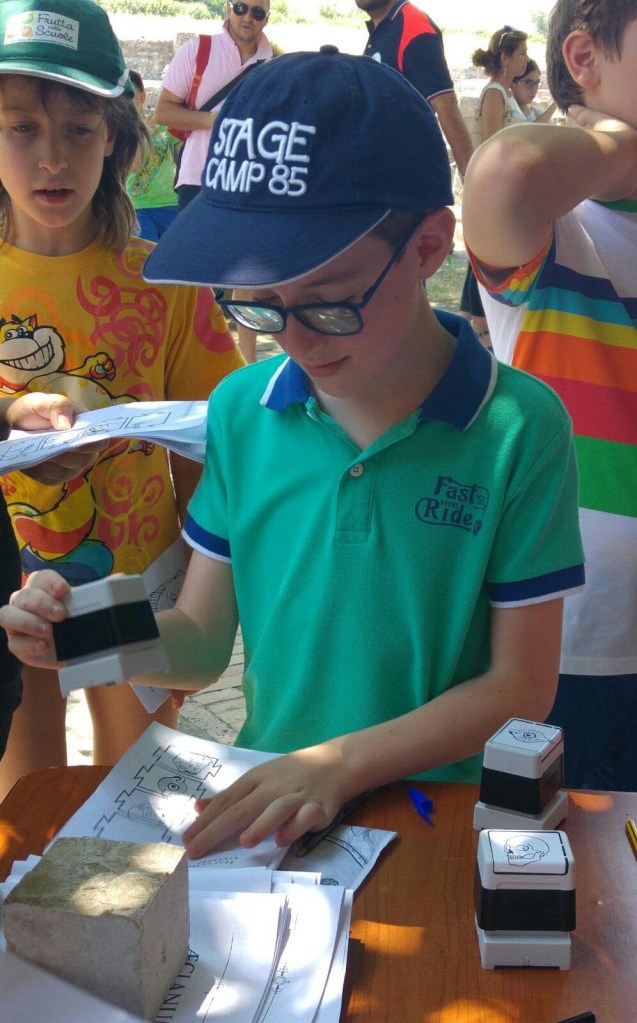
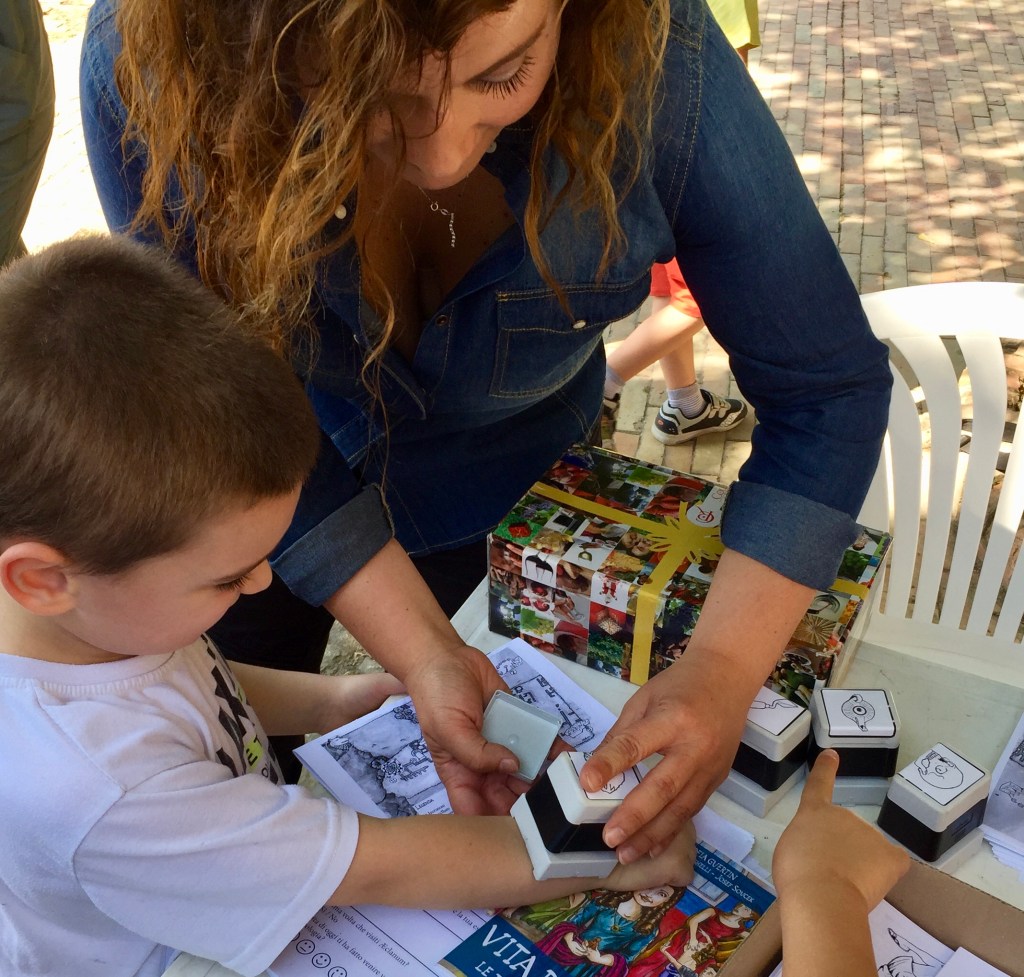
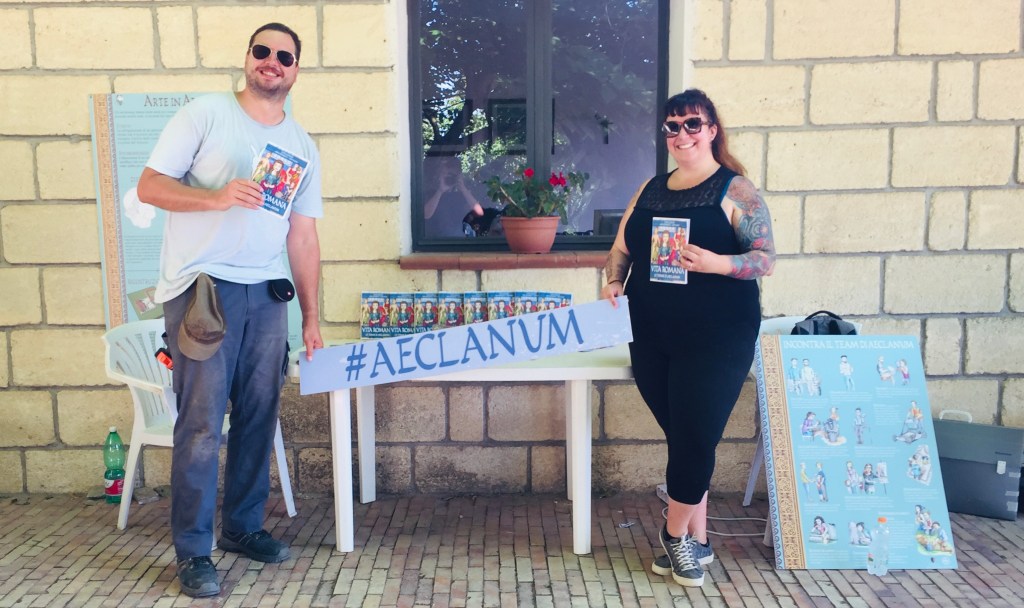
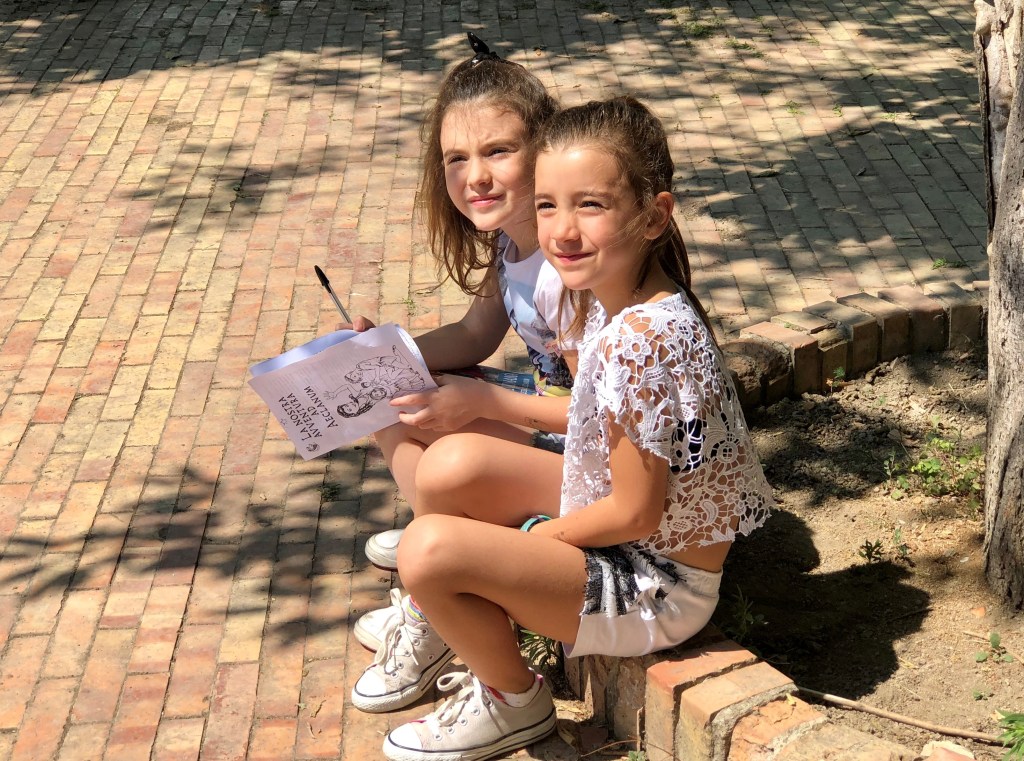
We had a great turn out this July at the comic launch, with hundreds of people visiting the archaeological park! The children’s scavenger hunt activity led them around the site using our third version (a self-directed version) of the archaeological passport as their guide. With Ferdinando crafting the texts and dealing with the translation needs, these materials will hopefully get English versions for download on Archaeokids!
They were asked to find the significant landmarks on the site with general information about their use, and fill out a letter which would lead them to the office piazza that contained the lost doll of Neratia Secunda, completing the narrative in the real world which is introduced in the passport. Once the children completed their scavenger hunt, they received a copy of Vita Romana: at the baths of Aeclanum, whose printing was generously funded by the Institute of Classics Studies (ICS).
The Road Ahead & Archaeokids.com
Seeing this stage of the journey come to a successful conclusion was pretty amazing. I’ve worked with some amazing people and had an incredible opportunity to have so much freedom to explore the ancient world in my favourite medium. The next steps ahead will involve working with the data collected from the launch, and an article which will be interesting to write this winter.
Josef, me and Ferdinando at the launch day in Passo di Mirabella.
As always, I look forward to challenges and adventures ahead! Ferdinando and I are continuing to find new avenues to create and highlight the public archaeology work that started in Aeclanum and is expanding to other sites!
Whether it is your first time on an excavation, or another chapter in your journey of archaeological field or laboratory work, fellow archaeologists, students and specialists have channelled their experience for you!
After years of going on digs, several archaeology students and I are passing on our pro-tips for planning a summer excavation season. From essentials, tech tips to creature comforts, here are some tips for a stress-free excavation!
Since beginning my journey in 2008 with field schools, excavating and studying abroad, I have progressed along in my journey from dig student to project manager. There are always so many more skills to learn and wonderful experiences to share. As the following list items will show, there are some handy things to bring on a dig, while others you can pick up wherever you are doing field work and save yourself the bag space!
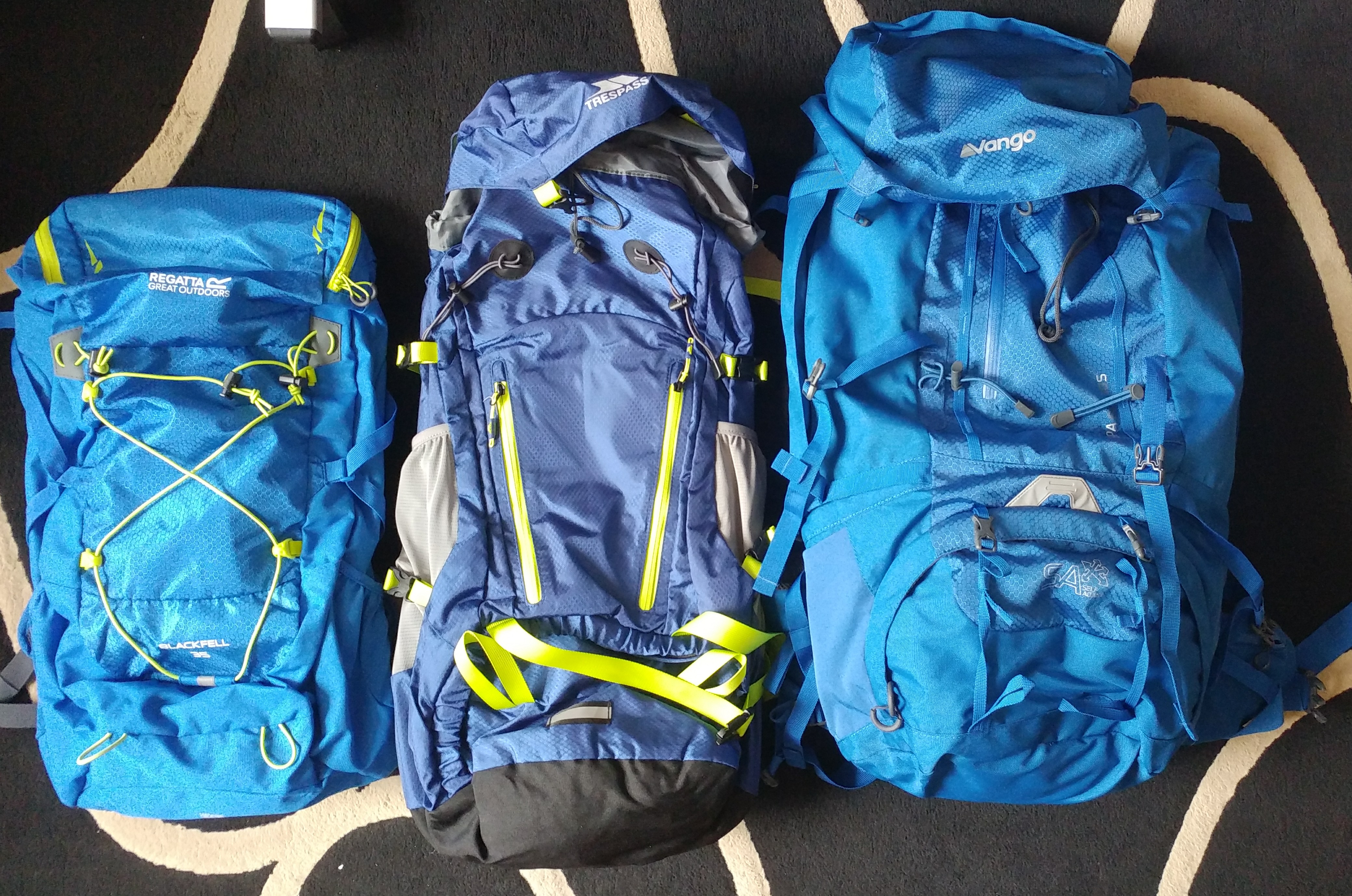
10. Start with a good rucksack. Your journey begins by investing in something that is comfortable and that you can move with minimal effort. Big wheelie bags can seem easier, but if you have any major walking to do, or plan to travel afterwards, aim to have something you can easily move and ALWAYS be able to lift it yourself. I have helped many a random traveler over the years because they couldn’t manage their own luggage.
Packing for field work for a few days (1), a fortnight (2) or a month (3), pick the right bag for the job!
The weekender (1) is good to bring along with you as a personal item so
you can spend a night or two sightseeing while you are on an excavation
season. The fortnight (2) can cover a two week dig, but if that is all
you are packing, pick up towels/toiletries in the location you are
ending up. The month-long (3) should be spacious enough for all your
necessities and still leave you enough space for souvenirs.
9. Doing your research pays off. Buying your gear off-season is always significantly cheaper. If you cross-check prices on a few different sites once you find a bag that catches your eye, you can often get it for a fraction of the cost. The three rucksacks pictured above were each 50-70% off, totaling £110.00 for all three!
8. Pack for the job you have and the experience you want. My packing list might look a little different than yours might this season, as a big part of my work tends to be organizational (project management) and art /writing (public archaeology) . However, there are some basics for organizing your belongings that are handy no matter what your role on a dig. Organizing by theme, by grouping what those needs are into little related clusters/packing cubes can help you avoid losing things or over-packing. Prioritizing what is a must to bring, and what you can probably just pick up at a shop when you arrive, will keep you on track. Pro-tip: bringing a small bundle of elastic bands and some Ziploc bags helps to compress your belongings in for space (or keep gross things away from nice things) by doing that Marie Kondo style roll, held with a rubber band will do the trick. Packing cubes are quite helpful, as once there you won’t have dressers to put your things away in, and some semblance of organization may spark joy.
Field Gear: Rules and regulations vary by country and sometimes site, but these are some general principles from my experience in Italy. Full-length trousers and steel toe boots are required for excavating. No exceptions. Trench supervisors will check this type of thing, since foot protection is a site safety issue. What styles of boots and trousers is entirely up to you. Long sleeve shirts are going to keep you from becoming a lobster, and a good option for layering between chillier mornings to hot afternoons.
From Primark to Jack Woolfskin, it’s up to you and your budget. There are frequently low-cost options highlighted on online shops, but comfort/breathability are pretty important. Quick dry (wicking) options make laundry less of a chore, especially in Mediterranean heat you can dry your washed clothes in 20 minutes. Pro-tip: break in new boots before arrival to avoid blisters and Merino wool socks help protect your feet from over-heating, wicking away moisture and avoiding odor.
Optional items: Fancy kit and tools is unnecessary for first-time excavations, as the programmes will provide the tools you need, mostly centrally-held by a trench supervisor. You can buy little handy tools and so on, but it is likely to go unused and just adds weight to your luggage.
Trowel
Not all trowels are made equally. My favourite is the WHS trowel. It is a British design that feels good in your hand and has a lot of durability. I prefer the soft-handle WHS trowel, but many others like the wooden handle. You can check out dig tools on the Past Horizons website: here or Strati-Concept: here. Order your kit several weeks before you expect to head off to dig, because having mail sent to you.
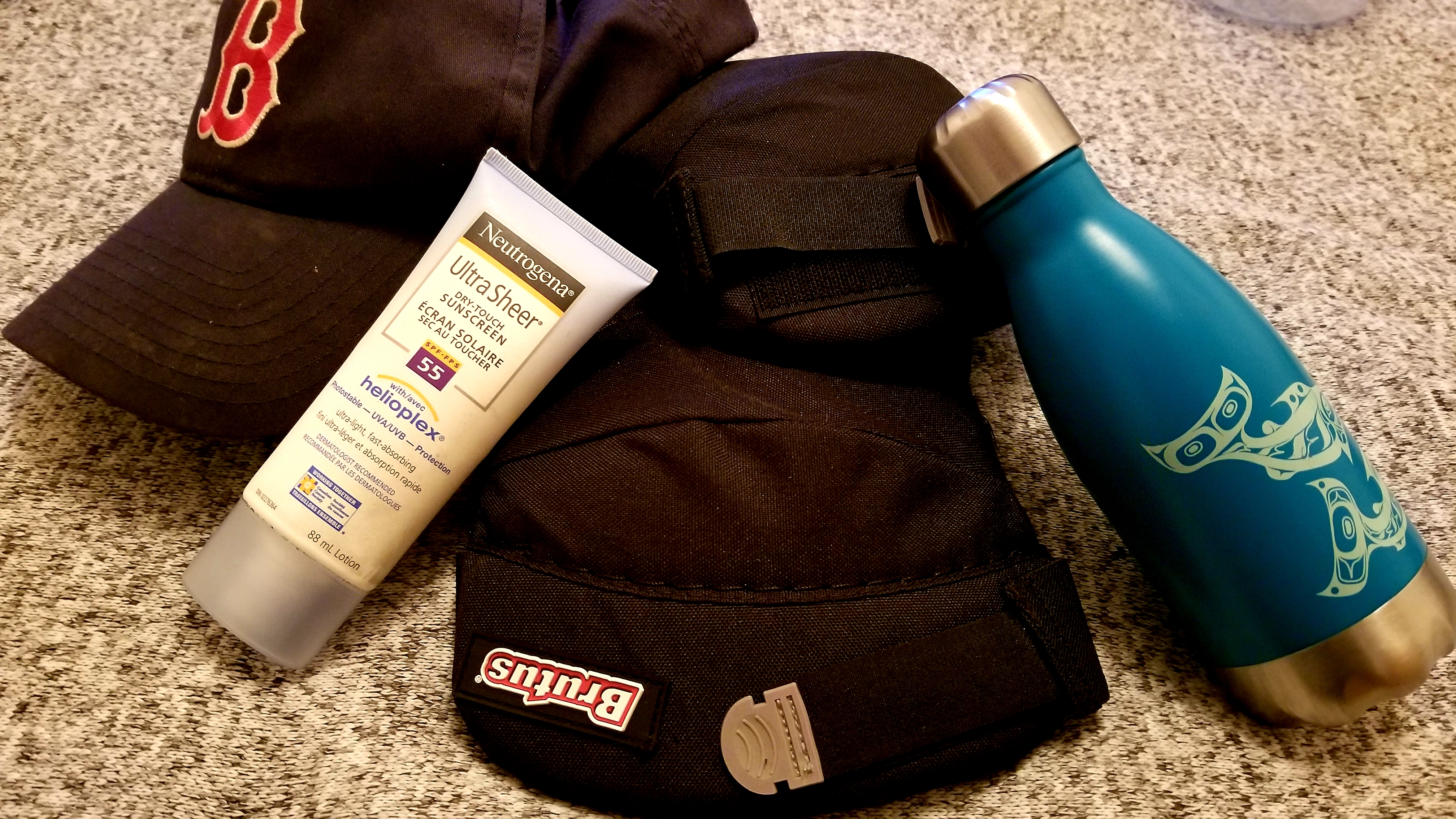
7. Working in the sun safely. Suncare products should be rigorously applied and re-applied throughout the day, especially after sifting for an hour and pushing up your 20th wheelbarrow to the spoil heap. Hats are a must, and shirts with built-in sun protection or that are at least long enough to cover your skin are essential. Staying hydrated is going to be paramount if you plan to get the most out of your field work experience and avoid overexerting yourself. Safety is always the most important thing.
6. Tech: should it stay or should it go? Working on my thesis and part-time job while on excavation means that a lightweight tablet-laptop hybrid is essential so I can take my work with me. The DSLR is also part of my art and field work kit for my thesis and public archaeology. I still optimistically bring dig boots and a trowel every year but my path has diverged slightly from within the trench to working on public engagement. It is worth considering leaving your expensive tech at home if you don’t really need it. I.e, if you aren’t writing a PhD or Masters, you actually may have the summer off, so why not enjoy it? Kick back with a kindle or a real paperback and soak in the sun or debate the classics over wine with fieldwork colleagues!
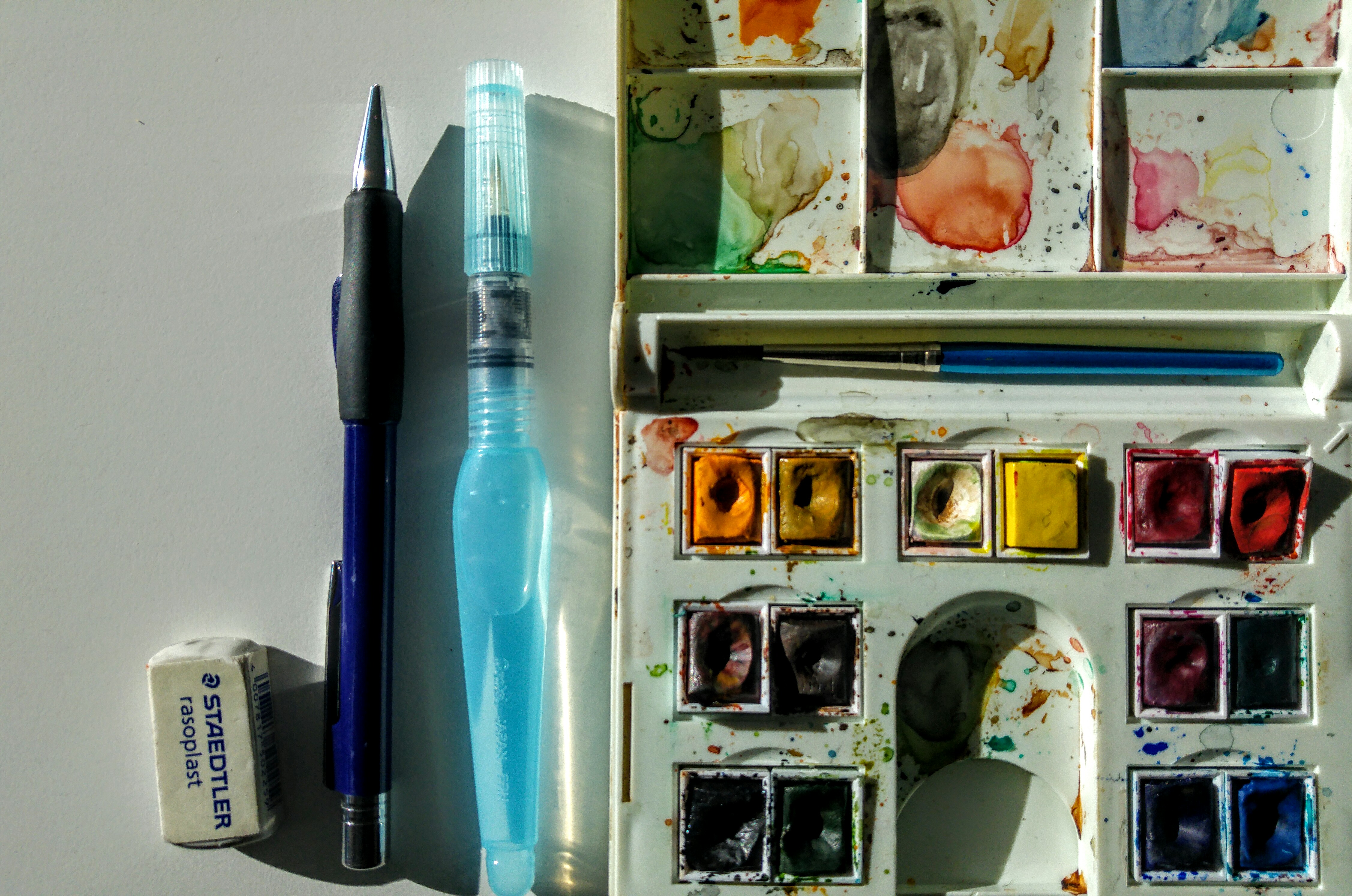
5. Entertainment itemsare important additions to your time away on excavation. If you enjoy photography, bring your camera. There will be amazing moments that you will capture through the camera lens that you will enjoy reflecting on. If you are an artist, bring a travel sketch and paint kit! Bringing something small for your downtime, that is still social, is a great way to meet new people. This is a great opportunity to try travel blogging or leveling-up your Instagram game. #DigSeason #ArchaeologyLife #QueensOfTheLab. If after a full day of working with others you would prefer some quiet time, ebooks and headphones are a good (lightweight) idea, as there will be plenty of time to rest and relax. Tech-tip extra: multi-plug usb and universal adapters will save your life. Most dig houses have limited plugs, and 50 people needing to charge their phones can be hard to accommodate.
Multi-usb port, universal adapter (€20, Amazon)
4. Working with injuries and staying healthy. Many of us have bad knees, sore backs and a host of other potential aches and pains. Knee pads are a must if you have any knee problems, but even if you are blessed with injury-free knees, they are a huge help for long periods of kneeling on hard surfaces. Necessary medications should be brought with you, you might find it hard to find an Italian equivalent. Things like painkillers and hydration aids are commonly available and not challenging to get a hold of. Keeping healthy extras: bug spray, flip flops (for showers), bandaids (plasters) and hand sanitizer/hand wipes are cheap as chips and good to have in your pack.
If you are going to bring toiletries, just grab enough for the travel to and fro. Anything you need at your dig, you can grab nearby once you arrive.
Hydration in high temperatures is tackled by investing in good insulated water bottles. Gulping down a mouthful of hot water is not the most refreshing while working, so insulated water bottles can keep your drinking water chilled for several hours. I typically have two with me and there are all sorts available on Amazon.
3. Mental health and wellness while working abroad. Excavation situations abroad can be full of life-changing experiences and new friends. They can also be very stressful, living with 50 strangers doing manual labour in a foreign country where you may not speak the language. This might be the first time experiencing a shared eating, washing and sleeping space. Even for those who are not shy or prone to a bit of social anxiety, this can seem like a pretty intense prospect. However, it is incredibly common to feel this way, and there are some great relaxation and mindfulness approaches to help and get the most out of your time abroad!
This might require you to actively seek some time alone on a walk, write in a travel journal to reflect on some of your experiences and don’t be afraid to carve out the time for you that you need to feel rested. If you are lucky enough to be working in or near a town, grabbing some colleagues and having a cheeky dinner out together is a nice break from the larger group.
2. Be open minded to new cultures. If this is your first time abroad or just in the location you will be digging, it goes without saying that you will encounter customs that are unfamiliar to you. Much of what you read online can be quite negative. If you read about places like Naples, there are a variety of opinions that are often quite apprehensive. Treat everything you read with a grain of salt. Some people have had bad experiences, but like all travel a trip is as good as you make it. If you pack smart, don’t flash your valuables around and keep important items secured, you should have no problems. Just as traveling anywhere, train and bus stations are not safe places to hang around full stop and often give a slightly grim impression. Take a breath, chill out and be smart.
Things [in Italy] run a little differently and certainly much slower than many of you will be used to (which you may not like at first), but if you are patient and keep an open mind you will find the beauty within the relaxed style of living, vibrant and passionate people, delicious food, and charming architecture.
Alex Slucky, Archaeobotany specialist, Aeclanum, presenting culinary delights of southern Italy.
Rather than looking for what is familiar, you are perfectly poised to learn new things about yourself and the world around you. Breaking out of your comfort zone by trying new foods, talking to locals and getting to know the culture and history of the place you are going to spend a few weeks or a full season excavating in is incredibly rewarding.
An Archaeological mindset, positive attitude and a trowel. Really there isn’t much else you need.
You have an incredible opportunity ahead of you. Everyone will have different backgrounds and varying amounts of experience, so use that to your advantage! Ask questions on and off site. You can learn so much from everyone around you. Many people will be coming to your dig without knowing anyone. Don’t be afraid to start a conversation with someone, they are likely in the same boat as you! If you are coming with friends, branch out and include others!
Many thanks to the feedback from students: Alex Slucky, Caity Concannon, Chanchal Rm, Erik Niskanen, Jazz Demetrioff, Jessica Staples, Kathleen Emily Ann O’Donnell, Max Ratcliffe, Mickey Ferguson, Emma Watts. With special thanks to Briana King for modeling gear!
Thank you for checking out my blog and have a great field school and excavation season!
From 2008 – 2018, so many wonderful people have come into my life, and I am so grateful for the experiences we have shared.
If you are going to be visiting Paris with the expectation that you are going to visit the most romantic city on earth, then this is not the list for you. I am just going to assume you will walk along the Champs–Élysées, check out the Eiffel Tower and Notre Dame, so you won’t find those things here. After half a dozen visits to this incredible city, there are some things I think are always worth a look, a re-visit, others to skip. A short trip to Paris can be incredible and dare I say, even relaxing, if you plan to take in sites in between promenades, and cheeky drinks along the Siene and let the ambience take over.
How to MuseumThere is a fine art to going to see art. Nothing makes you unhappier faster than being hangry, sore and tired and shuffling around a palace full of art – much of which looks basically the same. As someone who travels to see museums and archaeological sites exclusively, I double down when I travel alone and see as much as possible, but if there is another human with me, I (grudgingly) stick to a one large museum a day rule. As tempting as it is to visit a few together to save time, it diminishes your ability to appreciate and enjoy them. Breaking up the visits means you won’t literally run through rooms of incredible art just to sit down. I know there are only so many paintings of the crucifixion you can take in on any one visit. Don’t make seeing this stuff a performance of penance.
1. The LouvreI know what you are thinking; OBVIOUSLY you will be going to the Louvre. However, you will never see everything in the louvre, so don’t try. Rather, pick two themes that interest you; Greco-Roman statues and Near Eastern pre-historic art? Tapestries and Medieval painting? Sure, you may not see every highlight, but by focusing on things you are interested in versus what you ‘should’ be seeing, you will likely enjoy it more.
I don’t care if you don’t like Classical statuary, go see the Nike of Samothrace.
Pro tip: visit the Louvre in the evenings if you can since it is significantly less busy then, and you have the Venus di Milo all to yourself rather than struggling to find a spot in between tour groups. Wednesdays and Fridays the museum is open until 10pm/ closed on Tuesdays.
2. Musée d’Orsay/ Musée Orangerie For relatively more modern pieces of art, the impressionist painting collection of d’Orsay and Orangerie are worth the visit. If you’ve ever been curious to see the ‘L’Origine du monde’ (Origin of the World), now is your chance! If you are lucky enough, there might be some performance art happening there during your visit! Both buildings are gorgeous, and worthwhile for a visit. Places for good eats: Eric Kayser Artisan Boulanger & Cafe de la Nouvelle Marie
3. Place de la Concorde For me, nothing says going to Paris like staring at some Aegyptiaca. The big attractive Obelisk of Luxor and ornate fountains symmetrically placed at the center of Place de la Concorde, with Egyptian-styled decoration throughout the square is an interesting throwback to France’s imperial days. The site of execution of Louis XVI and Marie Antoinette, among many others. Surrounding crowds of jeering revolutionairies cramming into this space – briefly named ‘Place de la Révolution‘ during this period- is a viceral mental image of social and political upheaval to conjure.
4. Musée de Cluny (Musée national du Moyen Age) The museum de Cluny is full of art and artefacts from the Middle Ages, as you would expect from the name, but part of the treasure of this place is the building itself, built atop a Roman bath which you can see in the basement, the higgledy-piggledy building features of the exterior are sort of charming.
5. PantheonThe Pantheon feels as far away from its Roman predecessor as one could find; a monument to the civic spirit and fraternity of the famous French individuals. Once a church, a ruined abbey of Saint Genevieve, re-created by Louis XV in the mid-1700s. Interred within the Pantheon are the remains of Victor Hugo, Voltaire, Rousseau among others. There is something quite unique about such a ornate resting place for writers, philosophers and poets – secular heroes seldomly receive this type of hagiographic treatment.This area is great for wandering and grabbing a coffee and these sites are only 4 minutes walk from the Musée de Cluny. If nothing else, there is a famous macaron shop nearby which is worth the visit. Sweet treats near the Pantheon: Sebastien Degardin (Patisserie de la Pantheon) and La Macaron Laduree Paris.
6. Montmartre and Sacré-CœurThe stairs leading up to Sacré-Cœur and the Montmartre are the devil. It is a beast to get up to the top, but don’t cheat and take the funicular. It’s good for you and will build character.The neighbourhood around the basilica is lovely and winding, with a large number of cafés and restaurants priced to keep the likes of me away. Atmospherically, it’s a an area with a relaxed vibe. There is often music floating around by street performers, interesting architecture and artisans with a plethora of stalls selling their paintings/prints. Stopping in at a café with a decent view, this is one of my favourite areas to sketch urban life scenes.
7. VersaillesJumping on the a few metros and RER train out of town, visiting the Palace of Versailles is a pretty solid day trip. Built up from a swamp around his family’s hunting lodge, Louis XIV captured all of France’s nobility in his guilded cage of Versailles. Through elaborate specatcles to entertain them whilst there, and incredibly pedantic and restrictive court etiquette, Louis was gaslighting the French aristorcacy until they competed with eachother to help him put on his pants or use the toilet, as a sign of his favour.
There are so many architectural and decorative wonders in the palace; the public spaces like the Hall of Mirrors and each private room you amble through unveils small reminders of the period where Europe’s most influential art and fashions were being created in Versailles.
In addition to the historical interst of visiting Versailles, the grounds are exquist if you are partial to a manicured garden. Next-level landscaping. The fountains, which were unable to all be used at the same time in his life-time, now put on incredible water shows to classical music. The small cottage of Marie Antoinette in the gardens, the Hameau de la Reine, has lovely neo-Classical temples and picturesque views for some quiet contemplation and maybe some cake.
8. Musée d’Archéologie Nationale, Saint-Germain-en-LayA 40 minute ride on the RER, and you end up in the suburb of Saint-Germain-en-Lay, about 19 km west of Paris. There are nice gardens around the Château de Saint-Germain-en-Laye which house the archaeological collection, that offer a nice picnic space to nap post-Museum.
This is not a journey I would suggest if you have just a few days in Paris, or if you have never been before since there is so much to see and do in the city center. However, if you’ve seen the main sites and are looking for something different and a little quieter/less busy, this would be a worthwhile visit.
9. Spend as much time as possible picnicking and drinking wine along the Seine
I don’t know how much needs to be said on this, but most of the best moments I’ve shared in Paris, with friends or my fiance, have been taking some wine and picnic down to the Seine and hanging out in the sunset. As one of the busiest European tourist destinations, it can be hard to find places to just chill out and take in the majestic views (for free), but along the river you can have all those deep talks, relaxation and watercolour painting opportunities.
10.Make some art!
A small travel kit of water colours and watercolour brushes in tow, and you’ve got the makings for an art filled break. Even if you aren’t sure you are going to be a Renoir or Monet, a cheap and portable set of paints and watercolour pen can be the best companion on your trip. Unlike a photo, trying to make a small artistic rendering requires looking a little differently at the world around you, and a slower pace. Your mom will totally put your painting on her fridge.
Bars and nightlife
The Strasbourg St. Denis area is great for bars, chilling out till the wee hours with the unusual opportunity to hear French being spoken all around you. Nice space to unwind with decent food prices in this neighbourhood.
The Paris Pass
The Paris Pass is a great purchase; after a visit or two to the big museums, it will be evident that this little pink pass has paid for itself. Click here for a link.
Transport
There are many ways you can get into the city-center from the airport, but I tend to use the tested and true coach buses. It can be about €15.00 approximately. Click here for a link to a summary site on the transportation options.
Some nice spots to stay in town:
This AirB&B accomodation was an aboslute gem on a research trip last year, small but fully functional and very well situated. Just 10 minutes or so from the Louvre and Musée d’Orsay, with many small bakeries, grocery stores and bars nearby.
Hostel Oops is a throwback to my backpacking days, but it’s cheap(ish) and really bloody cool inside as hostels go. Right in the Latin Quarter next to some movie theatres and other fun establishments. It need not be mixed accomodations with strangers, as they have some private rooms, but that’s not as much fun…until you are 25.
“To be away from home and yet to feel oneself everywhere at home; to see the world, to be at the centre of the world, and yet to remain hidden from the world”
– Charles Baudelaire, The Painter of Modern Life and Other Essays”
Walls of Policastro Bussentino, Italy 2015
The concept of ‘the flâneur‘ is an old one that has recently entered my mind as my PhD research is starting to intersect conceptually with my artistic experiences within ancient city spaces. As someone who feels that you need to walk a city to really experience it, I also believe to really see a city, it helps to sketch it; not the whole thing, and not just its monuments, but small details and elements. The 19th century French symbol of the flâneur is relatable to me for that reason.
For the flâneur, one interacts within urban spaces through engagement (in painting or writing) and observation, but still remains apart- both a performer and spectator. The lesser-known ‘flâneuse’ is the female chronicler of urban life in the 19th century, figures like Virgina Woolf, as discussed in this article, are part of the underespresented presence of female urban explorers. As a modern female explorer of ancient urban spaces, creating a space to discuss, share and engage with these ideas and locations in the public sphere is important to me.
Additionally, this concept resonates for me, as an archaeology student and artist, because it embodies more than a spirit of adventure and making art, but also a spirit of understanding and trying to piece together the urban landscapes that have developed and disappeared over time.
Maratea and the statue of Cristo Redentore, 2015.
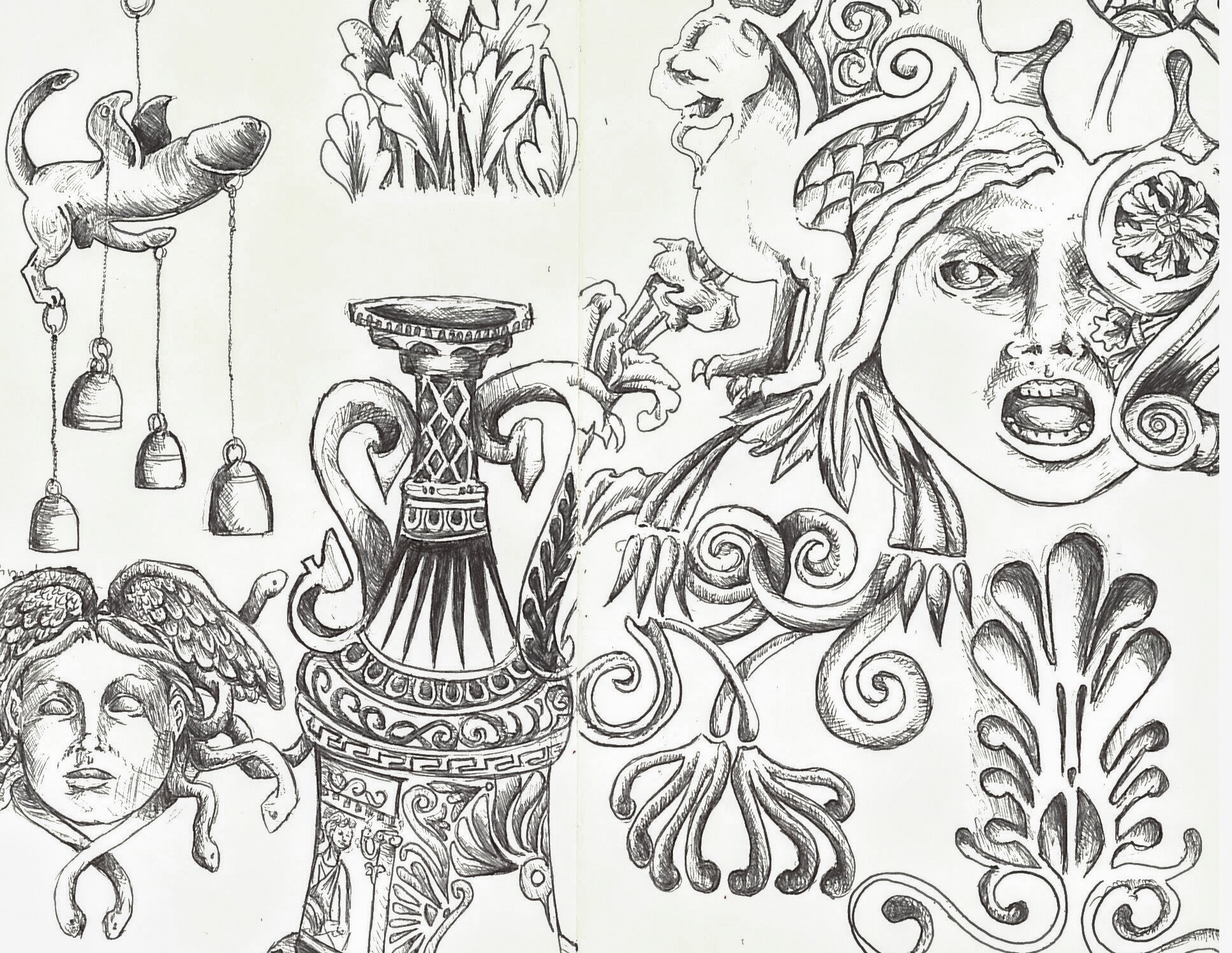
Since my first trip abroad, in 2002, the drive to sketch and take in everything that I could has formed an important part of appreciating a significantly bigger world than I knew. Sketches from my earlier books explored famous portraits and statues the likes of which I’d only ever seen in Art History courses.
This initial exposure provided me with access to masterpieces in galleries that were unlike the art I could see with any regularity in Canada. Sketching from paintings was a lot of fun and I felt so fortunate to see the images, but my first visit to archaeological sites in Greece and Italy really affected what I wanted to draw.
Sketches from Delphi: reliefs and helmets 2008
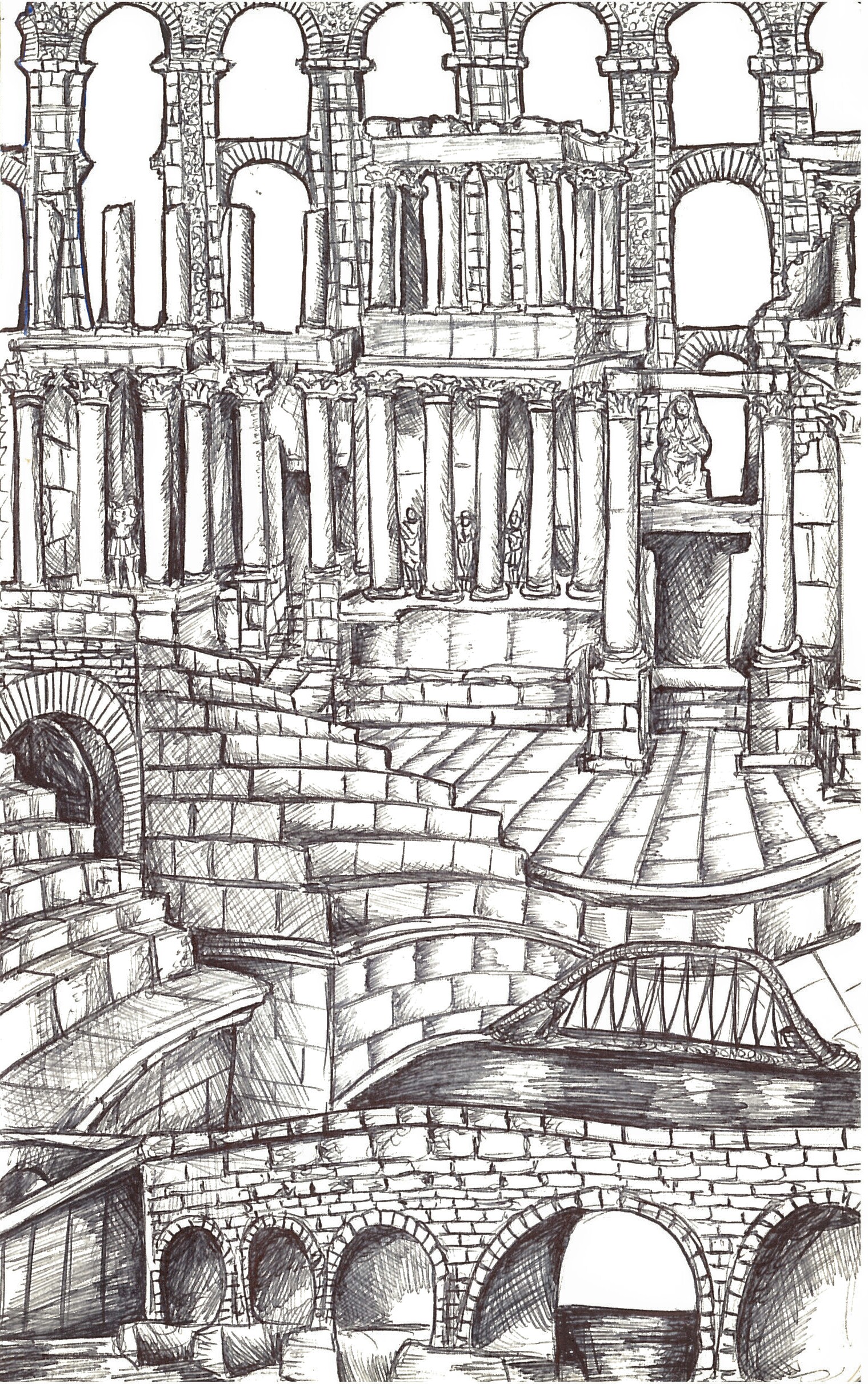
Visiting many sites in the Mediterranean over the last 10 years, I was able to sit and breathe in these ancient cities by focusing in on the shapes and forms of the stone, lines of sight, and views between one temple to the streets or the valleys below. My curiosity directed me to explore artifacts and material culture that were used to adorn Greek, Etruscan or Roman buildings and the individuals who navigated through them.
From Observer to Preformer
Lady of Elche, 4th century BC, Iberia
The most inspiring pieces of art in the world were at my fingertips (sketchbook and pen tip), but my shyness about drawing in front of strangers took a few years to overcome. Ironically, the simple act of drawing in public would lead to some of the most interesting encounters with fellow travellers, curious children and tour groups. I have found the quiet study of the place you are in, or artifacts in front of you, signals something unspoken to other people which is inviting.
Sir John Soane’s Museum 2015
Over time I developed my own sense of style. I could explore patterns and elements taken from brick designs, patterns of lace on Dutch merchant collars, hairstyles of Roman and Greek elite women, and not worry what the person hovering over my shoulder thought.
Much of what made this passion for drawing more appealing was the utility of having something free and enjoyable to do with the many hours you spend while traveling to get to the place you are going. Waiting to cross the sea on a ferry or idle at a train station on my way to a new city, provided me a good amount of time to reflect on my sketches.
This reflection began to take greater shape and purpose once I started to do postgraduate research. Having questions and a focus of study in my mind affects the way I approach the ancient city spaces around me. It focuses my vision, but also encourages me to think on the connections between the visual elements across the Mediterranean. You don’t need to travel all over the Mediterranean to realise there is a shared visual culture being used with an incredible exchange of ideas and styles at play, but it was helpful to visualize the scope.
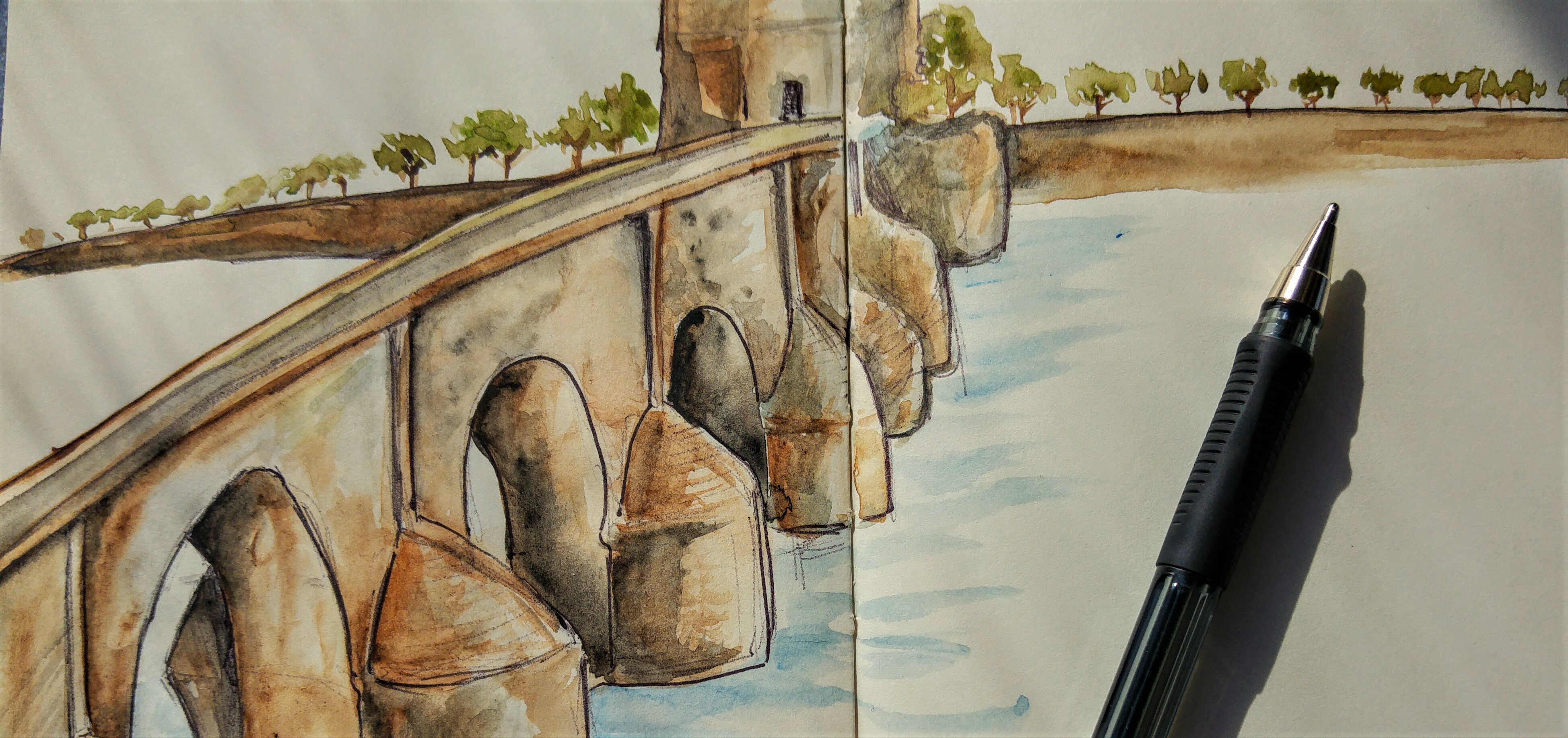
Roman Bridge, Cordoba 2018
It began to create a tapestry of experiences (passive and active) in my mind of ancient art and the interconnectedness of ancient communities that had risen and fallen many centuries ago. I remain inspired to learn more and document it in a way that is meaningful to me and hopefully others. By saving a small piece of my experiences in a sketch or painting, I am starting to develop ways in which these small illuminations of incredible places and artifacts can be used to share the benefits of the study of Archaeology and Ancient History.
October in Scotland has been, on occasion, described as so windy, “it’ll cut ye in half”. Locking myself indoors over this month to re-learn how to study has arguably been made easier by the poor weather. With the first month of my PhD done, and the piles of books I need to read steadily increasing, a kindly offer from my incredibly talented and successful bestie from Vancouver, to meet in Nice for a weekend, was pure class.
Place Massena et la Fontaine du Soleil.
My last rendezvous with Nice was in 2008 (the youthful and relatively tattoo free main picture dates to then); the sights and smells of Nice are summed up for me by ‘ça m’a marqué’. To walk the Promenade des Anglais again in the October sunshine was a welcome change of study space.I wish I could say that I studiously read up on much of the history of Nice, but that would be a lie. We came for sun, beaches and the famous cuisine that characterize this gorgeous little spot of paradise.The open-air markets had spectacular varieties of sea salts and spices, with dried herbs and lavender filling the air in the narrow winding streets.
A picnic of local specialties
For a few short days, the ambling life was pretty spectacular. But the itch to see some of the ancient history in Nice was more powerful than delicious paté and fancy cocktails.
Site Archéologiques de Nice-Cimiez
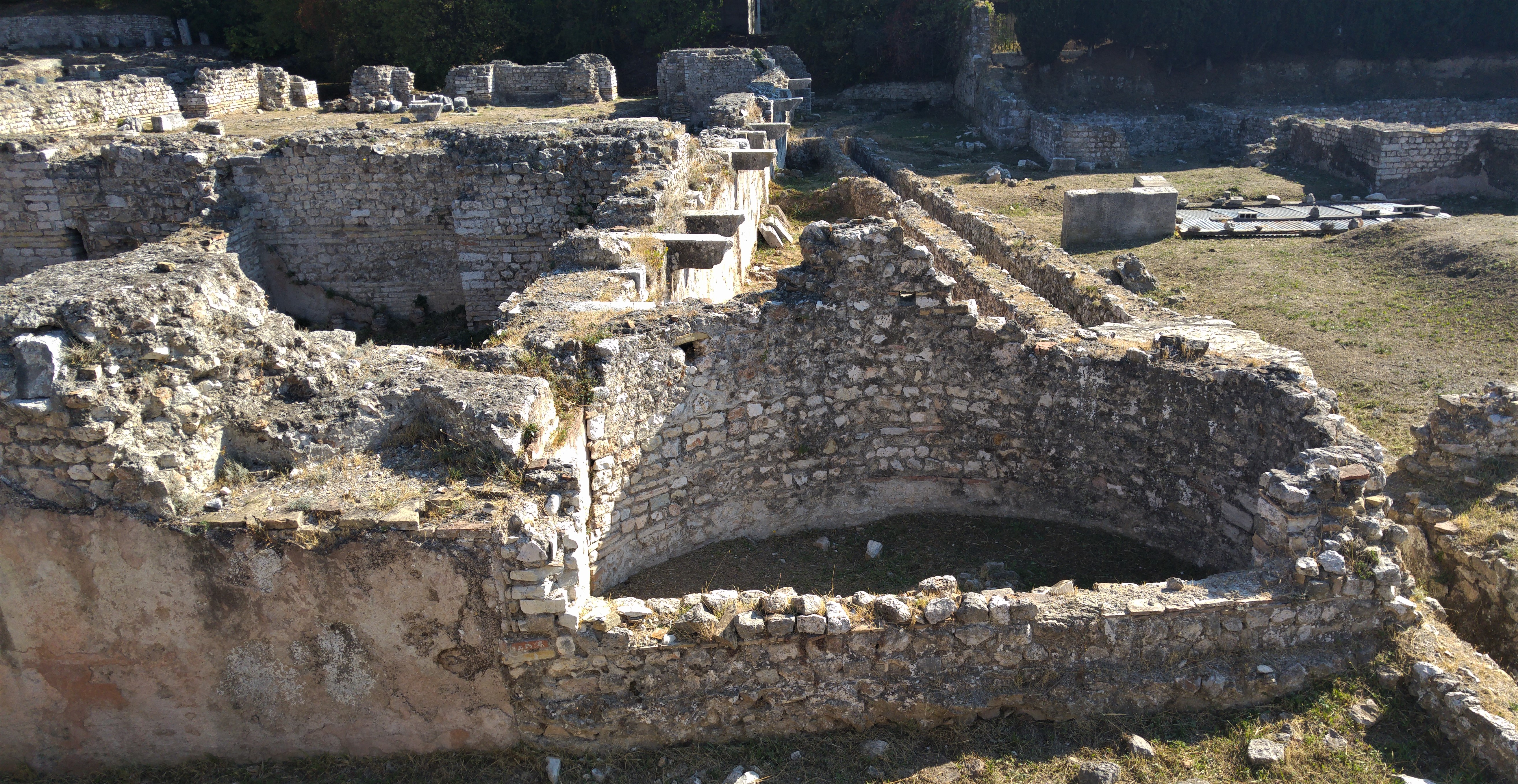
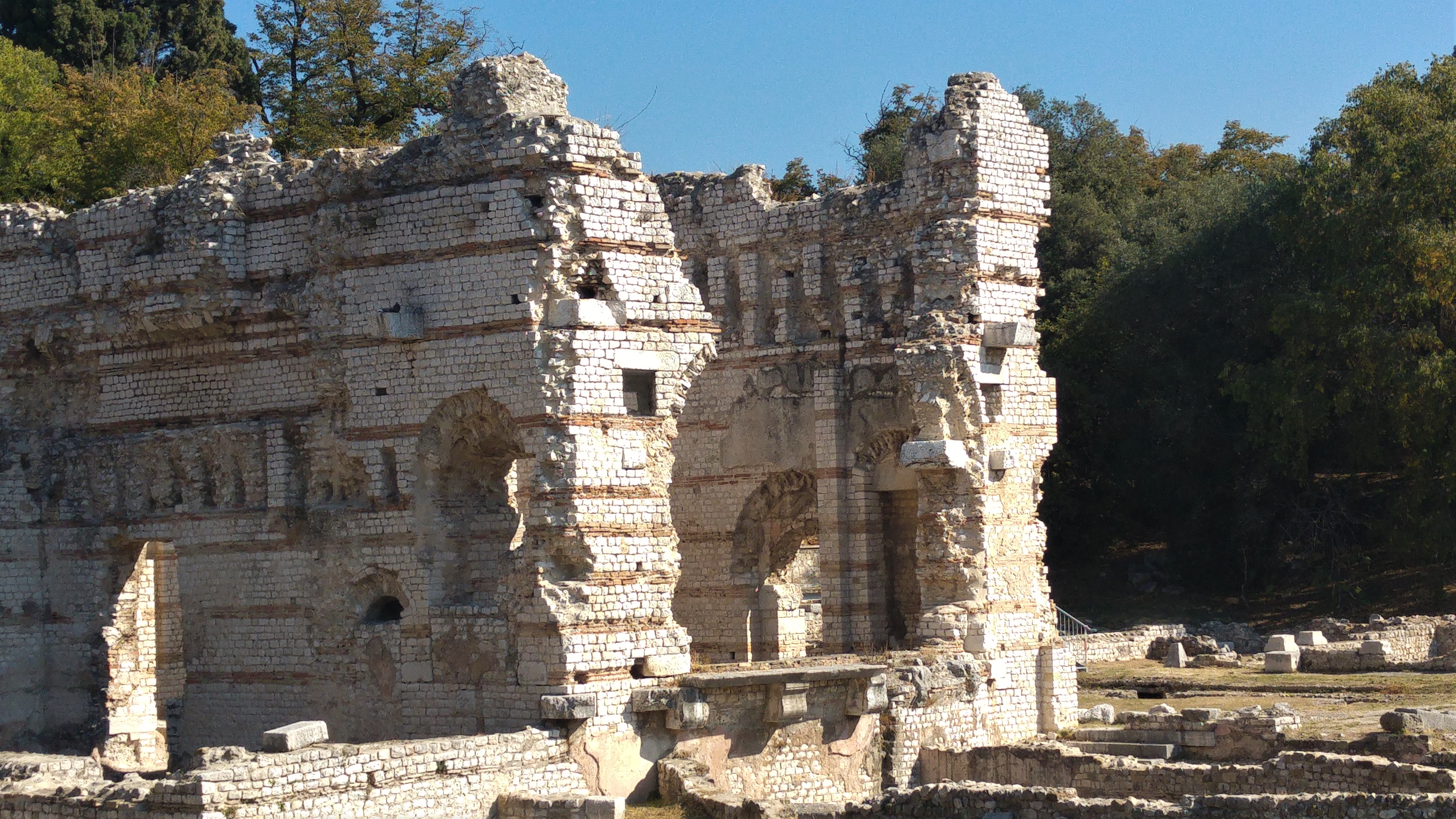
Though in the city centre of Vieulle Nice the shops and amenities were all bustling, Sunday morning in the outskirts of town was effectively closed for business. The imperative task of finding coffee and croissants before exploring Roman ruins was nearly impossible. Eventually, we secured essential pastries and found the archaeological site of Cemenelum. The hilltop archaeological park is situated in the fairly posh and residential neighborhood of Cimiez, and contains a small but interesting portion of the Roman baths.
Eastern bath complex
This Roman city was built not far from an established Greek city, Nikaia, and under Augustus, it became the capital of the province of Alpes Maritmae, with occupation and development into the 4th century AD.
Western bath complex
Northern baths frigidarium
The bath complex and partial roads that remain were part of a bustling military encampment, servicing the legions as they passed through or remained stationed there. Some estimates have placed the inhabitants at 10,000, with a decent amount of seating in the amphitheater, back when it still had seats.
Amphitheater entrance
The face of habitation changed over time, and even with incursions from hostile tribes, Cemenelum maintained a community of Christians into the 7th and 8th centuries AD. The evidence of this phase is present in the houses that were built into the abandoned baths.
After a solid hike up to the site, it was time for a few remaining hours on the beach, and one last swim in the Mediterranean. With the first month of my PhD over, and the piles of books to read getting ever higher, a sunny weekend of ambling around in Nice was the perfect excursion as fall quickly turns to winter. Merci pour ce merveilleux voyage ma chère amie! A la bientot!
“I divided the earth from the heaven. I showed the paths of the stars. I ordered the course of the sun and the moon”. (Kyme Aretalogy in honour of Isis)
Since backpacking in Europe in 2001, I have been drawn to images and archaeological sites relating to Isis. There are some things that just strike the right chord for you. My first experience with Isis (in a Greco-Roman style) was at the Capitoline Museum in Rome.
Capitoline Isis, Rome (2014).
The statue fit my understanding of what classical sculpture was, and simultaneously had something a bit unusual. The features were so exquisitely carved, and the goddess’s accoutrements were unlike anything I had seen before. While visiting Pompeii during the same trip, I didn’t quite make the connection between the figure in the statue that I’d seen in Rome and the temple in which I had been standing.
During my undergraduate studies, I came across her again while reading Lucian’s ‘Metamorphosis (The Golden Ass)’. My attention was drawn to the way that Lucian described the power of this mysterious foreign goddess. What was so brash about Lucian’s novel was how much he subtly revealed, through winks and nods, about the mystery cult. He described esoteric celebrations, events and magical healing, all the while saying, ‘but it’s a secret, so I can’t really talk about it’. The story is familiar, in a Shakespearean kind of way, through all the hubris, metamorphoses, changes of fortune, and bawdy humour.
Isis-Thermoutis, Musee des Beaux Arts, Lyon (2017).
I was fascinated by this religious movement and how it functioned within the religiously pluralistic Roman society. Isis and her cult would ultimately provide some of the foundation of early Christian practices such as baptism, in addition to the depictions with Horus (the infant nursing on her lap is a dead ringer for the baby Jesus), presaging the metamorphosis into the Virgin Mary.
Isis (holding the snake) and Io (sitting atop the shoulders of the personified Nile) wall painting, Museo Nazionale Napoli (2014).
Jumping in with both feet, I was excited and wanted to understand more about this deity. However, my introduction to the topic began at a much later point in the history of the Cult of Isis; to understand the cult and its significance, I would need to go farther back and approach it more broadly.My Masters at the University of Edinburgh was spent exploring the Greek and Hellenistic routes of the cult, from multiple angles, to start filling in the picture (and creating many of my own pictures).
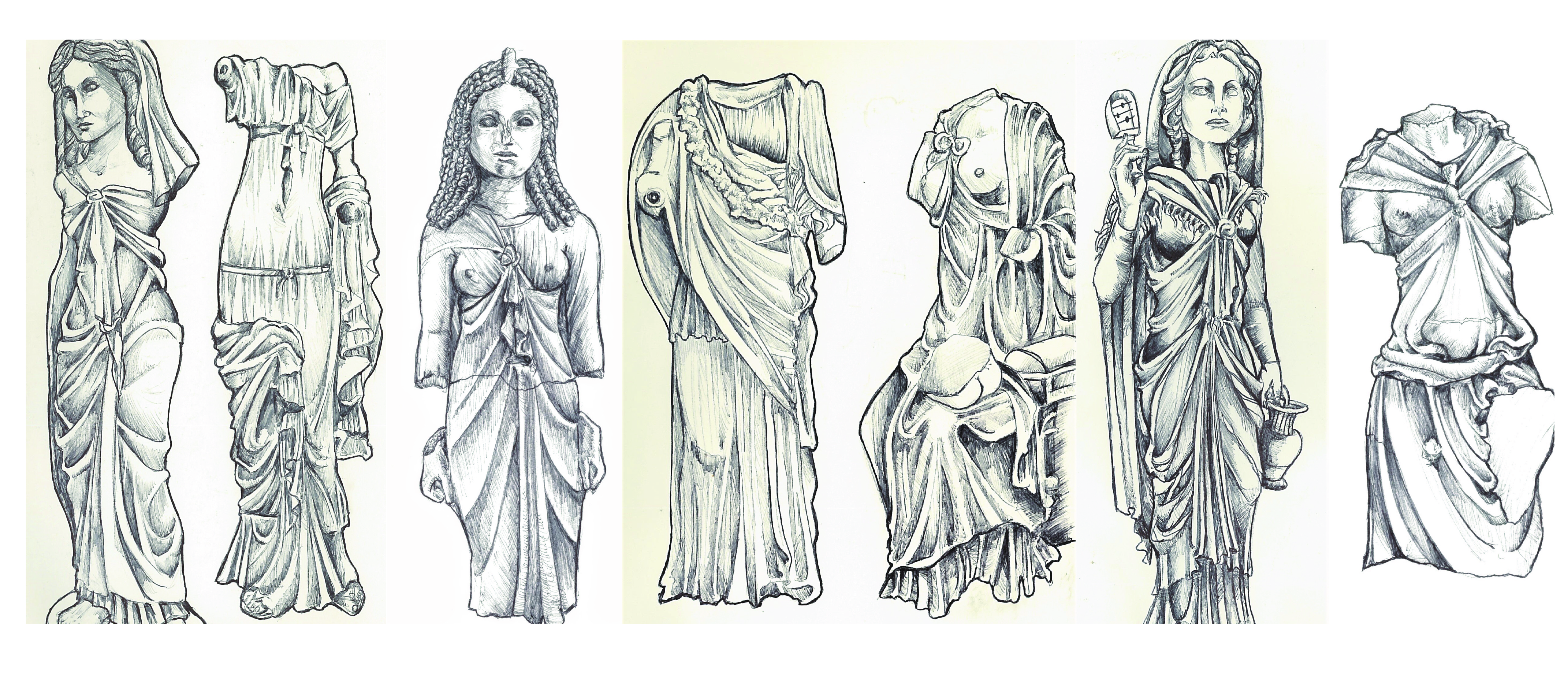
Some of my sketches of Isis statues over the last 4 years.
Isis’s power as a deity in Egypt rested in being the wife of Osiris and mother of Horus. She bridged the continuity of kingship from one king to his descendant. Her original function as the literal and symbolic role – as the throne and king-maker in Ancient Egypt – changes quite dramatically once the cult is exported into Greece and Italy.
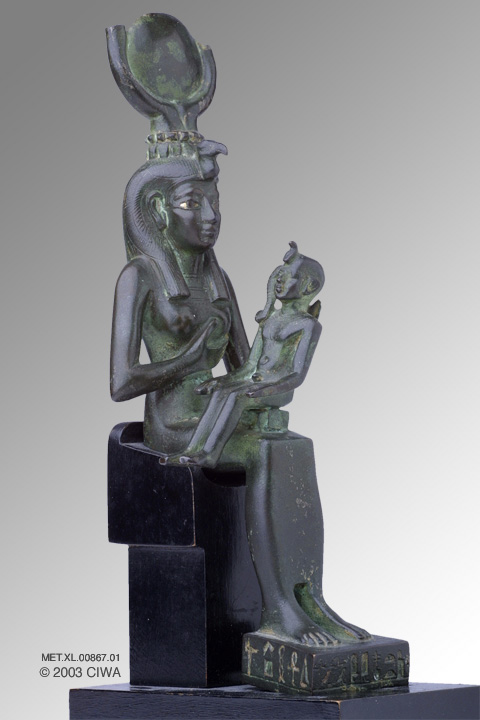
Isis cradling Horus – from the MET archives.
While the period of Isis worship in the pre-Hellenistic era (before 323 BCE) is interesting, what has captivated me more specifically is what happens with the cult in the Hellenistic-to-Roman period. Like a character from Sailor Moon, she gained many headdresses, wands, tools, and visual associations with other deities (Demeter, Aphrodite, Athena, Nike).
This is the period that I focused on during my MSc, researching the symbols and iconography over time, with an emphasis on the tiny figurines used in her worship. What I discovered was that her strength was in her flexibility. Her image could be adapted to all needs, wants and interests. She could be a local or international deity. She could be closely affiliated with a particular ruling dynasty, or one specific location.
Another investigation looked at the cult’s relationship with Athenian government in Delos, and some of the territorial quarrels that occurred between temples run by different factions on the island. The evidence of a push and pull scenario between Delos’ new overlords (the Athenians) and the previous residents, in the mid-second century BCE. Running cults was big business and politically useful to establishing ones career, and the Athenians had no interest in allowing an Alexandrian ‘Egyptian’ to maintain a monopoly on the worship of Isis in this economically powerful port.
While few temples of Isis remain in even remotely good shape, Pompeii possesses on of the most famous examples.
Temple of Isis and her #1 fan, Pompeii (2016).
Pompeii had one of the best-preserved temples (though most of the decorations were long since removed and put in museums). It was fascinating to see the spread of Egyptian-looking artefacts which tend to denote cult membership. The items that were recovered from Pompeii are varied and showed decorations and materials of incredibly high quality that were made for, and used by, the Temple of Isis.
Another leg of the journey in my first large research project involved a trip to Palestrina (ancient Praeneste), some 40 km east of Rome. Part of what I wanted to see was the Egyptian artefacts, which remain some of the most exquisite examples of mosaic work from ancient history.
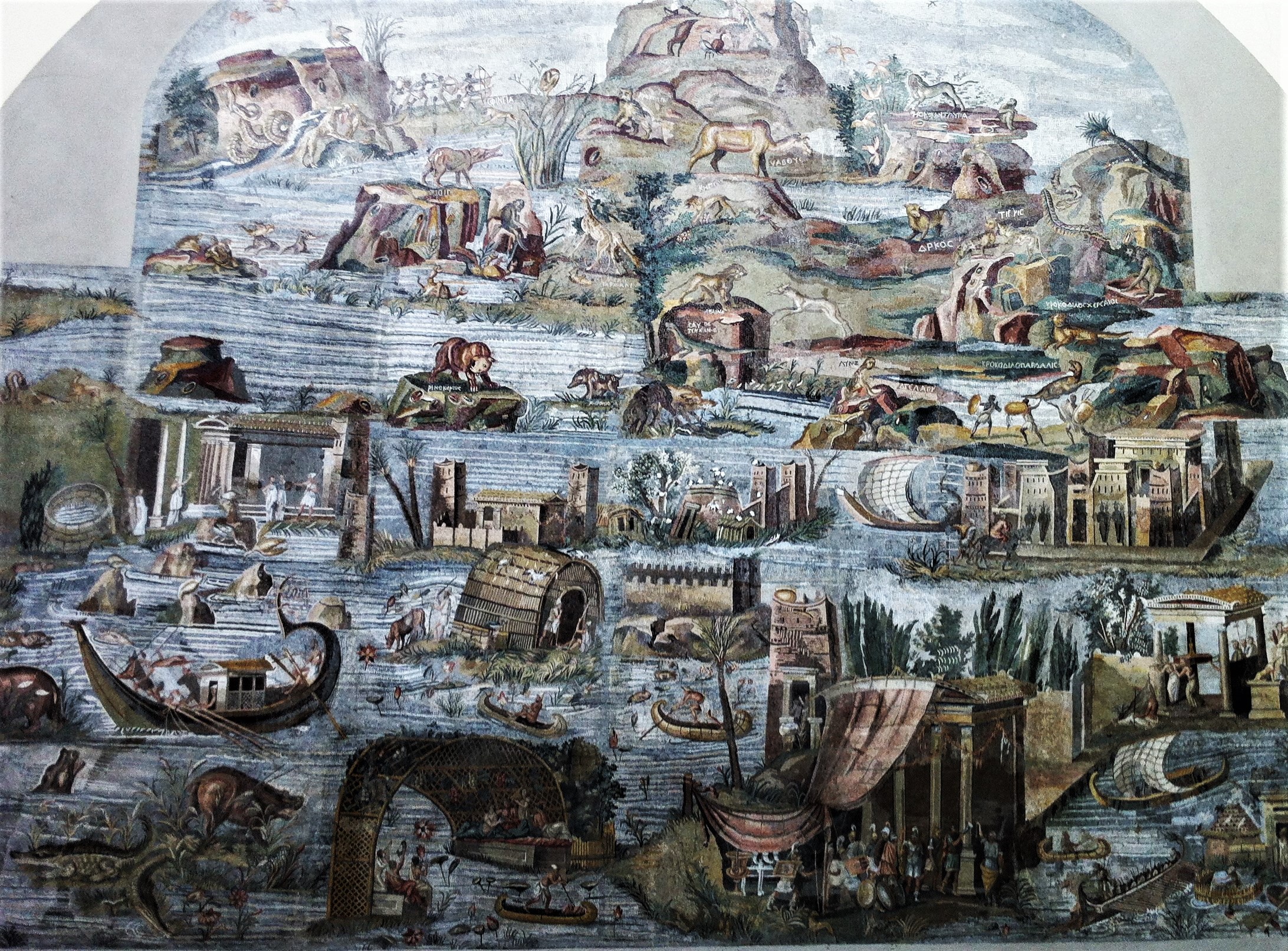
The Nile Mosaic of Palestrina, Italy (2014).
The Nile Mosaic of Palestrina was breath-taking in person and represented an interesting fusion of culture and appropriation of the Hellenistic Alexandrians and the native Egyptians. Although it is an uneven cultural balance, with the prioritising of the Macedonian elite over the native Egyptians.
It is a rare gem of the exquisite mosaic work that was part of art market in Italy, before the Rome dominated the Mediterranean. It highlighted aspects of Egyptian cult which would find its way into Italy, though altered for Italian tastes.
This September I will be stepping into the subject and delving deeper into urban design, Egyptian architecture and the art styles that appear in Roman cities. There are so many aspects and angles to investigate with this topic, and being able to work on a PhD toward this end is like a dream come true. There are still so many sites, statues, and sistrums to see in my journey into my studies of this Cult of Isis!
There is something breathtaking about the shores, mountains and harbours around Lesbos. Mithymna is a gem of a town, with all the fine features you hope for as a tourist destination, but a significant amount of history is embedded in every corner. As one of the largest Greek islands, and the nearest to Turkey, there is a remarkable amount of cultural fusion and warmth that shaped my experience of living in Mithymna (Μήθυμνα / Molyvos) for several months, some years ago.
Taking a libation at the Mithymna castle.
While being housed during the spring months in Mithymna, I explored the winding cobblestone streets, photographed dangling flowering plants and occasionally sampled the vibrant restaurant scene at the harbour.
Mithymna harbour
These elements, along with adorable roaming stray cats and dogs (some of whom we adopted), formed idyllic scenes that made it a beautiful and tranquil location to study some Byzantine History and Reception Studies (in effect, the study of modern interpretations of the ancient world) during my undergraduate degree.
A charming painting in the old schoolhouse where we took lessons.
What a draw for a historian!Like many ancient city centres, Mithymna has a foundation story whose characters possessed the very names of the location – in this case, Mithymna (daughter of a mythical son of the god Helios) who was married to the personification of Lesbos. Hard to prove, so I’ll take the Oxford Dictionary of the Classical World’s word for it.
Mithymna Castle
The history of Mithymna is actually the stuff of legends, literally. The Bronze Age warrior Achilles was said to have breached the fortifications of Mithymna due to the amorous machinations of King Peisidikis’s daughter.
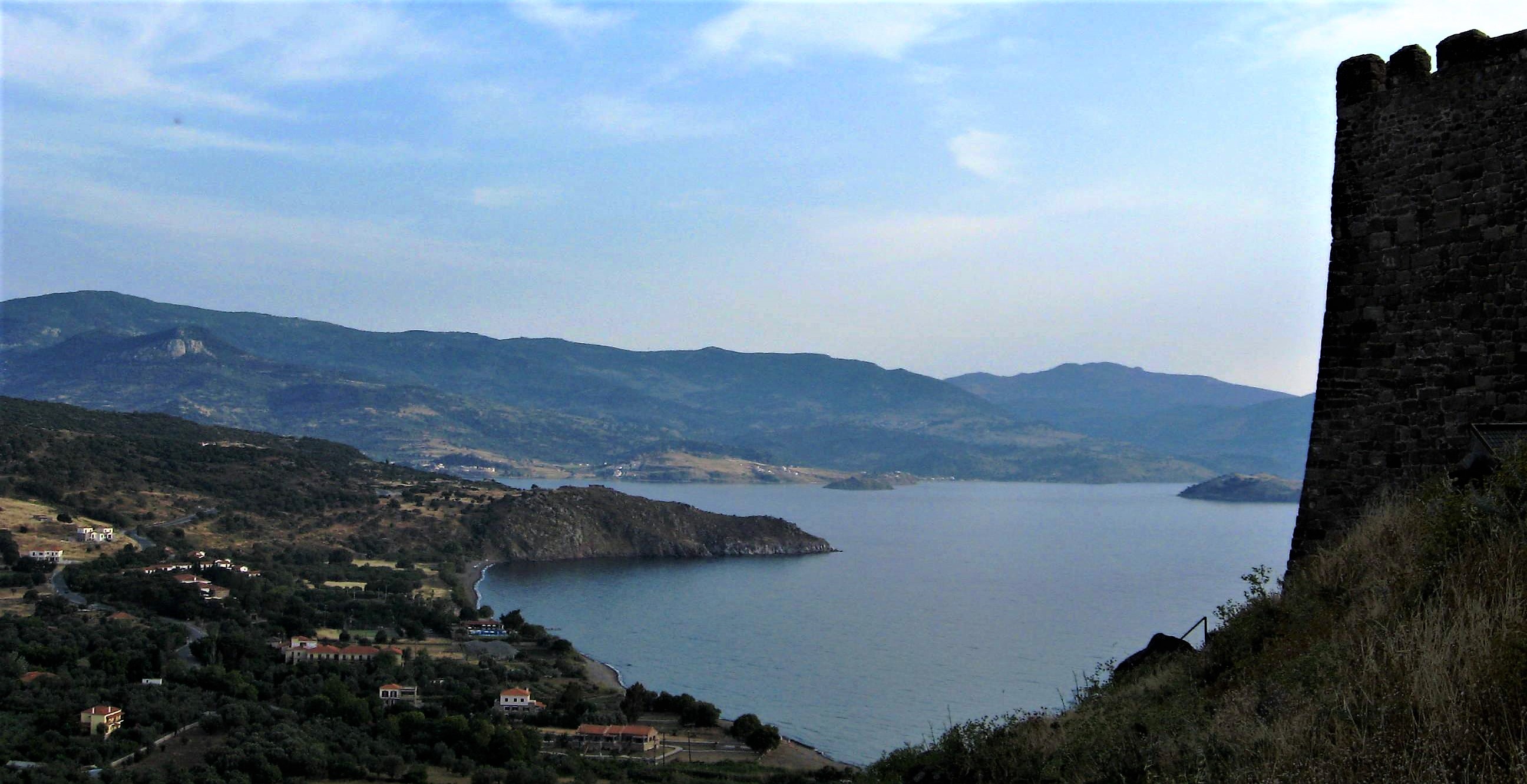
View from Mithymna castle of Efthalou.
The city fell to the Achaeans, as the events of the Illiad take place not far away across the water (you can see Turkey from the shores of Mithymna).
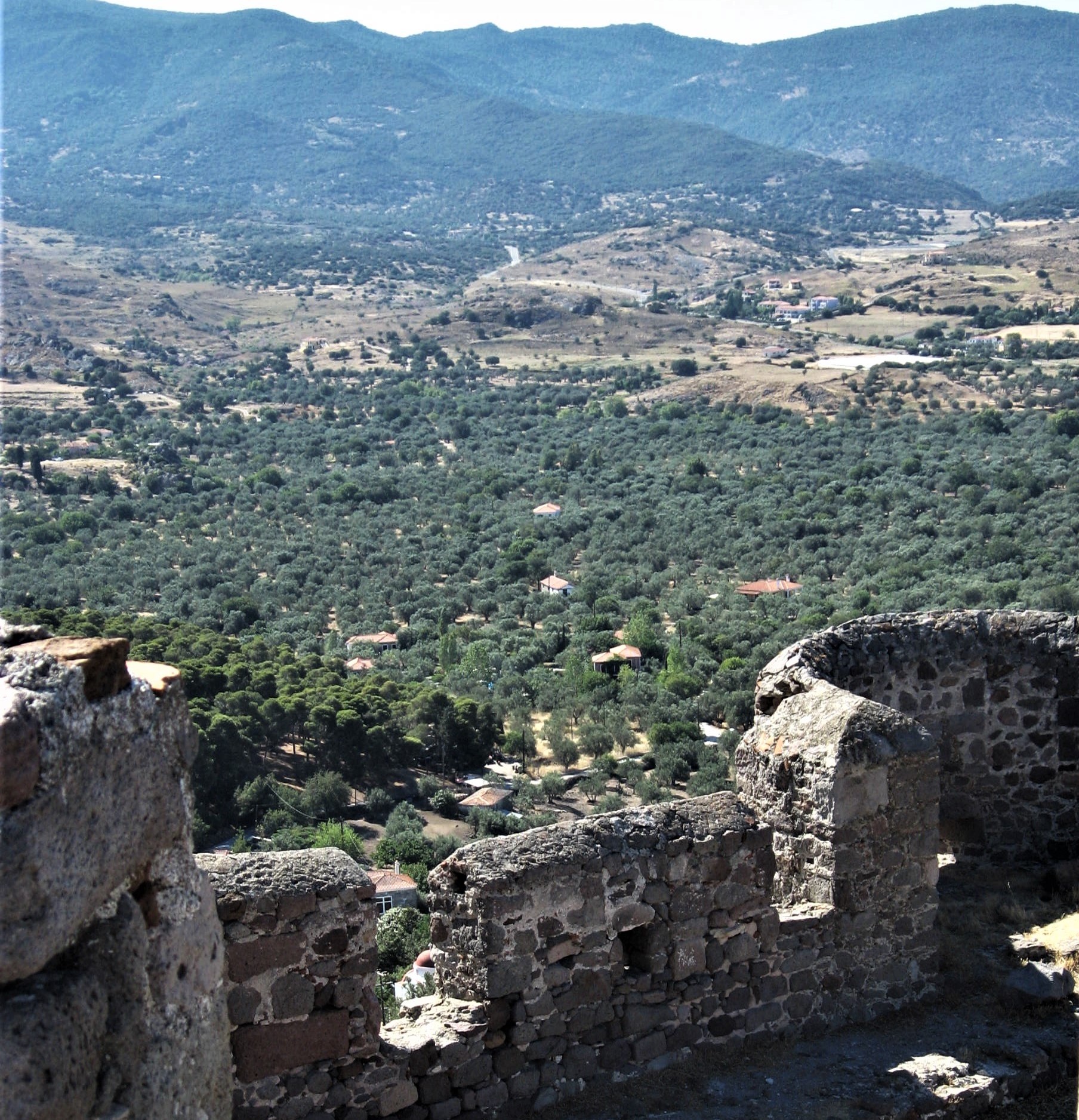
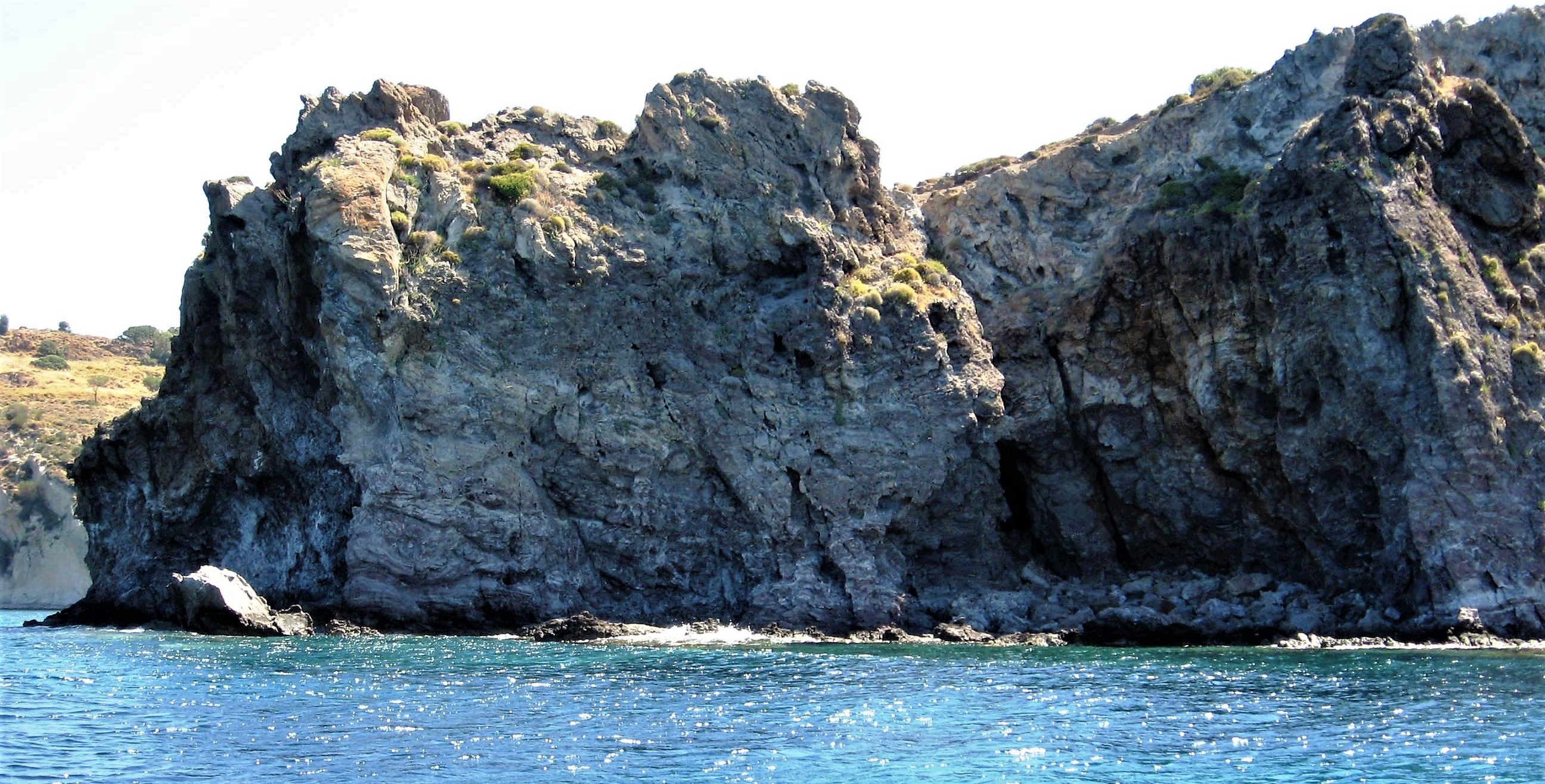
Mithymna had been an important location in the Classical period as it was caught between the Athenians, their ally, and the Spartans throughout the Peloponnesian War (431 – 404 BCE). To and fro, the balance of power shifted from Athens to Sparta, and back again throughout the war; and smaller allied cities were caught in the fight, or served as proxies for the conflict. Mithymna and Mytilene had a solid rivalry throughout this conflict and beyond, which I will go into when I post about Mytilene. But for the time being, some dark business went down during this three decades long war, and Mithymna and Mytilene had some serious issues to work out afterwards.
Splendid isolation on the beach
Remaining significant throughout the Hellenistic period, Mithymna played politics as it was captured by Macedonian forces and Persians, with tyrants ousting and aligning themselves with the conflicting superpowers when they gained control of the island cities. With the division of Alexander’s brief empire by his successors, King Lysimachus and later Ptolemy would control the island. With the influence of the Ptolemaic ruler, my academic obsession, the cults of Isis and Sarapis were introduced and worshiped.
Which brings us neatly to the Roman period.
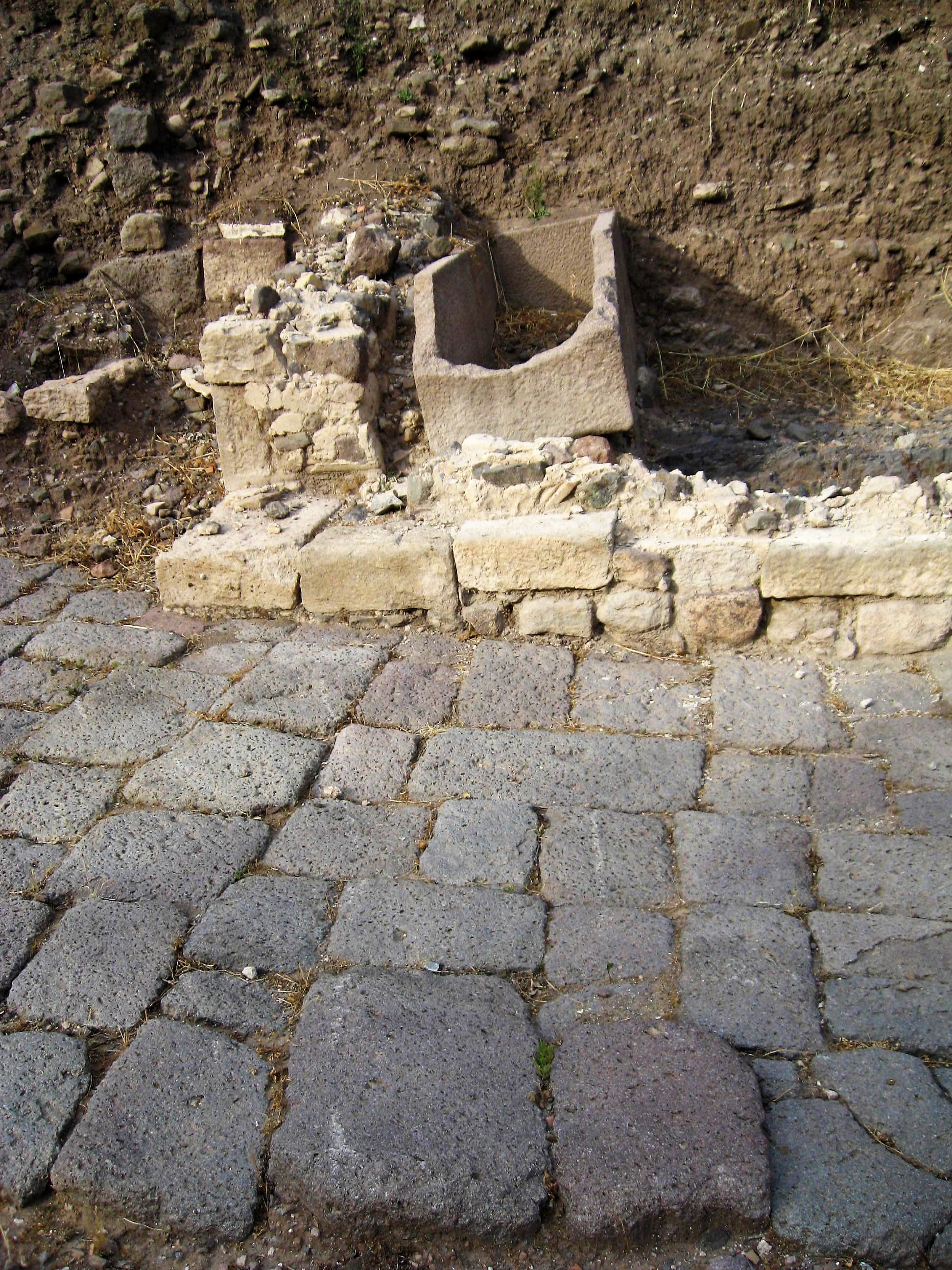
A bit of Roman road and tomb.
Sprinting through so much history, I can barely touch on how many fascinating moments in ancient history in which Mithymna has played a part, but one of the elements which leaves a physical trace, which I was thrilled to see, was the Roman archaeological remains dispersed throughout the city.The formal alliance between Rome and Mithymna was dated by an epigraphic source to 129 BCE. The Roman poets and writers spent many words to describe the quality and superiority of Mithymnian wines.
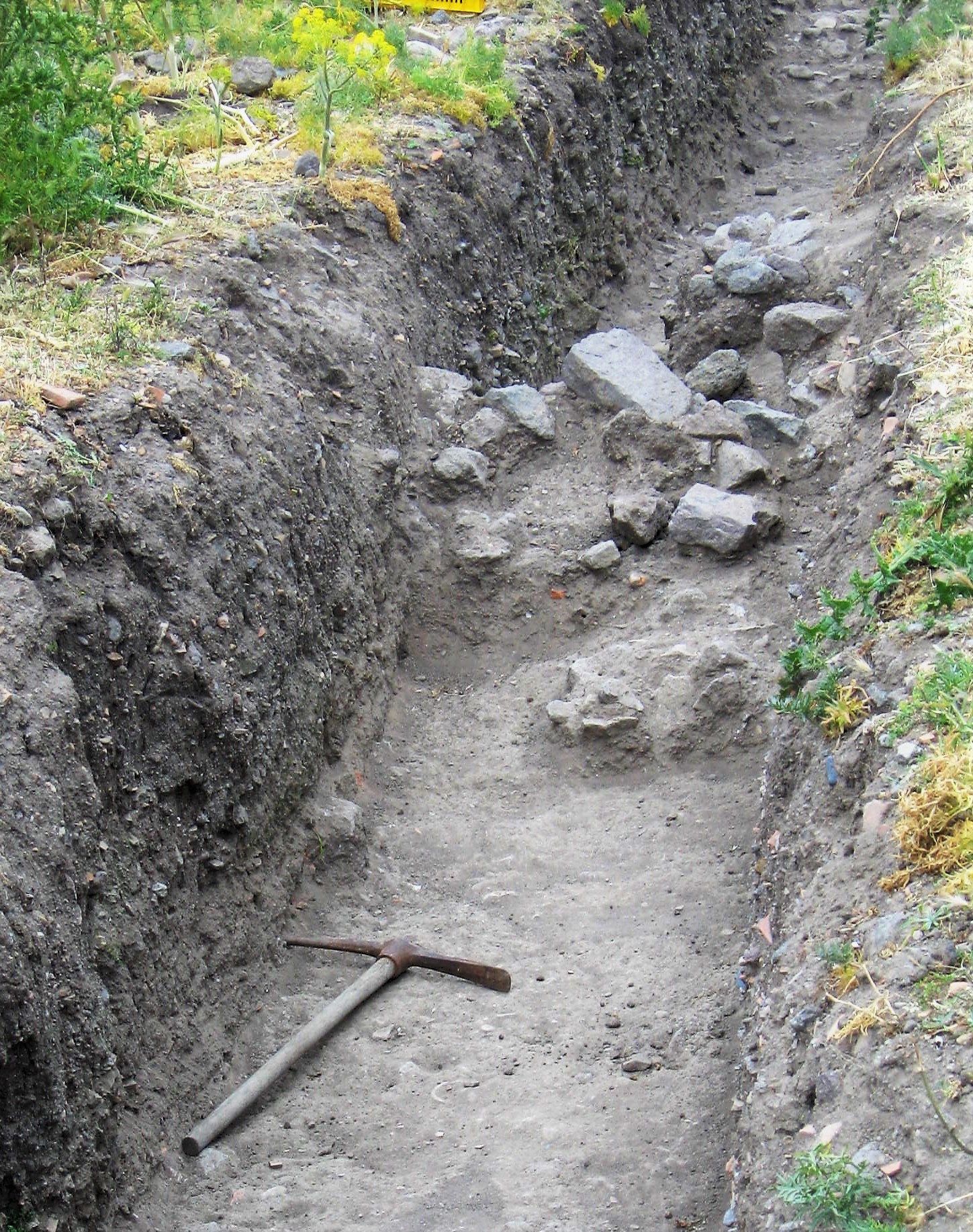
While staying in Mithymna, I was fortunate enough to meet a local archaeologist who gave us a small tour of the closed excavation.
Finds from this trench were rich in pottery and sea shells.
At that point, they had a great deal of pottery and many interesting rubbish dumps from the Roman period. It appeared that they were producing pottery, and likely distributing the wines in vessels made at this centre.With the political upheaval in the 5th century AD of the western half of the Roman empire, Lesbos fell into the orbit of political authority from the Byzantine power-base of the eastern empire. This orientation affected the flavour and practices on the island as Christianity became the prevalent belief system and religious power throughout the empire. Thank you for reading my blog!
For the last few months I have taken a hiatus from writing my blog to focus on applying for a PhD at the University of St. Andrews. What a harrowing adventure! From start to finish, it was a good 3-month process with dozens of re-writes, stress and the agonizing wait to hear back. Even starting early, and following advice from friends and online, there were so many unknowns going into it. There were many moments of self-doubt, which had the uncanny ability to creep in when I needed it the least. With the support of some amazing teachers, mentors and friends, I managed to get someone interested in the incredibly nerdy stuff I love – Roman Aegyptiaca. In a post coming soon I will write about what that is, but for now…I will be studying Egyptian-looking things in Roman cities.
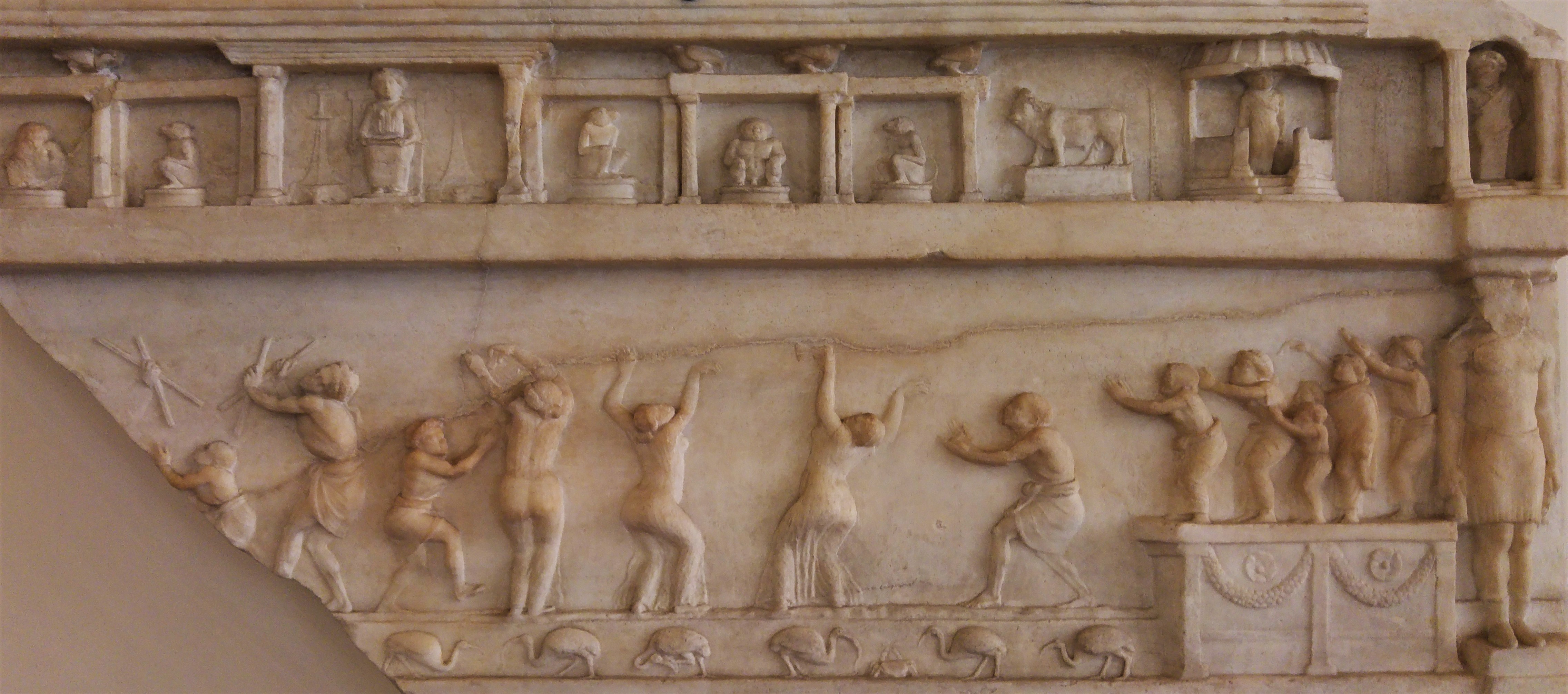
Khoiak Procession from the Nile Mosaic of Palestrina, Italy (2014)
While the outcome might seem straightforward, (person X likes (topic), studies Y = goes on to PhD) the path is rarely as clear as this. An interesting part of the curation on social media, is all of the crap that you don’t want people to see can easily be ignored, not reported or underplayed. I focus and emphasize the things that I am most proud of, that arguably demonstrate a clear connection to my goals and objectives. It’s not always a conscious choice, but it excites me to share upcoming adventures (research trips, excavation work, conferences etc), and even if those activities are the exception to fairly humdrum periods of time, I try focus on the positive and engaging elements in my life. That curation presents a deceptively well-planned and linear pathway however.
Roman road excavation. Merida, Spain (2014)
Like many people in the ‘millennial’ category, I have taken a strange circuitous route to finding a path. For many years I was uncertain what it was I wanted to do, or how I would even get there. My professional or academic shortcomings would emerge when I contemplated pursuing any concrete direction. Supporting myself through school involved things that looked remarkably unrelated: Italian train information CSR, custom picture framer, freelance artist, call centre CSR, book and video store sales person, maternity store sales clerk, telecommunications CSR, office administrator for an engineering firm, work-study intern with a museum, housing assistant, university credit secretary, repairs assistant, catering delivery driver, and endless amounts of ‘exposure’ work (free) and side-hustle to get through.
‘Work for exposure? Oh can I?’ Roman wind chime. Merida, Spain (2014)
Despite working in areas that for many would happily suffice as a career, I have always been half in and half out. Every work placement is an opportunity to learn useful skills, but nothing had any real resonance to me or inducement to stay long term. I always had an eye to what might be ahead and to apply to any and every opportunity, often ending comfortable employment for a scrambling uncertainty.
Egyptian relief. Louvre, Paris (2016)
Sure, I love ancient history, archaeology and art…but what can I really do with all this?
Throughout all of that, I knew I wanted to spend my life studying and sharing aspects of ancient history through art and writing, but unsure as to what my mixed-bag of skills would allow me to do. When I drew all of my work experience, hobbies and passions together a picture emerged that put the question to rest: I want to be an educator of Ancient History. Fundamental to this was attaining a PhD, and getting more focused and industry specific work experience.
See? So much time spent on ancient walls. Hadrian’s Wall, England (2013)
Having been accepted to St. Andrews, I now have several months to plan and prepare – skills my varied work experience has hammered into me. Much of the existential angst of ‘what will I do and where will I be next?’ can finally be put to rest for the next few years. With the patchwork of experience that has sustained me, now behind, I look forward with more clarity and focus.
Whilst I was excavating in Policastro Bussentino, I decided to use my down-time productively and get to know the cities in southern Italy. The train routes were cheap and plentiful along the Tyrrhenian coastline, with beautiful views on this regional train ride from Napoli Centrale.
One such a day trip, I ventured from Naples on an ambitious outing to see some ancient cities of Magna Graecia. I say ambitious because by foot it is a very long walk from Baiae to Cumae along a winding hillside with no shoulder or footpath- all in all, a 15 mile walking day.
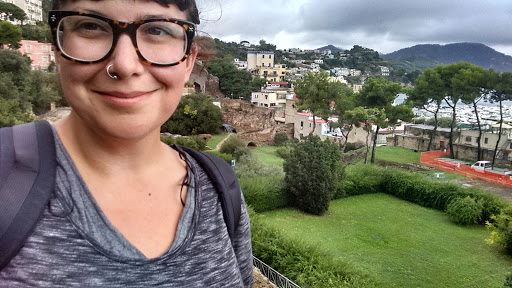
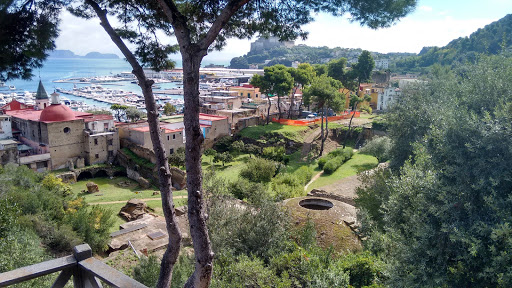
When I arrived at the ancient town of Baiae in Gulf of Puzzuoli, I had the unique experience of being in a spectacular archaeological site entirely alone.
It was a beautiful clear morning and I rocked up without having purchased a ticket (tickets you are supposed to buy at Cumae first then head over to Baiae, unbeknownst to me). Luckily, the park steward let me in for free and after I explained my disorientation!
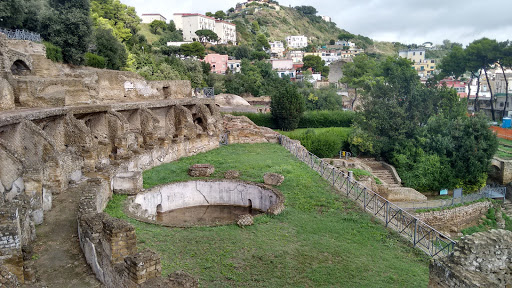
The archaeological park was stunning, as you can see. The multi-story bath complex was built into the hillside, and standing atop the complex it is not hard to imagine why the super-rich of the Republican period into the Principate were drawn to this place. This area was rich in volcanic activity (Vesuvius is very close, of course) which the Roman architects and engineers were able to channel into sulphur springs – perfect for hot baths!
There seemed to be endless rooms, and many with mosaic floors still remaining in situ. The mosaics are, appropriately, water-themed with divinities and typical meander and wave patterns. Water and neglect have left them in the current state of disrepair they are in, but you can see evidence of the gorgeous technical ability.
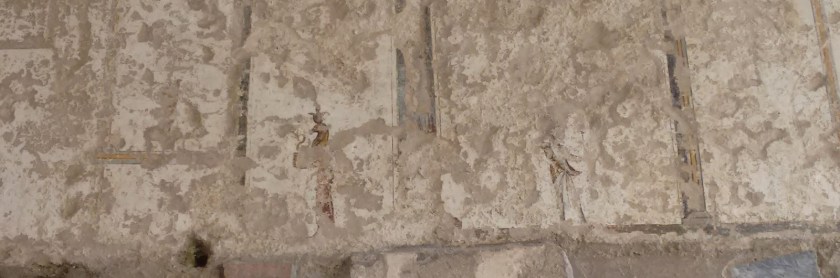
A surprising amount of painted plaster was still visible as well, with typical decorative motifs and some strange ones. The frescoes date to two particular stylistic phases: the middle of the 1st century A.D., called the 3rd Pompeian style (notably because of the ‘Egyptianising’ features they possess. This stuff is my research jam, and I shall in due course dedicate many 1’s and 0’s of the internets to discuss it.Below I’ve tried to highlight the figures which have zoomorphic features and elements meant to evoke Egypt (costumes and symbols).
A later, 2nd century A.D. phase is also present, which could be viewed as slightly irregular and a bit shabbier in execution. This little green dragon below was part of that later design.
There were a few cisterns still, and one was even fully intact. The echo inside made singing sound like I was using a microphone. Yes, I sang a few Disney songs before giving my spot to the tourists who were waiting at this point, bemused, outside. Nothing like being in a archaeological sites for belting out tunes (Florence and the Machine). Amusingly, it wasn’t until a month later I learned the name of it was called the “Temple of the Echo“. While not a temple, the name was still pretty on point.
Top-view of the cistern”Temple of the Echo”
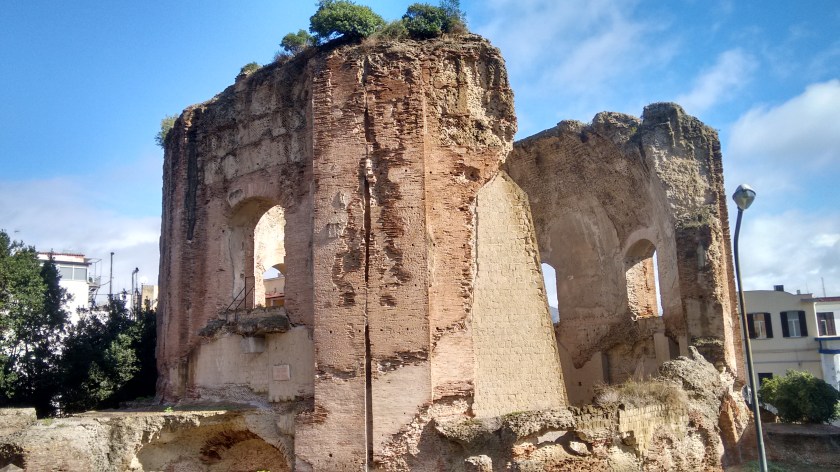
This was built during the reign of Hadrian, one of the greatest building emperors of the Roman Empire. The influx of funds in the 2nd century A.D. – which manifested earlier in the frescoes being added to – coincides with the building of this structure. Called a temple erroneously, it has been argued to be a pool, a further spectacular addition to the bathing complex. As I neared the bottom of the hillside, I could see a MASSIVE temple-looking structure, across the (modern) street, outside of the bath complex. I stood to sketch it for a while, and saw that it was a ‘Temple of Venus‘, which, given the history of this elite spa-town, would have made perfect sense.
Prolific in his building, this massive Hadrianic era building could have been a casino, pool, or possibly religious building- all suggestions I read at the site. The lingering naming of the building, ‘Temple of Venus’ betrays the varying perceptions of it that carried on over the last thousand years since it was in use.The political landscape in Rome during the late Republic into the Principate involved the elevation of the Julio-Claudians and funding to their parton deity- Venus. Julius Caesar had a villa in the area, and other notables like Pompey Magnus, Caligula and Septimus Severus all frequented the area.
Temple of Venus at Baiae
Augustus took over the entire complex (and much of the town), adding it to his sizeable imperial property. Controlling where the rich went to relax, socialise and play was pretty much Augustus’ raison d’etre during his early formation of how the empire would be run.
Anyone watching the Versailles (2015) series right now could imagine the same processes occurring in Rome under Octavian as was happening in the court of Louis XIV. Like the French nobles who were forced to adopt new practices and behaviours, Rome’s elite probably required some wrangling to stay in the lines as Augustus delineated them. Controlling spaces goes a long way towards controlling behaviours and shaping ideas.
Squinty little study of shapes at the Temple of Venus
The analogy of Versailles can be taken farther, as Baiae developed a reputation for moral bankruptcy, with salacious and scandalous behaviour taking place in the steamy rooms of this wellness retreat. One commentator on the depravity of Baiae’s baths and wellness centre was Seneca the Younger, describing it as a “vortex of luxury” and amusingly, “harbor of vice”. I suspect he may not have been on the guest list for the sexier parties.With Romans, physical wellness was linked with spiritual wellness. The presence of temples in a site like this would make a lot of sense
Not surprising then, that as time and memory faded the original meaning of these buildings more mundane structures, nestled along the coast, took on impressive religious connotations.




























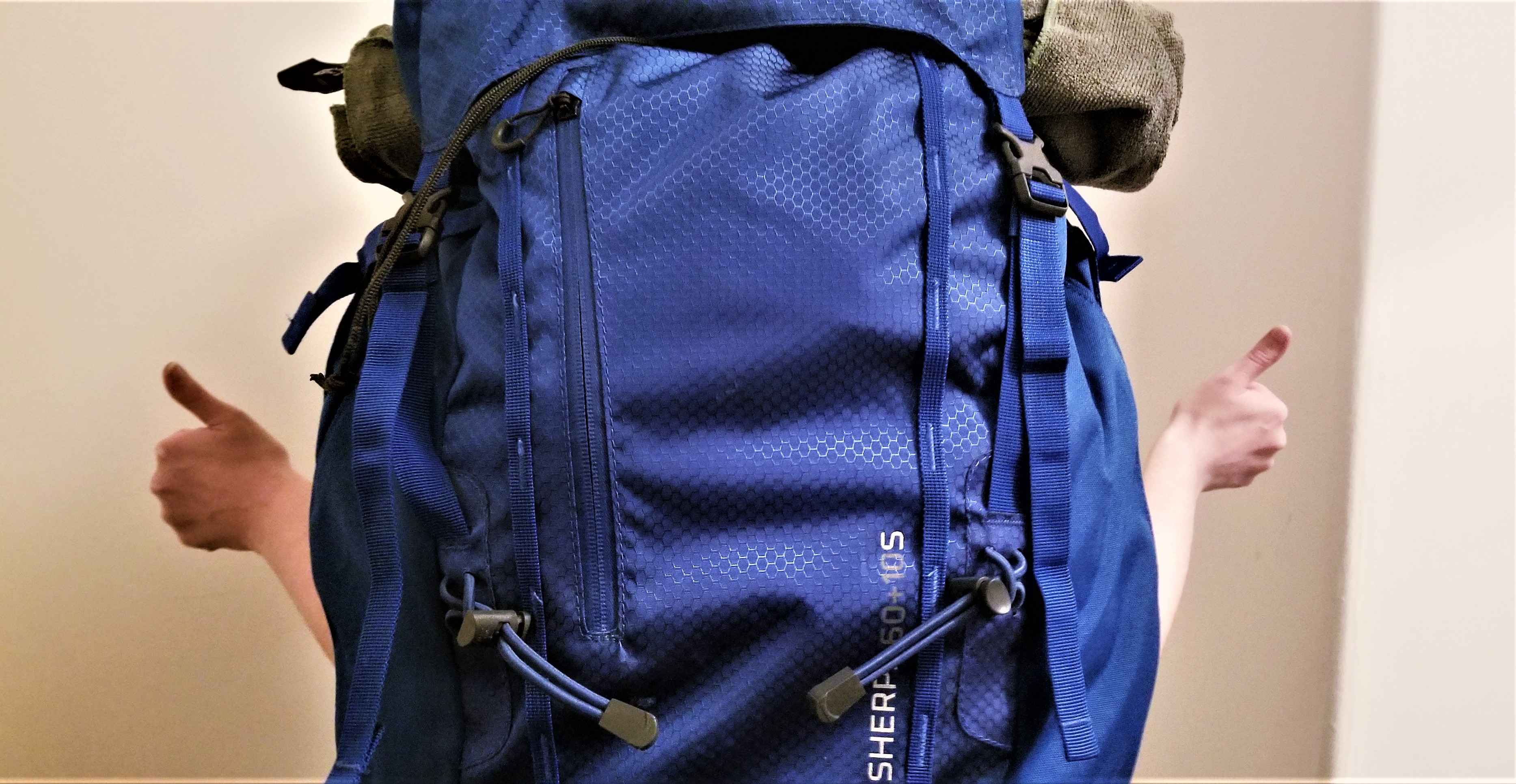


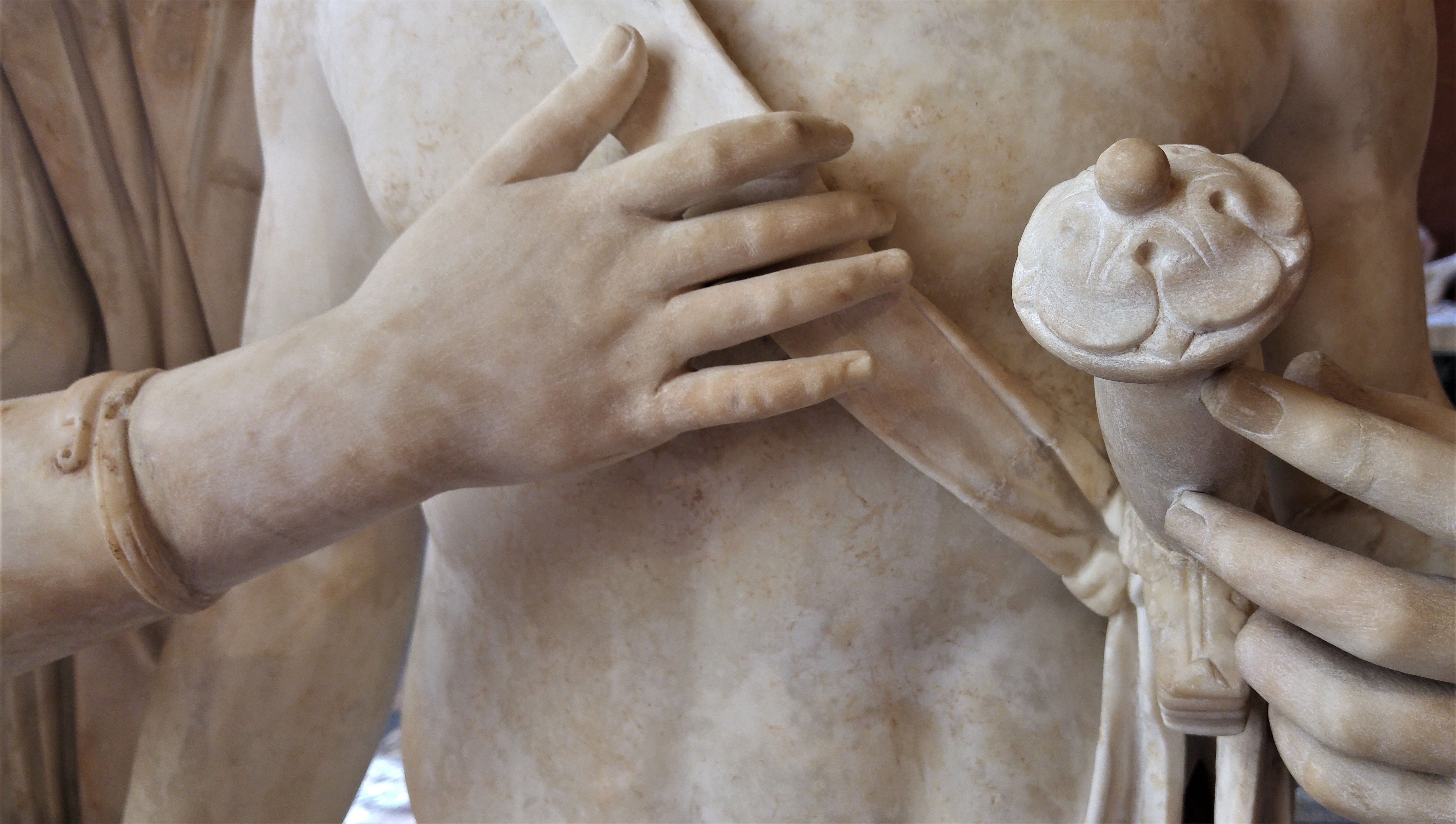 There is a fine art to going to see art. Nothing makes you unhappier faster than being
 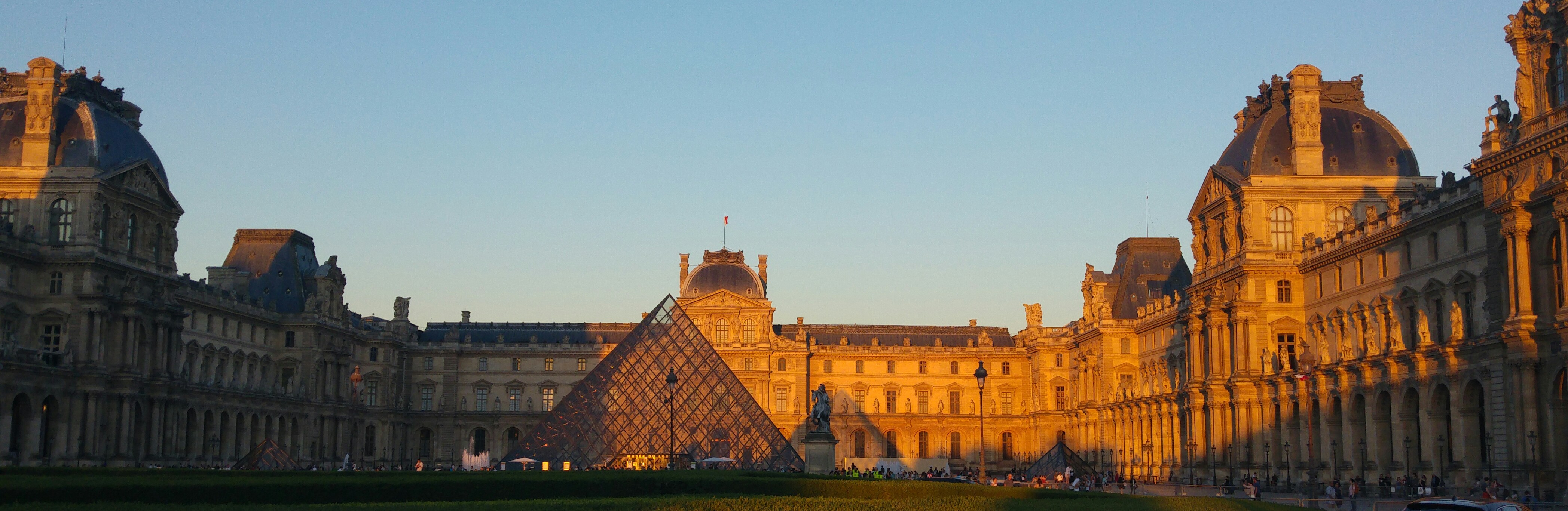 I know what you are thinking; OBVIOUSLY you will be going to the Louvre. However, you will never see everything in the louvre, so don’t try. Rather, pick two themes that interest you; Greco-Roman statues and Near Eastern pre-historic art? Tapestries and Medieval painting? Sure, you may not see every highlight, but by focusing on things you are interested in versus what you ‘should’ be seeing, you will likely enjoy it more.
 For relatively more modern pieces of art, the impressionist painting collection of d’Orsay and Orangerie are worth the visit. If you’ve ever been curious to see the ‘L’Origine du monde’ (Origin of the World), now is your chance! If you are lucky enough, there might be some performance art happening there during your visit! Both buildings are gorgeous, and worthwhile for a visit.
  Places for good eats:
  For me, nothing says going to Paris like staring at some Aegyptiaca. The big attractive Obelisk of Luxor and ornate fountains symmetrically placed at the center of Place de la Concorde, with Egyptian-styled decoration throughout the square is an interesting throwback to France’s imperial days. The site of execution of Louis XVI and Marie Antoinette, among many others. Surrounding crowds of jeering revolutionairies cramming into this space – briefly named ‘Place de la Révolution‘ during this period- is a viceral mental image of social and political upheaval to conjure.
 The museum de Cluny is full of art and artefacts from the Middle Ages, as you would expect from the name, but part of the treasure of this place is the building itself, built atop a Roman bath which you can see in the basement, the higgledy-piggledy building features of the exterior are sort of charming.
 The Pantheon feels as far away from its Roman predecessor as one could find; a monument to the civic spirit and fraternity of the famous French individuals. Once a church, a ruined abbey of Saint Genevieve, re-created by Louis XV in the mid-1700s. Interred within the Pantheon are the remains of Victor Hugo, Voltaire, Rousseau among others. There is something quite unique about such a ornate resting place for writers, philosophers and poets – secular heroes seldomly receive this type of hagiographic treatment.
 This area is great for wandering and grabbing a coffee and these sites are only 4 minutes walk from the Musée de Cluny. If nothing else, there is a famous macaron shop nearby which is worth the visit. Sweet treats near the Pantheon:
  The stairs leading up to Sacré-Cœur and the Montmartre are the devil. It is a beast to get up to the top, but don’t cheat and take the funicular. It’s good for you and will build character.
 The neighbourhood around the basilica is lovely and winding, with a large number of cafés and restaurants priced to keep the likes of me away. Atmospherically, it’s a an area with a relaxed vibe. There is often music floating around by street performers, interesting architecture and artisans with a plethora of stalls selling their paintings/prints. Stopping in at a café with a decent view, this is one of my favourite areas to sketch urban life scenes.
 Jumping on the a few metros and RER train out of town, visiting the Palace of Versailles is a pretty solid day trip. Built up from a swamp around his family’s hunting lodge, Louis XIV captured all of France’s nobility in his guilded cage of Versailles. Through elaborate specatcles to entertain them whilst there, and incredibly pedantic and restrictive court etiquette, Louis was gaslighting the French aristorcacy until they competed with eachother to help him put on his pants or use the toilet, as a sign of his favour.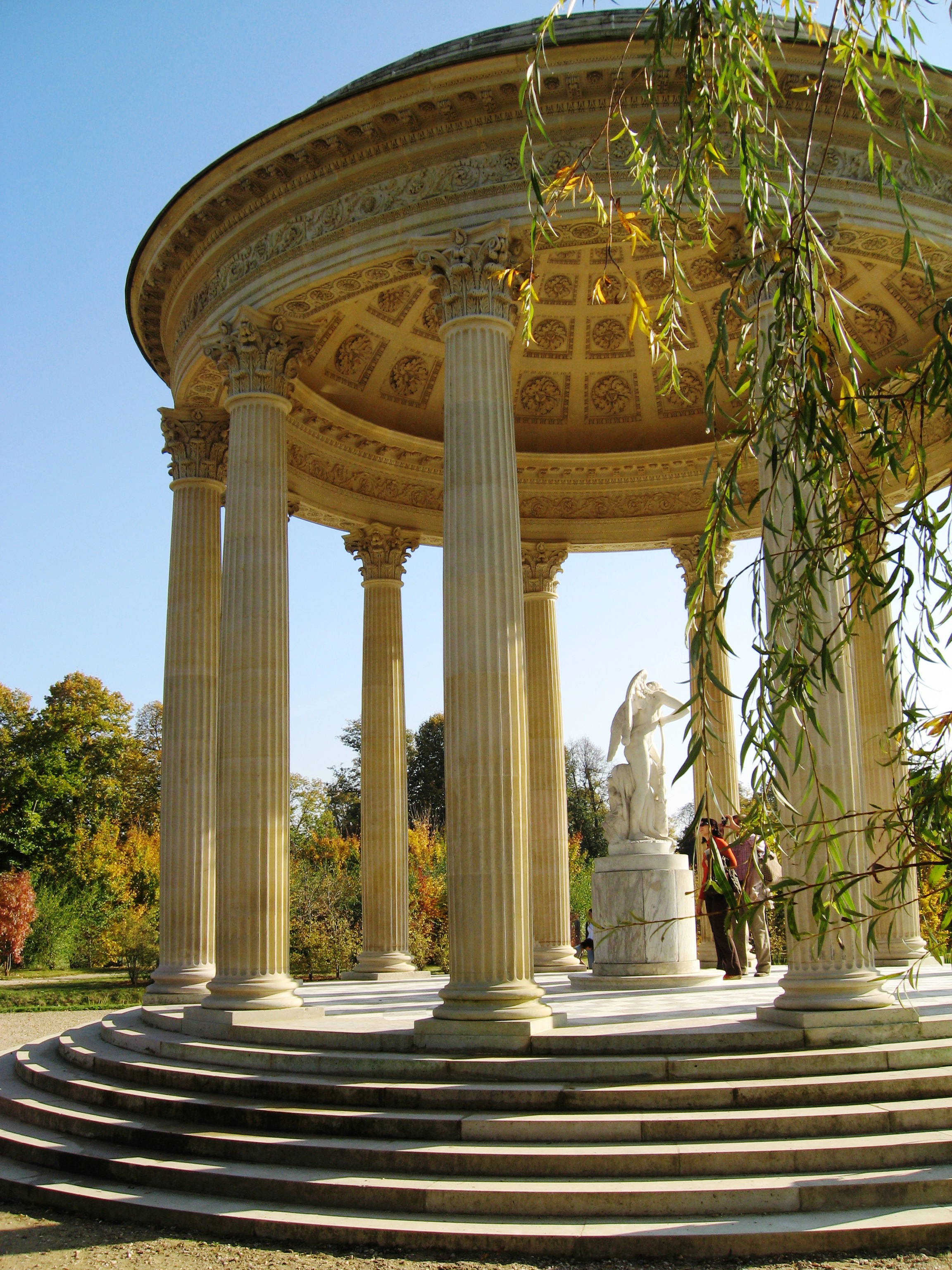
 A 40 minute ride on the RER, and you end up in the suburb of Saint-Germain-en-Lay, about 19 km west of Paris. There are nice gardens around the Château de Saint-Germain-en-Laye which house the archaeological collection, that offer a nice picnic space to nap post-Museum.




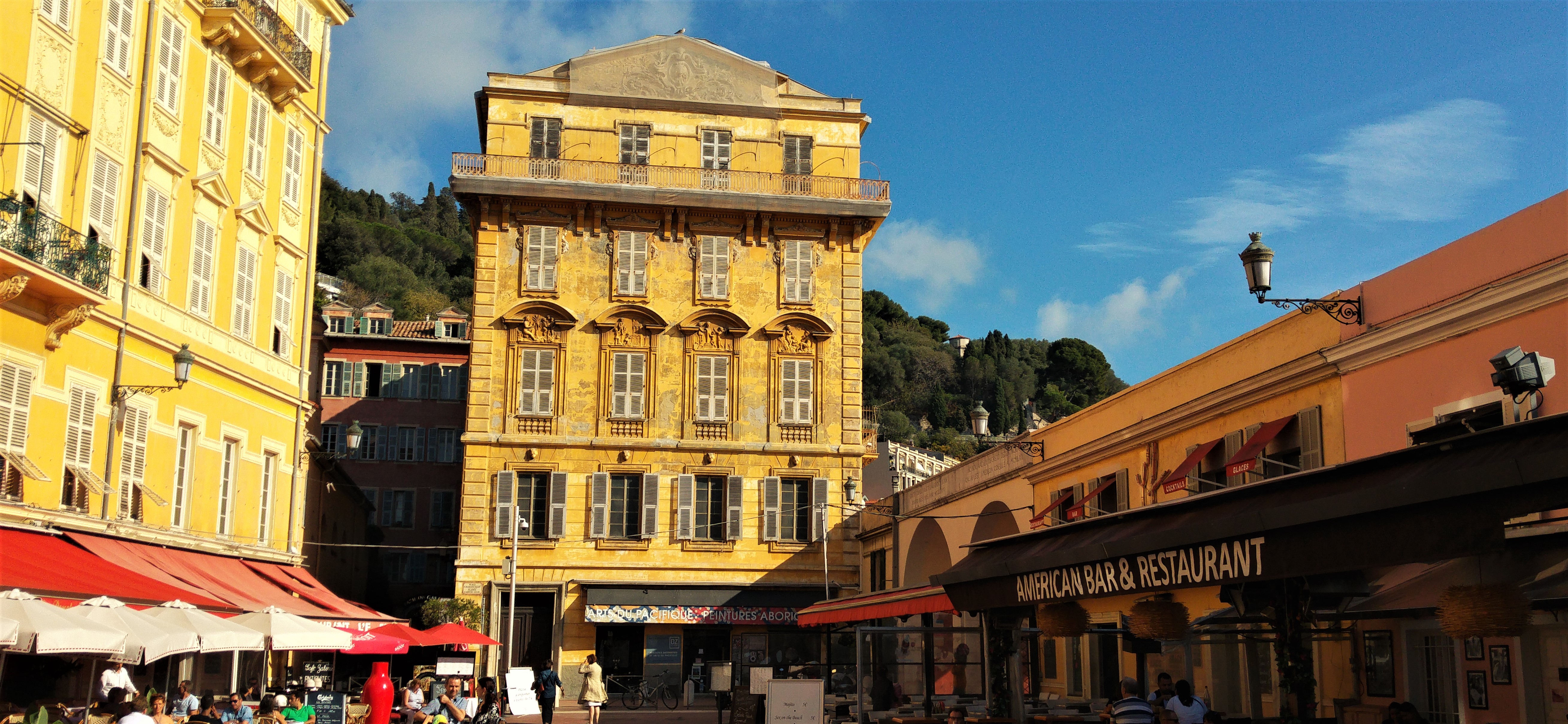 I wish I could say that I studiously read up on much of the history of Nice, but that would be a lie. We came for sun, beaches and the famous cuisine that characterize this gorgeous little spot of paradise.
 The open-air markets had spectacular varieties of sea salts and spices, with dried herbs and lavender filling the air in the narrow winding streets.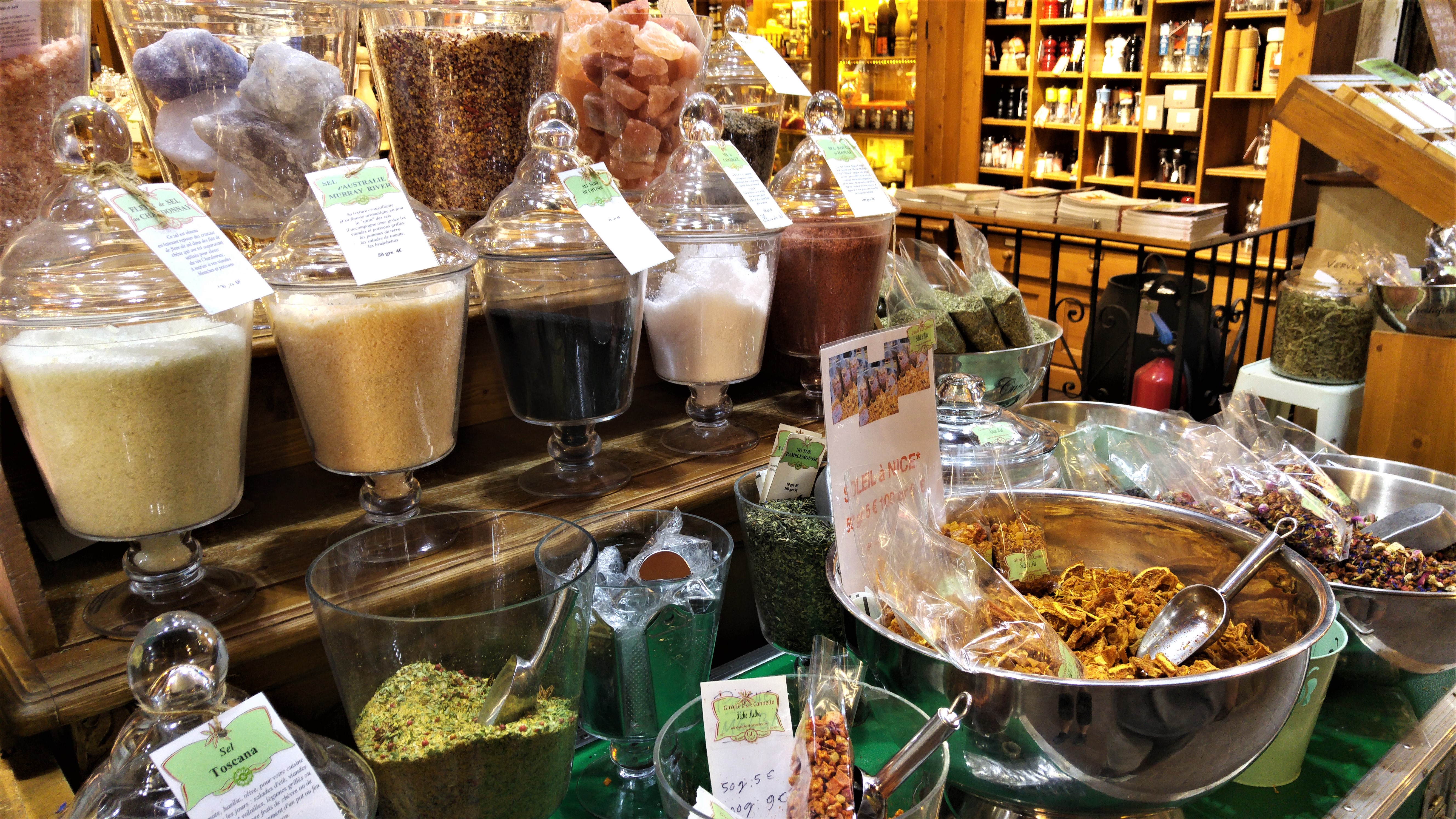





 “I divided the earth from the heaven. I showed the paths of the stars. I ordered the course of the sun and the moon”. (Kyme Aretalogy in honour of Isis)


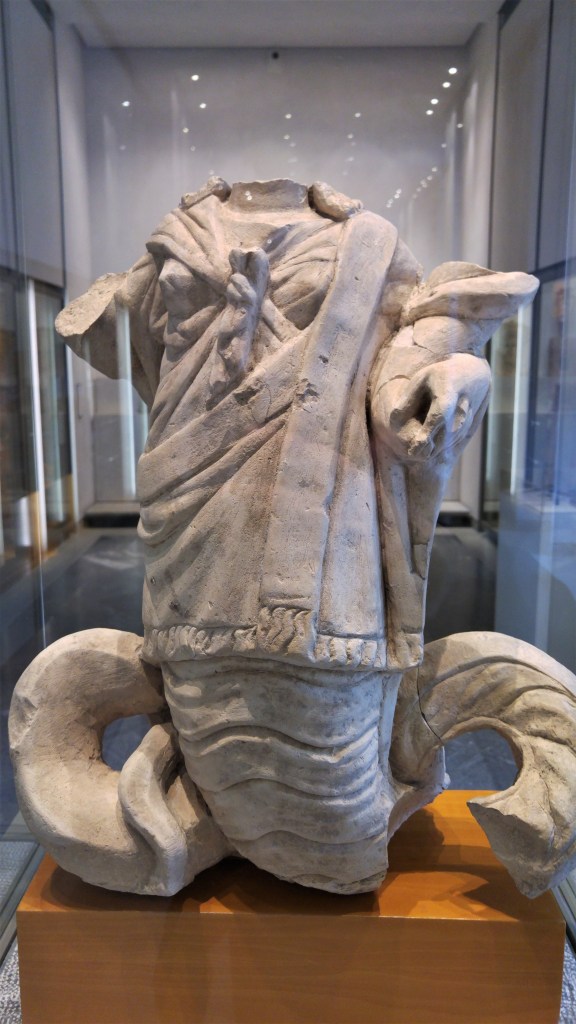

 My Masters at the University of Edinburgh was spent exploring the Greek and Hellenistic routes of the cult, from multiple angles, to start filling in the picture (and creating many of my own pictures).


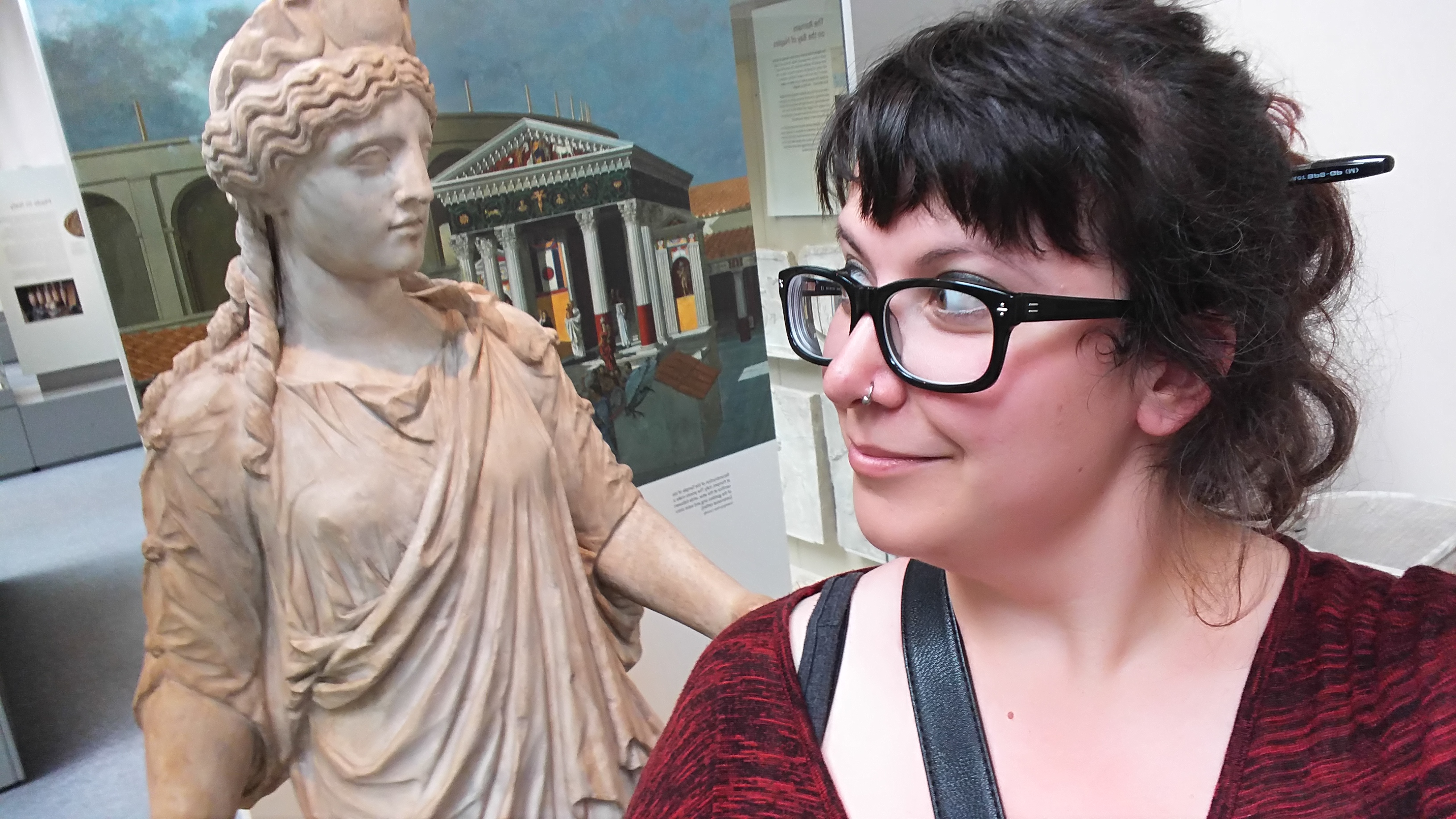 There are still so many sites, statues, and sistrums to see in my journey into my studies of this Cult of Isis!

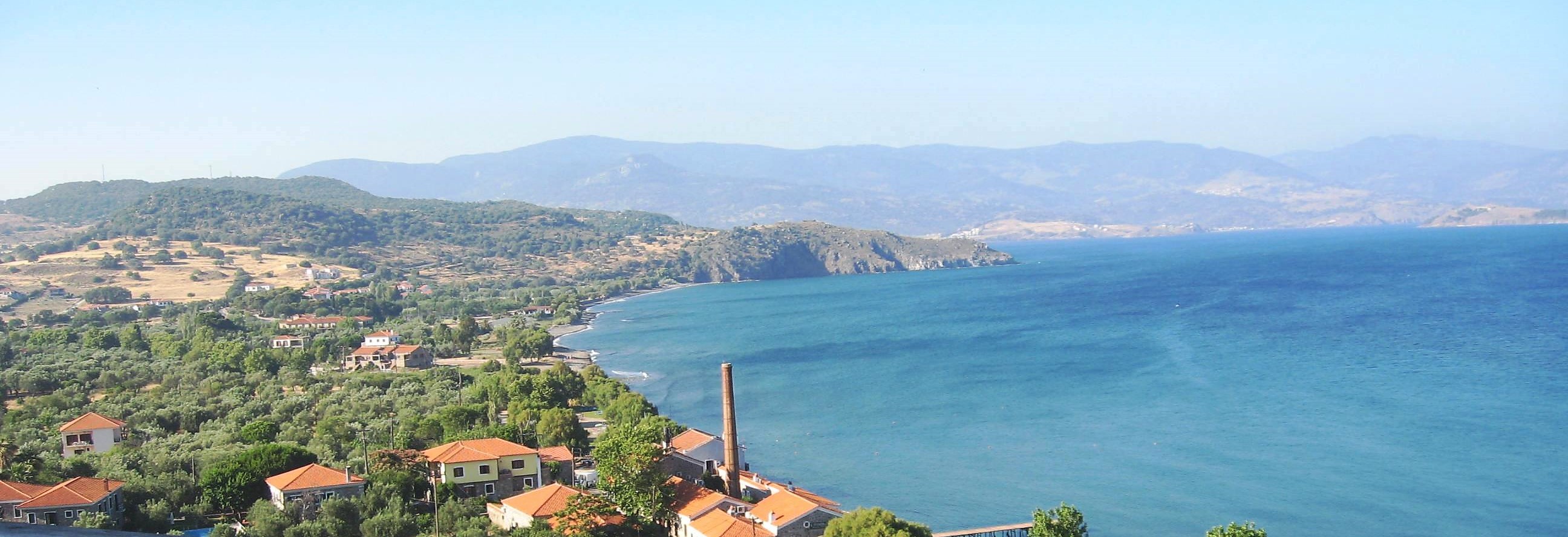 As one of the largest Greek islands, and the nearest to Turkey, there is a remarkable amount of cultural fusion and warmth that shaped my experience of living in Mithymna (Μήθυμνα / Molyvos) for several months, some years ago.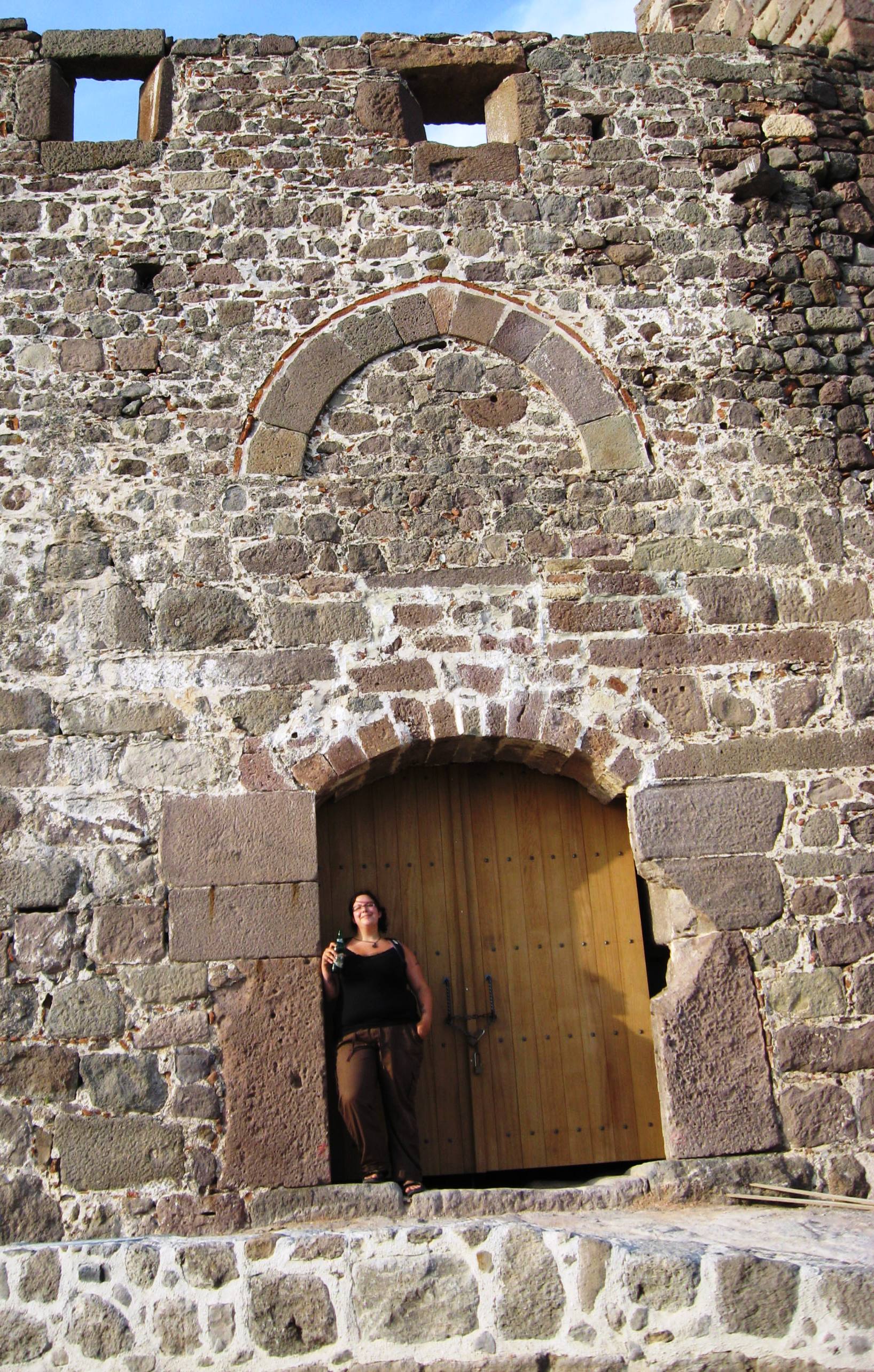


 Like many ancient city centres, Mithymna has a foundation story whose characters possessed the very names of the location – in this case, Mithymna (daughter of a mythical son of the god Helios) who was married to the personification of Lesbos. Hard to prove, so I’ll take the Oxford Dictionary of the Classical World’s word for it.
 Mithymna and Mytilene had a solid rivalry throughout this conflict and beyond, which I will go into when I post about Mytilene. But for the time being, some dark business went down during this three decades long war, and Mithymna and Mytilene had some serious issues to work out afterwards.

 The formal alliance between Rome and Mithymna was dated by an epigraphic source to 129 BCE. The Roman poets and writers spent many words to describe the quality and superiority of Mithymnian wines.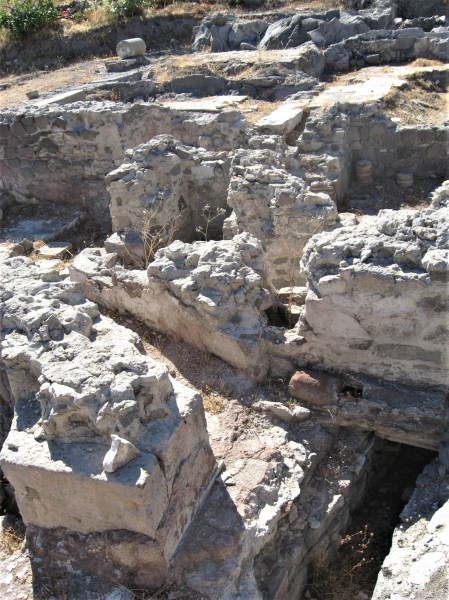

 With the political upheaval in the 5th century AD of the western half of the Roman empire, Lesbos fell into the orbit of political authority from the Byzantine power-base of the eastern empire. This orientation affected the flavour and practices on the island as Christianity became the prevalent belief system and religious power throughout the empire.
  Thank you for reading my blog!











 ArchaeoArtist
You must be logged in to post a comment.