

In the latest episode of Two Friends Talk History, I invited the brilliant Florence Felsheim, a PhD candidate in Classics at the University of St Andrews, for a fascinating deep dive into the intersection of virtual reality (VR) and cultural heritage. Together, they explore how technology is transforming the ways we visualise and interpret the past—and why that matters for both academics and the general public.

The episode kicks off with Florence introducing her work and academic journey. As a scholar specializing in ancient history and human trafficking in ancient Greece and Rome, Florence brings a nuanced perspective to the conversation. But her passion for technological innovation in cultural heritage projects is what makes this discussion particularly captivating.
Florence and Zofia delve into the evolution of virtual archaeology—the application of VR and augmented reality (AR) to reconstruct and visualize historical sites, artifacts, and environments. They discuss how initiatives like the Seville Principles emerged to create ethical and methodological guidelines for these digital reconstructions. These principles emphasize historical accuracy, interdisciplinary collaboration, and transparency, aiming to balance scientific integrity with the creative liberties of visual interpretation.
Why Do Digital Reconstructions Matter?
Throughout the conversation, Florence and I reflect on the “so what?” of VR in archaeology—why does it matter beyond the digital novelty? Florence makes a compelling case for the power of immersive reconstructions to democratize access to heritage. Through VR, people who might never visit physical archaeological sites can explore ancient cities, temples, or objects from the comfort of their homes or local museums.
The conversation also highlights how VR can provide new layers of interpretation. For example, by digitally reconstructing a ruined temple, researchers can experiment with lighting, architectural features, and hypothetical decorations, offering new insights into how these spaces might have appeared and been experienced by ancient people.
One of the most thought-provoking parts of the discussion is the tension between historical accuracy and artistic license. Florence discusses how art and accuracy can vary through different approaches, questioning where the line should be drawn between creative interpretation and factual representation. The episode explores whether reconstructions should prioritise strict accuracy or allow for some imaginative flair to engage wider audiences.
In our discussion , we touch on a few projects that are really interesting, that you should definitely check out:
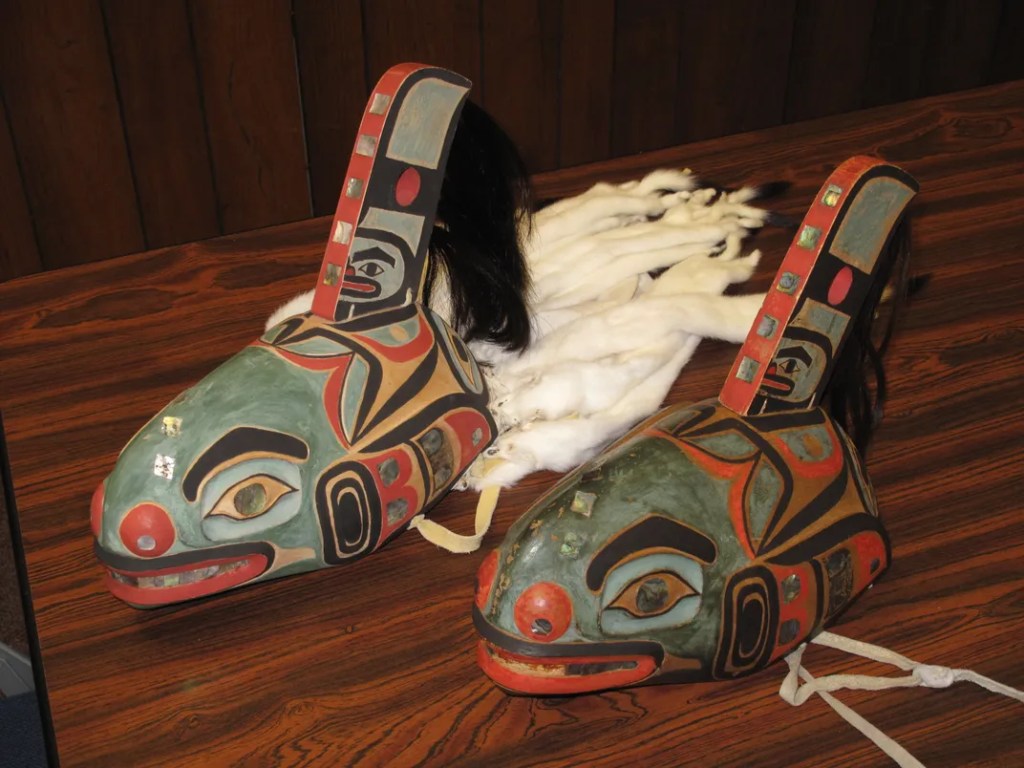
(Photo: Smithsonian Online Magazine, September 11, 2017)
To read the Smithsonian article and find out more about the Tlingit Dakl’aweidi clan’s Killer Whale clan crest hat, or Kéet S’aaxw (photo below from isplayed together at the 2012 clan conference in Sitka, Alaska), click here.
For more information about the virtual environment analysis of the fantastically cool submerged Late Pleistocene cave site in Quintana Roo we discussed, click here.
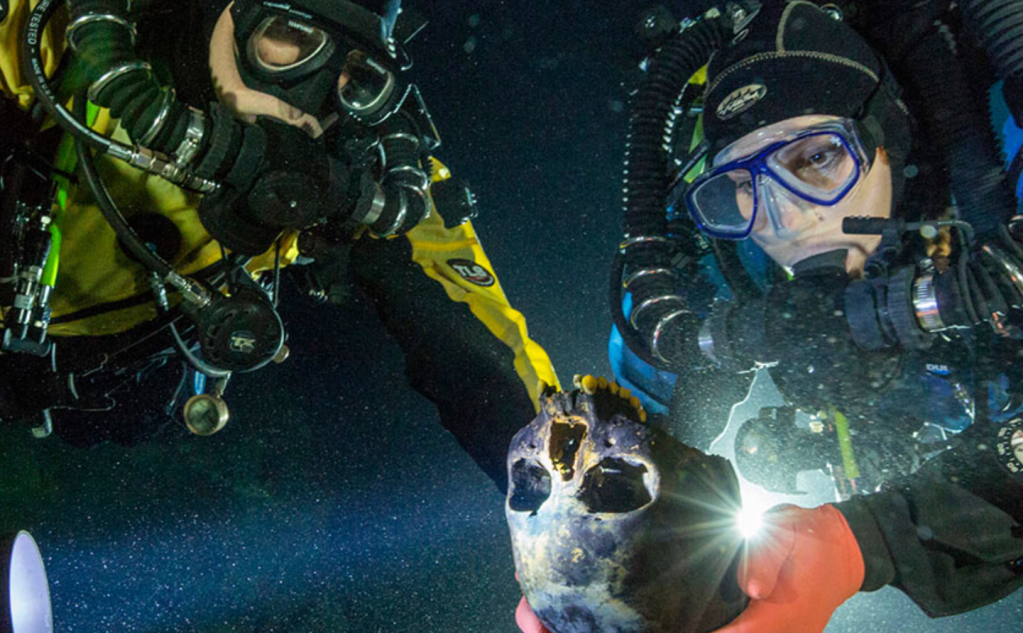
(Photo https://hoyonegro.ucsd.edu )
Challenges and Opportunities in Virtual Heritage
Despite its immense potential, VR in cultural heritage is not without challenges. Florence and Zofia discuss several hurdles:
- Resource Intensity: High-quality VR reconstructions require significant technical expertise, funding, and computing power, which can limit accessibility for smaller institutions.
- Authenticity vs. Engagement: The challenge of making VR experiences both educational and entertaining without distorting historical facts.
- Interdisciplinary Collaboration: Effective virtual archaeology demands teamwork between archaeologists, historians, engineers, and computer scientists—fields that don’t always speak the same language.
However, the conversation also highlights the exciting opportunities:
- Public Engagement: Museums and educational institutions are increasingly using VR to create interactive exhibits, sparking new interest in ancient history.
- Research Innovation: Scholars can use VR models to test theories about ancient structures, city planning, or daily life.
If you’re fascinated by history, technology, or the future of cultural heritage, this episode is a must-listen. Florence’s insights into the ethical and methodological complexities of virtual archaeology will leave you with a deeper appreciation for the ways technology is reshaping our connection to the past.
Tune in to Two Friends Talk History to explore how VR is breathing new life into ancient worlds—and what that means for historians, artists, and the curious minds who love to explore them.
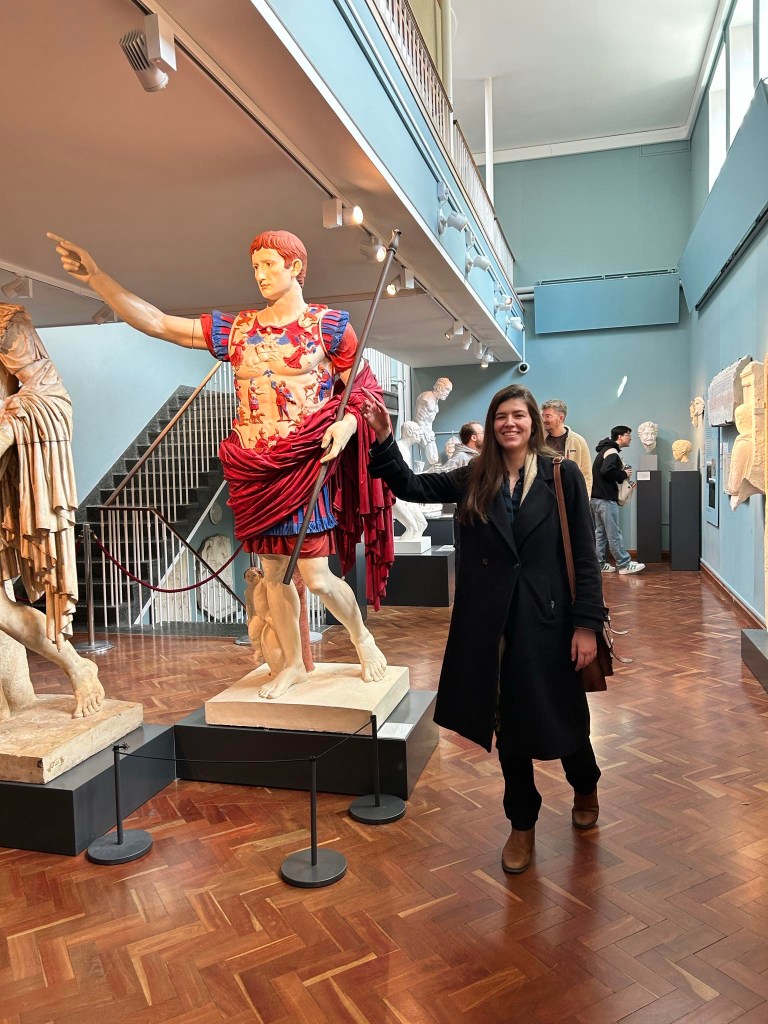
(Photo: The fabulous Florence, meeting our Augustus and his amazing technicolour dream cuirass)!
Sources
Bendicho, V.M.LM., ‘International Guidelines for Virtual Archaeology: The Seville Principles’, in Corsi, C., Slapšak, B., Vermeulen, F. (eds), Good Practice in Archaeological Diagnostics. Natural Science in Archaeology, 2013, 269-283. https://doi.org/10.1007/978-3-319-01784-6_16
Barcelo, J., ‘Visualizing what might be. An introduction to virtual reality in archaeology’, in Barcelo, Fonte and Sanders(eds), Virtual Reality and Archaeology, 2000, 9-36. https://www.researchgate.net/publication/200018330_Visualizing_What_Might_Be_An_Introduction_to_Virtual_Reality_in_Archaeology
Watterson, A., ‘Beyond Digital Dwelling: Re-thinking Interpretive Visualisation in Archaeology’, in Open Archaeology 1 (1), 2015, 119-130. https://doi.org/10.1515/opar-2015-0006






 ArchaeoArtist
You must be logged in to post a comment.