In the latest episode of Two Friends Talk History, Zofia and Dr Briana King return to our discussion into Classical Receptions. This time, we go into some of the heavier subject matter that we felt deserved its own episode. Returning guest, Dr. Briana King, joins me to unpack the dark and often overlooked threads of sexual violence in ancient history and its modern reinterpretations. We discuss ancient precedents for modern cinematic and television representations of sexual violence – made spectacle – in retellings of Roman narratives.
We’re diving deep into how classical reception shapes public perception—and why that matters. This is a heavy but essential conversation about power, misrepresentation, and the stories we choose to tell. 🏛️
📢 Trigger warning: this episode discusses sexual violence and may be distressing to some listeners. Please listen with care.
Dr King has argued through her doctoral research, and in her more recent publications, that these scenes can be interpreted as real reflections of actual events. And perhaps, these visualisations were part of shaping realities that they depicted in antiquity, as they appear to be doing now.
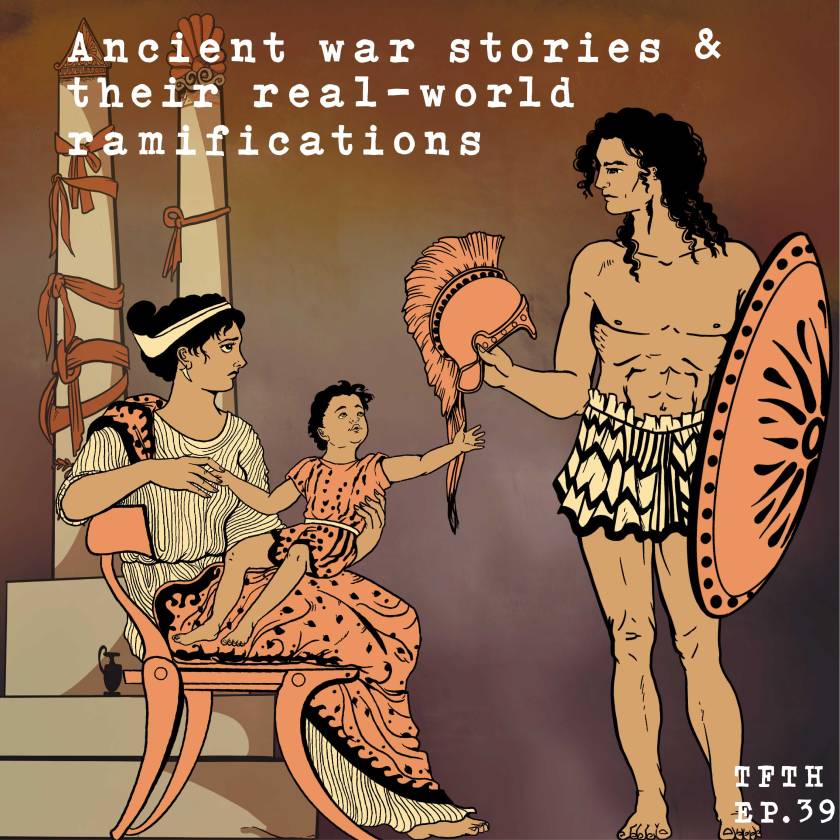
Due to copyright, I have drawn the images that we discussed in the episode, since those available for viewing on the Beazley archive are difficult to make out at times.
- (Left) Athenian red-figure stamnos; c. 430 BCE; Two men lifting a hetaira between them; Polygnotos Painter; Musee du Louvre Cp274/Cp9682; Beazley 213398.
- (Top Right) Athenian red-figure kylix; c. 510-500 BCE; Orgy scenes; Pedieus Painter; Louvre G13; Beazley 200694.
- (Bottom Right) Athenian red-figure cup; c. 490 BCE; Orgy scenes; Brygos Painter; Florence 3921; Beazley 203929.
In our discussion, several sculptural pieces from the Roman period were discussed, as representative of the brutal or depraved aspects of Roman society. In 2000 the Museo Nazionale di Napoli opened the “Secret Cabinet”, a special room that had for over a hundred years kept items found in Pompeii that were deemed “pornographic” away from the average viewing public. That these items are still held in this space, though the doors have been opened, still suggests that this is how we ought to understand them, not unlike their first museum display context in the Portici Palace, in Naples.
Taken from their original contexts, their use as emblems of that can be understandable, but as with all analysis of antiquity, context is key. Items like Pan and the she-goat (found in 1752) were, like many erotic images from the Roman period, in garden or outdoor spaces within a Roman villa. Sexually explicit sculpture – sometimes violent, could be commonly found within Roman society, and was not locked away in secret viewing rooms – it was open access.
Pan and the she-goat were found in a garden, south of the pool in the Villa of the Papyri, in Herculaneum. The garden was filled with several sculptures that included erudite philosophers, animals, and gods.
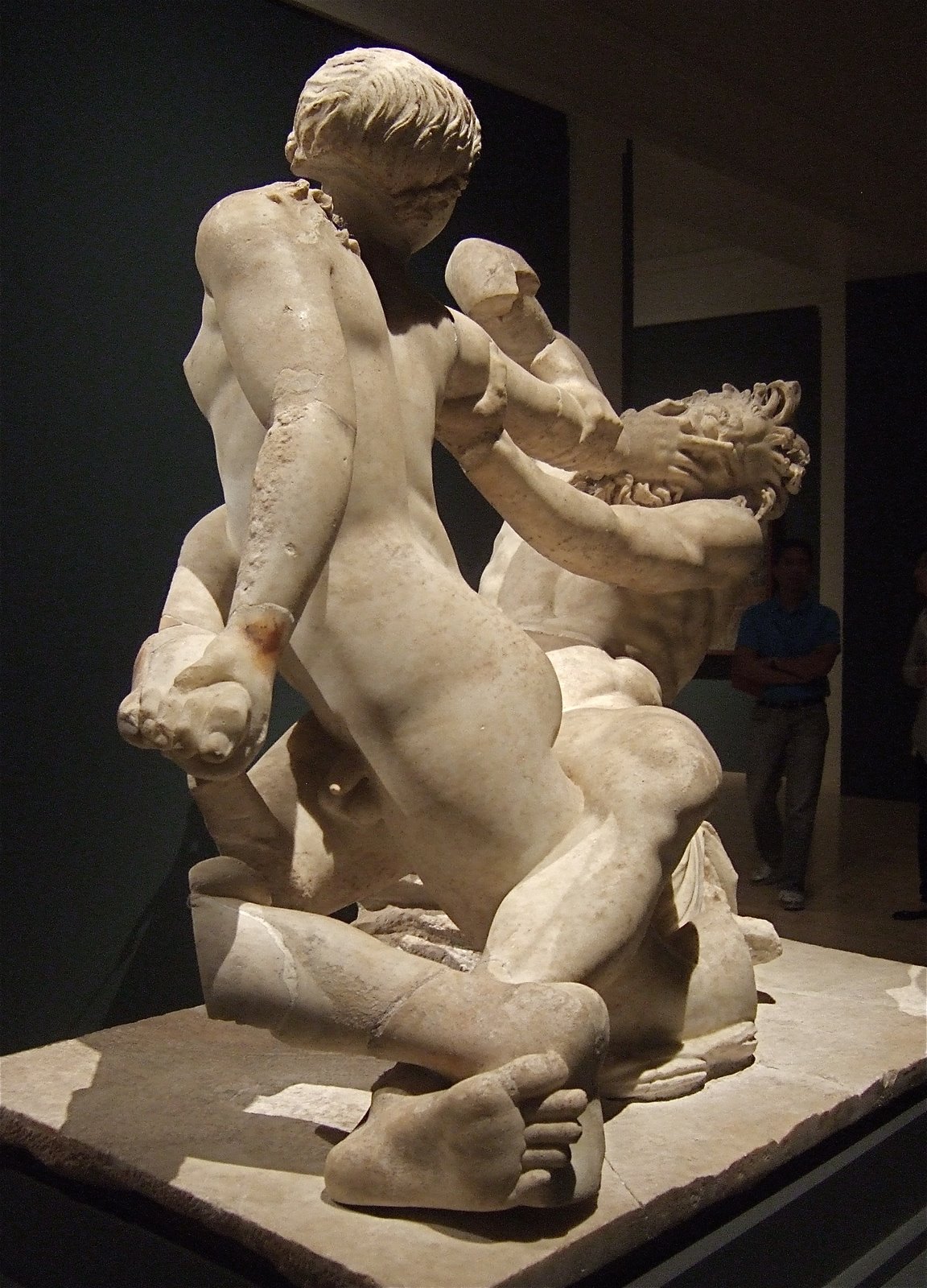
Another sculptural piece discussed in the episode was the Satyr and Hermaphrodite, a type so popular in antiquity that at least 30 replicas survive in marble, bronze, and frescoes. This image was so popular, the reproductions were found across the Roman Empire and likely derived from a Hellenistic model.
Left: Sculpture of Pan and she-goat, from the Herculaneum villa of the Papyri. National Archaeological Museum, Naples; Right: Hermaphroditus fighting off a Satyr from the Villa of Poppaea, Oplontis. Images from Wikimedia Commons.
This statue group would have likely been displayed in villa (Villa of Poppaea in Oplontis, Italy, and the villa at Chiragan in Gaul) or theatre (Daphne and Side) contexts, and likely among other statues that could be ‘read’ in addition to it. It was very much a public art Retzleff suggests that its interpretation could include:
“Dionysiac aspects, the reversal of norms, the objectification of the body, the sexual tryst, and the agon.”
Connotations of sexual violence and vulnerability are suggested by the hermaphrodite unclothed state, with her garments below the scene, and a rocky framing- indicating a possible outdoor bathing context.
Dr King also discusses the frescoes from a bathhouse in Pompeii that used erotic imagery above the locker/cubbies in the building’s changing rooms. These have been interpreted as humorous, meant to be read as an aide-mémoire, for where one left their garments. Similar images were found within a Pompeiian brothel, where the context suggests seductive enticements for clients, rather than a funny visual decoration.
Suburban bath locker frescoes, Pompeii. Left: a foursome; top right: a female and two males; bottom right: male performing cunnilingus.
🎙️ Two Friends Talk History continues to explore the uncomfortable but necessary intersections of ancient narratives and modern storytelling. In this episode, we invite you to listen with openness and care, to reflect on the legacies of representation, and to question how visualisations of sex and violence continue to echo through time.
📚 You can follow Dr Briana King’s work on Academia.edu.
🎧 Subscribe to the podcast via Buzzsprout or wherever you get your podcasts.
Until next time,
— Zofia
To follow the spectacular Dr King’s academic work, check out her page on Academia.edu.
King, B. (2024), ‘Un-silencing the Girls: Critical Classical Reception in Feminist Retellings of Greek Myths’, in Thersites. Journal for Transcultural Presences & Diachronic Identities from Antiquity to Date, vol. 19.
King, B. (forthcoming), ‘Fatal Attraction: Ancient Precedents, Modern Appropriations’, in Acta Instituti Romani Finlandiae.
Sexual Violence Support Resources
Rape Crisis Scotland: https://www.rapecrisisscotland.org.uk/help-helpline/
For sexual violence or violence against women, the National Domestic Abuse Helpline (0808 2000 247) run by Refuge and Women’s Aid provides 24/7 support and information.
Additional resources include Rape Crisis England & Wales which offers specialist support for women who have experienced sexual violence. Women’s Aid also offers a live chat service and email support
Visit the Rights of Women website on legal information sheets on a range of issues, including Forced Marriage and the law. Support for victims of ‘honour’-based violence and forced marriage.
References
Images of the pottery we discussed can be found on the Beazley Archive: https://www.carc.ox.ac.uk/XDB/ASP/searchOpen.asp
Cohen, E. E. (2000). “Whoring under Contract: The Legal Context of Prostitution in Fourth-Century Athens.” In V Hunter and J. Edmondson, eds., Law and Social Status in Classical Athens. Oxford. 113-48.
Cohen, E. E. (2006).”Free and Unfree Sexual Work: An Economic Analysis of Athenian Prostitution.” In C. A. Faraone and L. A. McClure, eds., Prostitutes and Courtesans in the Ancient World. Madison. 95-124.
Cohen, E. E. (2014). “Sexual Abuse and Sexual Rights: Slaves’ Erotic Experience at Athens and Rome.” In T. K. Hubbard, ed., A Companion to Greek and Roman Sexualities. Malden, MA. 184-98.
Davidson, J. (1997). Courtesans and Fishcakes: The Consuming Passions of Classical Athens. London.
Gardner, J. (2009), Women in Roman Law and Society. London.
Glazebrook, A. (2017). “Gender and Slavery” in The Oxford Handbook of Greek and Roman Slaveries. Eds. Stephen Hodkinson, Marc Kleijwegt, and Kostas Vlassopoulos. Oxford University Press. Oxford Handbooks Online.
Glazebrook, A. (2016). “Prostitutes, Women, and Gender in Ancient Greece” in Women in Antiquity: Real Women across the Ancient World. Eds. Stephanie Lynn Budin and Jean Macintosh Turfa. Routledge Publishing. 703-13.
Glazebrook, A. (2011). Greek Prostitutes in the Ancient Mediterranean, 800 BCE to 200 CE. Madison WI: University of Wisconsin Press. (co-edited with M. M. Henry).
Keuls, E. C. (1993). The Reign of the Phallus: Sexual Politics in Ancient Athens. London: University of California Press Ltd.
McGinn, T. A. J. (1998). Prostitution, Sexuality, and the Law in Ancient Rome. Oxford.
McGinn, T. A. J. (2004). The Economy of Prostitution in the Roman World: A Study of Social History and the Brothel. Ann Arbor.
Moses, D. C. (1993), “Livy’s Lucretia and the Validity of Coerced Consent in Roman Law,” in Consent and Coercion to Sex and Marriage in Ancient and Medieval Societies. Dunbarton Oaks.
Retzleff, A. (2007). The Dresden Type Satyr-Hermaphrodite Group in Roman Theatres in the AJA, Vol. 111, No.3, July. Pp. 459-472.
Stewart, A. F. (1995). ‘Rape?’ In Reeder, E. D. (Ed.). Pandora: Women in Classical Greece. Princeton: Princeton University Press. 74-90.
Thomas, S. (11 June 2019). “‘I’m not watching this’: Film’s brutal account of Australia’s colonial history sparks walkout”. ABC News. Retrieved 11 March 2021.


























 ArchaeoArtist
You must be logged in to post a comment.