
When we think of ancient historians, names like Livy or Herodotus often come to mind. But Dionysius of Halicarnassus deserves a closer look. Around 30 BC, Dionysius was a Greek scholar who moved to Rome during the early days of the Empire. There, he produced Roman Antiquities, a sweeping history of Rome from its mythical beginnings up to the First Punic War. Though 15 titles of his work are known, 13 survived in one form or another; his work remains a crucial source for early Roman history, standing alongside Livy’s accounts.
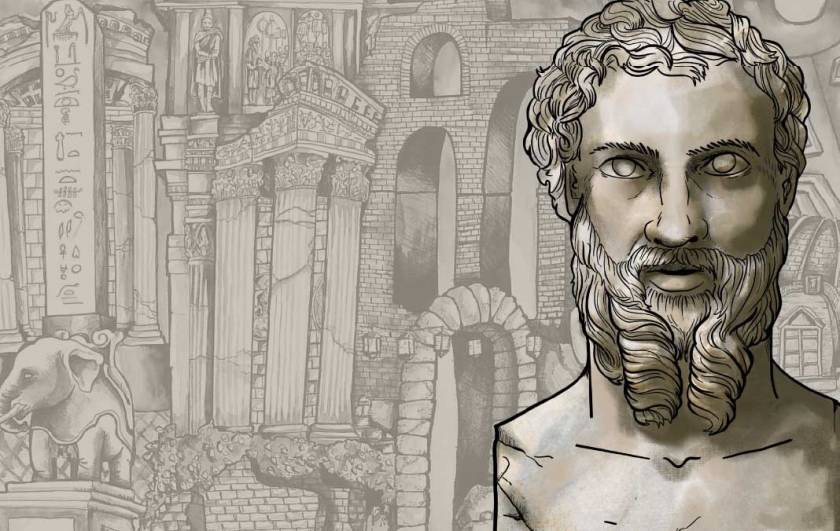
Theatre of Pompey plan and Dionysius of Halicarnassus. Illustration by Zofia Guertin.
Dionysius wasn’t just a historian—he was also a master of rhetoric. His writings aimed to explain and justify Roman culture to a Greek audience, blending historical detail with rhetorical theory. In fact, he often used his history as a practical showcase of rhetorical principles. Beyond history, he wrote insightful critiques of famous Greek orators like Demosthenes and Isocrates, praising Roman writers for returning to classical Greek ideals over more ornate styles.
In this episode of Two Friends Talk History, Zofia welcomes Stefano Carlo Sala, a PhD candidate at the University of St Andrews, to discuss Dionysius of Halicarnassus—a key figure in Roman historiography.

Dionysius of Halicarnassus with Stefano Carlo Sala – Two Friends Talk History
They explore how Dionysius, a Greek historian in Augustan Rome, used monuments and myths to present early Rome as a fundamentally Greek city. Through comparisons with Livy and Polybius, Stefano unpacks Dionysius’ unique approach to storytelling, monumentality, and cultural identity.

Brick and Marble. Illustration by Zofia Guertin.
While Dionysius of Halicarnassus and Livy both wrote about the early history of Rome, their approaches reveal striking differences—especially in how they describe the city’s monuments. Dionysius, writing for a Greek-speaking audience unfamiliar with Rome’s layout, offers detailed observations about buildings still visible in his time, even noting which ones he personally visited. Livy, on the other hand, paints a broader picture centered around familiar Roman landmarks like the Forum and Capitol, assuming a Latin-speaking readership already acquainted with the city. Dionysius’s attention to architectural detail connects to his larger ideological project: presenting Rome as the heir to Classical Greece. This vision runs through his historical work, where he draws frequent parallels between early Roman and Classical Greek monuments, values, and myths. By doing so, Dionysius not only makes Roman history more accessible to Greek readers but also argues that Rome deserves a central place in the Greek cultural tradition. His comparisons—even when archaeologically inaccurate—serve a deeper symbolic purpose, showing Rome as both the continuation and the future of Greece’s classical legacy.
💡 Topics covered:
- Dionysius’ blending of rhetoric and history
- Why monuments mattered in shaping Rome’s past
- Connections between Classical Greece and Archaic Rome
- How historians under Augustus crafted Rome’s legacy
- The political and cultural stakes of memory
Whether you’re into ancient history, architecture, or historical narratives, this episode offers a rich perspective on the ways history gets written—and rewritten.
Sources
Edlund, I. (1980). Livy and Dionysios of Halikarnassos as Roman archaeologists in Rivista di Archeologia vol.4, pp. 26-30. You can download for free: Here.
Wiater, N. (2011). The Ideology of Classicism: Language, History, and Identity in Dionysius of Halicarnassus. (Untersuchungen zur antiken Literatur und Geschichte; Vol. 105). de Gruyter.
Stefano’s Academia Page and Publications:
Carlo Sala, S. (2025). Law as a catalyst and remedy for civic violence in early Rome : two examples from Dionysius of Halicarnassus, in Cahiers des études anciennes [En ligne], LXII | 2025. URL: READ HERE ONLINE.
If you would like to follow Stefano, you can join him on LinkedIn: HERE or Academia.edu: HERE !
🔗 Support the show on Patreon at Patreon.com/Archaeoartist
📸 Follow on Instagram @TwoFriendsTalkHistory




 ArchaeoArtist
You must be logged in to post a comment.