
Monuments and Memory: Dionysius of Halicarnassus and the Story of Rome


When we think of ancient historians, names like Livy or Herodotus often come to mind. But Dionysius of Halicarnassus deserves a closer look. Around 30 BC, Dionysius was a Greek scholar who moved to Rome during the early days of the Empire. There, he produced Roman Antiquities, a sweeping history of Rome from its mythical beginnings up to the First Punic War. Though 15 titles of his work are known, 13 survived in one form or another; his work remains a crucial source for early Roman history, standing alongside Livy’s accounts.
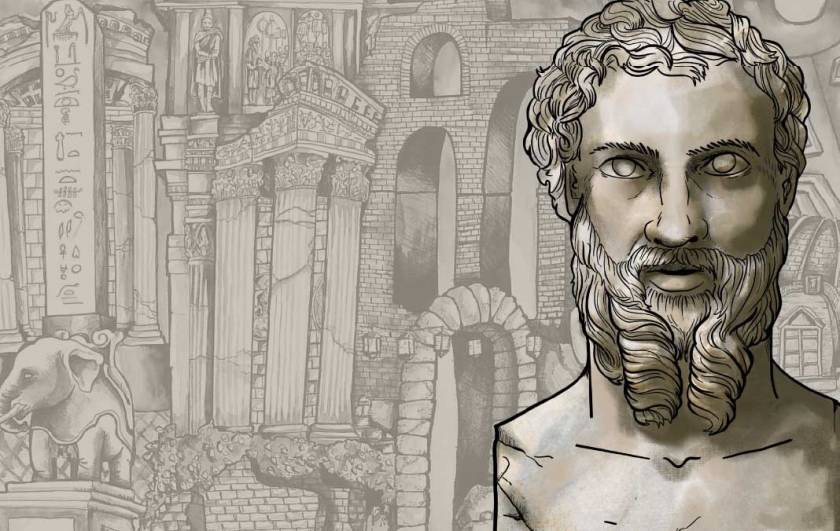
Dionysius of Halicarnassus and ruins of Rome by Zofia Guertin

Theatre of Pompey plan and Dionysius of Halicarnassus. Illustration by Zofia Guertin.

Dionysius wasn’t just a historian—he was also a master of rhetoric. His writings aimed to explain and justify Roman culture to a Greek audience, blending historical detail with rhetorical theory. In fact, he often used his history as a practical showcase of rhetorical principles. Beyond history, he wrote insightful critiques of famous Greek orators like Demosthenes and Isocrates, praising Roman writers for returning to classical Greek ideals over more ornate styles.

In this episode of Two Friends Talk History, Zofia welcomes Stefano Carlo Sala, a PhD candidate at the University of St Andrews, to discuss Dionysius of Halicarnassus—a key figure in Roman historiography.

Dionysius of Halicarnassus with Stefano Carlo Sala Two Friends Talk History

They explore how Dionysius, a Greek historian in Augustan Rome, used monuments and myths to present early Rome as a fundamentally Greek city. Through comparisons with Livy and Polybius, Stefano unpacks Dionysius’ unique approach to storytelling, monumentality, and cultural identity.


Brick and Marble. Illustration by Zofia Guertin.

While Dionysius of Halicarnassus and Livy both wrote about the early history of Rome, their approaches reveal striking differences—especially in how they describe the city’s monuments. Dionysius, writing for a Greek-speaking audience unfamiliar with Rome’s layout, offers detailed observations about buildings still visible in his time, even noting which ones he personally visited. Livy, on the other hand, paints a broader picture centered around familiar Roman landmarks like the Forum and Capitol, assuming a Latin-speaking readership already acquainted with the city. Dionysius’s attention to architectural detail connects to his larger ideological project: presenting Rome as the heir to Classical Greece. This vision runs through his historical work, where he draws frequent parallels between early Roman and Classical Greek monuments, values, and myths. By doing so, Dionysius not only makes Roman history more accessible to Greek readers but also argues that Rome deserves a central place in the Greek cultural tradition. His comparisons—even when archaeologically inaccurate—serve a deeper symbolic purpose, showing Rome as both the continuation and the future of Greece’s classical legacy.

💡 Topics covered:

  • Dionysius’ blending of rhetoric and history
  • Why monuments mattered in shaping Rome’s past
  • Connections between Classical Greece and Archaic Rome
  • How historians under Augustus crafted Rome’s legacy
  • The political and cultural stakes of memory

Whether you’re into ancient history, architecture, or historical narratives, this episode offers a rich perspective on the ways history gets written—and rewritten.

Sources

Edlund, I. (1980). Livy and Dionysios of Halikarnassos as Roman archaeologists in Rivista di Archeologia vol.4, pp. 26-30. You can download for free: Here.

Wiater, N. (2011). The Ideology of Classicism: Language, History, and Identity in Dionysius of Halicarnassus. (Untersuchungen zur antiken Literatur und Geschichte; Vol. 105). de Gruyter.

Stefano’s Academia Page and Publications:

Carlo Sala, S. (2025). Law as a catalyst and remedy for civic violence in early Rome : two examples from Dionysius of Halicarnassus, in Cahiers des études anciennes [En ligne], LXII | 2025. URL: READ HERE ONLINE.

If you would like to follow Stefano, you can join him on LinkedIn: HERE   or Academia.edu: HERE !

🔗 Support the show on Patreon at Patreon.com/Archaeoartist
📸 Follow on Instagram @TwoFriendsTalkHistory

Invisible Chains: Human Trafficking in Antiquity with Florence Felsheim

What did it mean to be bought, sold, and sexually exploited in the ancient world? In this powerful episode of Two Friends Talk History, Zofia is joined by doctoral candidate Florence Felsheim to explore the hidden realities of sexual trafficking in ancient Greece and Rome. Drawing on literary texts, archaeological evidence, and cognitive science, Florence unpacks how systems of enslavement and exploitation operated in societies often romanticized in popular culture.

We examine the scale of the ancient slave trade, the gendered dimensions of exploitation, and how enslaved women were commodified—expected to provide not just labor, but sexual access. From Roman brothels to banquet halls, the episode reveals how normalized sexual violence was embedded in the fabric of ancient daily life.

As part of Sexual Violence Awareness Month, this conversation sheds light on uncomfortable histories, connecting past systems of abuse to present-day conversations on power, consent, and human dignity. Listener discretion is advised.

Invisible Chains: Human Trafficking in Antiquity with Florence Felsheim Two Friends Talk History

Human Trafficking in the Ancient World: A Forgotten Reality

When most people think of human trafficking, they imagine a modern crisis. However, the practice of exploiting people for labor, sex, and servitude dates back thousands of years. In the ancient world, trafficking was not only common—it was institutionalized and deeply woven into the fabric of many societies.

In ancient Mesopotamia, Egypt, Greece, and Rome, slavery was a cornerstone of the economy. Prisoners of war, kidnapped foreigners, and even impoverished citizens were often sold into slavery. Unlike modern trafficking, which is largely illegal and hidden, ancient systems openly supported human trade. Markets for slaves were publicly established and legal codes could regulate their trade and treatment.

Women and children were particularly vulnerable. Many were trafficked for domestic service, labor, alongside sexual exploitation. In ancient Greece, for instance, women were commonly sold into brothels or forced to work as concubines. Rome’s vast empire relied heavily on enslaved people, many of whom were captured from conquered territories and transported long distances.

Though the term “human trafficking” didn’t exist in antiquity, the mechanisms of coercion, transport, and exploitation mirror modern patterns. Individuals lost autonomy, families were torn apart, and countless lives were shaped by violence and subjugation.

Understanding the ancient roots of human trafficking challenges the myth that it’s a purely modern problem. Instead, it reveals a tragic continuity in human history: the persistent commodification of people. While laws and attitudes have evolved, the underlying injustice remains disturbingly familiar.

By studying trafficking in the ancient world, we can better understand the cultural, economic, and political forces that continue to allow it today. Acknowledging its history is a step toward dismantling it in the present.

Speaking Through Objects

Moregine bracelet, illustrated by Zofia Guertin.

In 2000, archaeologists at Moregine, near Pompeii, uncovered a gold snake-shaped bracelet inscribed “dominus ancillae suae” (“the master to his very own slave girl”) on the body of a woman fleeing the eruption of Vesuvius. Found alongside other jewelry and coins, the bracelet, weighing about 500 grams, is crafted to coil three times around the arm. Its inscription has sparked debate: it may have been a gift to a domestic slave, a freedwoman, or a slave prostitute, or a metaphorical gift between lovers. The discovery highlights complex social dynamics and the harsh realities of slavery in ancient Roman society.

Resources

  • Levin-Richardson, Sarah. “Modern Tourists, Ancient Sexualities.” Pompeii in the Public Imagination from Its Rediscovery to Today. Oxford: Oxford University Press, 2011.
  • Keuls, Eva C. Reign of the Phallus : Sexual Politics in Ancient Athens. Berkeley, CA: University of California Press, 1994.
  • McClure, Laura. Phryne of Thespiae : Courtesan, Muse, and Myth. New York, NY: Oxford University Press, 2024.
  • Funke, Melissa. Phryne : a life in fragments. London : Bloomsbury Academic 

🌍 Sexual Violence Support Resources

If you or someone you know needs support, here are trusted organizations offering help across the globe:

1. RAINN (USA/global support)
🔗 rainn.org
📞 1-800-656-HOPE (4673)
💬 24/7 online chat

2. UN Women – End Violence Against Women
🔗 unwomen.org

3. The Survivors Trust (UK)
🔗 thesurvivorstrust.org
📧 info@thesurvivorstrust.org

4. Women Against Violence Europe (WAVE Network)
🔗 wave-network.org

5. Child Helpline International (for youth/caregivers)
🔗 childhelplineinternational.org

6. UNFPA – Global Helpline Directory
🔗 Global helpline list

7. Amnesty International – Gender & Sexuality Support
🔗 amnesty.org

💻 Online & Anonymous Support

8. Lifeline Chat (24/7, anonymous)
🔗 suicidepreventionlifeline.org/chat

🔐 Tip: Use a VPN or private browser if privacy is a concern. Always contact local emergency services if in immediate danger.